

A large or antique rug is not decor. It is an asset—cultural, historical, and often financial. How it is hung will directly determine whether it remains stable and valuable, or slowly deforms under its own weight.
For a rug of stature, hanging is not a task—it is a conservation procedure.
Gravity never rests. Fibers respond to tension, humidity, and time. Improvised hanging systems—no matter how well intentioned—introduce stress points that can permanently distort shape, weaken selvages, and quietly erode value.
This guide reveals the professional rug hanging methods used by museums, galleries, and conservation studios. These are not advanced DIY techniques. They are engineered systems designed to support, not merely suspend, heavy, fragile, or antique rugs.
DIY methods hang.
Professional methods preserve.
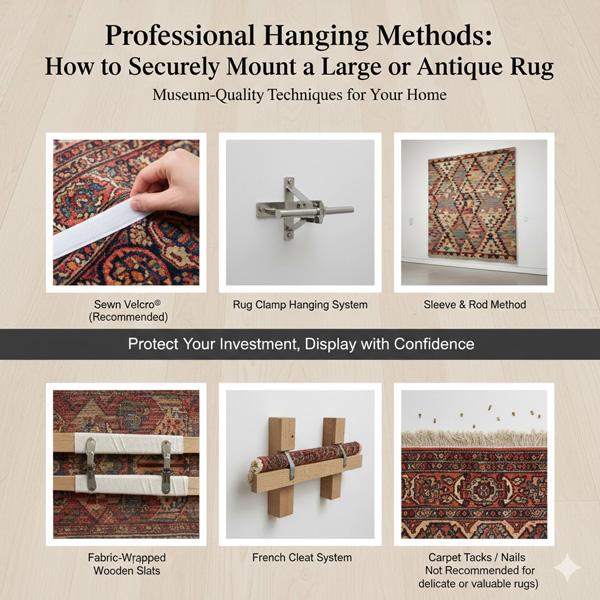
Decision Matrix: Which Professional Method Is Right?
| Rug Type / Condition | Recommended Method | Key Benefit | Complexity | Relative Cost |
|---|---|---|---|---|
| Heavy antique pile rug (30–100+ lbs) | Museum Strainer Frame | Rigid, even support; prevents distortion | Very High | $$$$ |
| Fragile silk, Kilim, slit-weave | Stress-Free Mounting Board | Zero point load; full surface support | High | $$$ |
| Oversized contemporary rug | Custom Sleeve & Rail System | Load capacity + easy removal | Medium–High | $$–$$$ |
| Institutional or seismic zone | Strainer Frame + Anchored Cleat | Structural safety | Very High | $$$$ |
If a rug has historical value, weak edges, or significant mass, there is no substitute for a professional solution.
>> Beyond the Basics: Special Rug Types Guide to Maintenance & Creative Uses
The Professional Philosophy: Principles of Preservation
Before discussing methods, it is critical to establish the non-negotiable standards that define professional rug conservation mounting.
Non-Negotiables
- Zero adhesive on the textile itself
- Even tension across the entire structure
- No weight borne by weak points (edges, corners, damaged areas)
- All techniques must be reversible
- All materials must be acid-free and compatible
The Enemies of Rugs on the Wall
- Gravity: causes shoulder drop and elongation
- Stress points: lead to tearing and distortion
- Humidity fluctuations: accelerate fiber fatigue
- Acidic materials: cause long-term chemical degradation
Assessment Is Everything
Before any installation, a professional evaluates:
- Weave structure (pile vs. flatweave)
- Fiber content (wool, silk, cotton)
- Existing repairs or weak selvages
- Overall weight and distribution
- Wall construction and load paths
Only after this assessment can the correct method be chosen.
>>> Wet Rug Crisis: How to Dry Any Rug Fast and Prevent Mold
Method 1: The Museum Strainer Frame (The Gold Standard)
Ideal For
- Heavy antique pile rugs
- Large-format carpets
- Rugs with significant monetary or historical value
This is the highest standard in museum rug display and long-term preservation.
Anatomy of a Museum Strainer Frame
1. Kiln-Dried Hardwood Frame
- Custom-built to exact rug dimensions
- Keyable corners allow micro-adjustments over time
2. Archival Lining Layer
- Linen or cotton rag fabric stretched over the frame
- Acts as an intermediary—not attached directly to the rug
3. Reversible Stitching Line
- Cotton or polyester thread
- Stitches placed every ~2 inches
- Rug is sewn to the lining, never to the frame
4. Hidden French Cleat System
- Transfers the full weight to wall studs
- Completely invisible once installed
>> Get Inspired: 10 Unexpected Ways to Transform Your Space with a Decorative Rug
The Conservation Process
The rug is gently aligned over the lined frame.
Stitching begins at the center and works outward, ensuring even tension distribution. The rug is not pulled tight; it is supported so it can move naturally with environmental changes.
The goal is zero stress. Every point of contact is calculated.
Installation
The completed frame behaves like a rigid panel. It is mounted using a concealed cleat system anchored directly into wall studs or structural backing. For seismic regions, additional anchoring is integrated.
Why a Pro Matters (Strainer Frames)
Incorrect tension—even by a small margin—can permanently distort a rug within weeks. Amateur attempts often result in trapezoid shapes, fiber fatigue, or irreversible shoulder drop.
Bloom Nestify Insight:
For large rugs, this is the only method that truly prevents long-term gravitational damage.
>>> Hang It Like a Pro: The Definitive Guide to Turning Your Rug Into Wall Art
Method 2: The Stress-Free Mounting Board (For Delicate & Flat Weaves)
Ideal For
- Fragile silks
- Antique Kilims and Dhurries
- Slit-weave or tapestry textiles
This method prioritizes full-surface support, eliminating all point loads.
Anatomy of a Stress-Free Mounting Board
1. Archival Substrate
- Rag mat board or Gatorboard
- Lightweight, rigid, and acid-free
2. Sewn Velcro™ Loop System
- Loop (soft) side is hand-sewn to the rug’s backing
- Wide spacing to distribute load
3. Hook Surface on Board
- Industrial-grade Velcro™ fixed to the board
- Rug attaches evenly across its width
>>> No-Nail Solutions: 5 Damage-Free Ways to Hang a Heavy Rug on Any Wall
The Conservation Process
The rug is never asked to carry its own weight. Instead, it rests against the board, supported at thousands of points across its surface.
This is particularly critical for textiles with:
- Weak selvages
- Historic repairs
- Slit or discontinuous weaves
Installation
The board itself is mounted to the wall using concealed anchors or cleats. Once mounted, the rug is pressed into place, creating a flawless, flush presentation.
Why a Pro Matters (Mounting Boards)
Improper board materials or spacing can trap moisture or introduce chemical damage. Professionals select substrates and attachment spacing based on fiber type and age.
Bloom Nestify Insight:
This method virtually eliminates sagging—making it the safest option for irreplaceable flatweaves.
>>> Not Just for Floors: 10 Unexpected Ways to Use Rugs in Your Home Decor
Method 3: The Custom Sleeve & Heavy-Duty Rail System
Ideal For
- Very large contemporary rugs
- Commercial or hospitality spaces
- Rugs requiring periodic removal or access
This system balances strength, flexibility, and reversibility.
Anatomy of the Sleeve & Rail System
1. Hand-Sewn Fabric Sleeve
- Fabric matched for compatibility
- Sewn with long, reversible stitches
2. Powder-Coated Aluminum Rail
- Engineered to hold hundreds of pounds
- Corrosion-resistant and perfectly straight
3. Wall-Mounted Brackets or Continuous Rail
- Anchored into structure
- Allows micro-leveling
The Process
The sleeve distributes weight evenly across the rug’s width. The rail carries the load, not the textile. Removal is straightforward and does not stress the rug.
Installation
The rail is leveled and anchored. The rug is then threaded or hooked onto the rail, allowing for fine adjustment and safe removal for cleaning or rotation.
Why a Pro Matters (Rail Systems)
Rails must be engineered for load, not improvised. Underspecified systems can bow or fail catastrophically.
Bloom Nestify Insight:
This is often the best choice for oversized modern rugs where access and flexibility matter.
The Bloom Nestify Process: From Assessment to Final Installation
Step 1: Conservation Assessment
In-home or in-studio evaluation. Documentation of structure, condition, and risks.
Step 2: Fabrication & Preparation
Frames, boards, or sleeves are custom-built in our conservation workshop using archival materials.
Step 3: Installation
Certified installers execute the mounting with precision, structural anchoring, and concealed hardware.
Step 4: Final Review & Care Instructions
Clients receive a walkthrough and long-term display guidance, including rotation and environmental considerations.
The Invisible Art of Display
The best professional installation is unseen.
There are no visible hooks, no sagging edges, no tension lines—only the rug, presented in perfect equilibrium.
Do not entrust a masterpiece to standard hardware or well-intentioned guesswork. The methods detailed here require training, materials, and judgment refined through experience.
