

You found the rug. It’s substantial. It’s gorgeous. It deserves to be on the wall. And then reality hits. Your lease says “no nails.” Your walls are plaster, brick, or concrete. Or maybe you own the place—but the idea of drilling holes (and possibly doing it wrong) makes your stomach drop. Put the hammer down. You won’t need it.
Heavy doesn’t have to mean permanent. And damage-free does not mean unstable.
At Bloom Nestify’s Rug Care Academy, we’ve tested renter-friendly, reversible systems on drywall, plaster, painted brick, and concrete. We’ve hung rugs that weigh over 20, 30, even 40+ pounds—securely, safely, and without sacrificing walls or rugs.
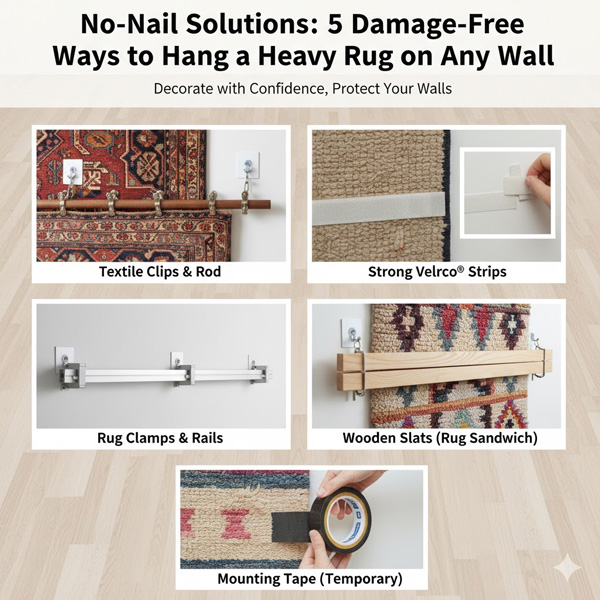
Below are five ranked, foolproof methods, from easiest to most robust. Each one is brutally honest about what it can (and cannot) handle.
✅ Safety & Suitability Checklist (Do This First)
Before choosing any method, confirm YES to all that apply:
- ☐ Rug weight is under 50 lbs (over 50 = skip to pro help)
- ☐ Wall surface is clean, dry, and painted (no crumbling plaster)
- ☐ Rug is not a fragile silk or museum-grade antique
- ☐ You can test adhesives in a hidden spot for 24 hours
- ☐ Rug will hang in a low-traffic area (no frequent bumps)
If you checked all five, you’re good to proceed.
Method 1: The Industrial-Strip Stack (Easiest Start)
Ideal For
- Smooth drywall
- Rugs 15–25 lbs
- Renters who want to test the look before committing
How It Works
You stack multiple Extreme Hold Picture Hanging Strips (Command™-style) so the load is shared across a wide area. The key is distribution, not brute force.
Never attach adhesive strips directly to the rug. Ever.
Instead, all adhesive attaches to a mounting interface (board or sleeve).
Step-by-Step
- Create a Mounting Interface
- Use a thin wood slat or rigid plastic strip
- Secure it to the rug indirectly (via sleeve or clamp—never glue)
- Prep the Wall
- Clean with isopropyl alcohol
- Let dry completely (this step is non-negotiable)
- Stack the Strips
- Use multiple strip pairs, spaced every 3–4 inches
- Press firmly for 30 seconds per strip
- Cure Time
- Wait at least 1 hour (24 hours is safer)
- Mount the Rug
- Align carefully and press evenly
Battle-Tested Weight Limit
Holds up to 25 lbs on properly prepared drywall
The Stress Test
- Resists downward shear force
- Weak against peel force (avoid tugging or bumping)
Bloom Nestify Verdict
Best for: Lightweight-to-medium rugs and short-term installs
Skip if: Rug is over 25 lbs or valuable
Confidence Level: ⭐⭐☆☆☆
>>> Beyond the Basics: Special Rug Types Guide to Maintenance & Creative Uses
Method 2: The J-Channel Clamp Grip (The Rug-Specific Savior)
Ideal For
- Flatweaves (Kilims, Dhurries)
- Sturdy piled rugs
- Rugs 20–40 lbs
- Renters who want real security
How It Works
A J-Channel Rug Hanging System is an aluminum bar that clamps the rug along its top edge—no piercing, no sewing. The bar carries the load, not the fibers.
This is then mounted to the wall using damage-free hardware.
Step-by-Step
- Measure & Cut J-Channel
- Match the rug’s width (or slightly shorter)
- Clamp the Rug
- Slide the rug edge into the channel
- Tighten evenly—snug, not crushing
- Attach Wall Interface
- Apply industrial-strength adhesive strips or adhesive-backed cleat to the channel
- Mount to Wall
- Press, level, and cure per adhesive instructions
>>> Get Inspired: 10 Unexpected Ways to Transform Your Space with a Decorative Rug
Battle-Tested Weight Limit
Holds up to 40 lbs on drywall, 30 lbs on plaster (with proper prep)
The Stress Test
- Excellent against shear force
- Weight is distributed across the entire rug width
- Very resistant to sagging
Bloom Nestify Verdict
Best for: Most renters with medium-heavy rugs
Skip if: Rug is fragile silk or over 45 lbs
Confidence Level: ⭐⭐⭐⭐☆
This is our top DIY recommendation for renters.
Method 3: The Adhesive French Cleat (Gallery-Grade Flush Mount)
Ideal For
- Design-forward DIYers
- Rugs 20–35 lbs
- Those who want a clean, professional look
How It Works
A French cleat (or Z-bar) uses two interlocking pieces. One attaches to the rug’s mounting board, the other to the wall—both using industrial adhesive, not screws.
The cleat converts downward force into wall pressure.
Step-by-Step
- Create a Lightweight Mounting Board
- Foam board or thin plywood
- Rug is attached via sleeve or clamps
- Attach Cleat to Board
- Use screws into the board, not the rug
- Attach Wall Cleat with Adhesive
- Clean wall thoroughly
- Apply adhesive and cure fully
- Hang
- Lower rug into place—gravity locks it in
>>> Hang It Like a Pro: The Definitive Guide to Turning Your Rug Into Wall Art
Battle-Tested Weight Limit
Holds up to 35 lbs on smooth drywall
The Stress Test
- Excellent load distribution
- Very strong against downward force
- Requires precise leveling
Bloom Nestify Verdict
Best for: Long-term display with a flush, modern look
Skip if: You want ultra-fast install
Confidence Level: ⭐⭐⭐⭐☆
>>> Wet Rug Crisis: How to Dry Any Rug Fast and Prevent Mold
Method 4: The Board & Lock System (For Problem Walls)
Ideal For
- Plaster, brick, concrete, or textured walls
- Renters in historic buildings
- Rugs 20–40 lbs
How It Works
Instead of hanging the rug directly, you mount it to a large lightweight board, then hang or lean the board using wall-safe methods.
The board provides rigidity and spreads stress.
Step-by-Step
- Mount Rug to Board
- Use clamps, Velcro™ (sewn backing only), or sleeve
- Choose Wall Strategy
- Heavy-duty adhesive hooks OR
- Floor-supported lean with anti-slip pads
- Secure Board
- Ensure no lateral movement
>>> Not Just for Floors: 10 Unexpected Ways to Use Rugs in Your Home Decor
Battle-Tested Weight Limit
Depends on board system; typically 30–40 lbs
The Stress Test
- Very forgiving on bad walls
- Lower risk of sudden failure
- Slightly thicker visual profile
Bloom Nestify Verdict
Best for: Impossible walls where nothing sticks well
Skip if: You want ultra-slim presentation
Confidence Level: ⭐⭐⭐⭐☆
Method 5: The High-Tech Temporary Anchor (The Overachiever)
Ideal For
- Rugs 40–50+ lbs
- When adhesives alone aren’t enough
- Renters willing to patch pin-holes
How It Works
You use temporary screw-in anchors designed for renters. They behave like real anchors but leave only a pin-hole, easily filled on move-out.
This anchor then supports a J-channel or cleat.
Step-by-Step
- Install Temporary Anchor
- Hand-driven or light screw-in
- No drilling required
- Attach Hanging Hardware
- J-channel or cleat system
- Hang Rug
- Test load gradually
- Removal
- Unscrew, fill pin-hole with spackle
>>> Professional Hanging Methods: How to Securely Mount a Large or Antique Rug
Battle-Tested Weight Limit
Holds 50+ lbs (anchor-dependent)
The Stress Test
- Performs like a real screw
- Extremely stable
- Minimal, repairable wall impact
Bloom Nestify Verdict
Best for: Very heavy rugs when nothing else works
Skip if: Zero wall touch-up is allowed
Confidence Level: ⭐⭐⭐⭐⭐
The Final Word: Security First
Before you hang:
- Measure twice
- Test adhesives for 24 hours
- Avoid high-traffic zones
- Never trust a single point of failure
When DIY Meets Its Limit
Stop and call a pro if:
- Rug exceeds 50 lbs
- Rug is silk or antique
- Wall surface is crumbling or unpainted
