

If you’ve ever found yourself staring at a size chart thinking “5×8… 6×9… but what does my room actually need?”—you’re asking the wrong first question. Stop thinking in inches and start thinking in purpose.
At Bloom Nestify’s Rug Care Academy, we approach rugs the way a spatial planner would: every rug has a job. When you know what you need the rug to do, the right size, shape, and placement suddenly become obvious.
Think of it this way: Buying a rug without knowing its function is like buying a screwdriver without knowing whether you’re turning a screw or driving a nail. Let’s assign your space its perfect rug employee.
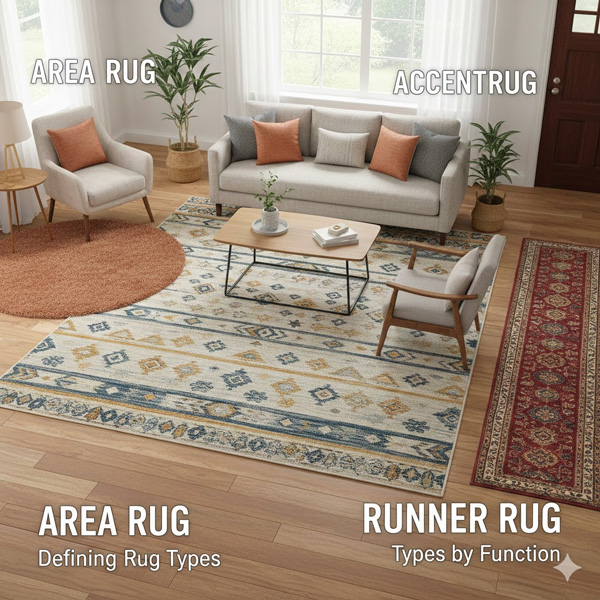
The Right Tool for the Job: Rug Functions 101
Nearly every rug in a home falls into one of three functional categories:
- Area Rugs → Anchor and define spaces
- Runner Rugs → Direct traffic and protect pathways
- Accent Rugs → Add style, comfort, and emphasis
Once you understand these roles, confusing terms like small rug vs large rug or endless size charts stop being overwhelming—and start making sense.
>>> Hand-Knotted, Tufted, or Power-Loomed? A Beginner’s Guide to Rug Construction
Rug Function Finder (Quick Flowchart)
Use this mental shortcut before you shop:
Is the rug going under major furniture (sofa, bed, dining table)?
→ Area Rug
Is it for a narrow, high-traffic space like a hallway or kitchen run?
→ Runner Rug
Is it for a small spot, layering, or a style pop?
→ Accent Rug
That’s it. Now let’s break each one down properly.
The Area Rug: Your Room’s Anchor
The Primary Mission
The area rug’s job is to anchor furniture, define a zone, and visually organize a room. It tells your eye: this grouping belongs together.
If a room feels “floaty” or disconnected, the problem is usually a missing—or undersized—area rug.
>>> Flatweave vs. Pile Rugs: Choosing Between Kilim, Dhurrie & Plush Styles
Standard Size Range
This is a large-format rug category.
Common area rug sizes include:
- 5×8 ft
- 6×9 ft
- 8×10 ft
- 9×12 ft
(Exact size depends on room dimensions and furniture layout, but function comes first.)
The Golden Rules of Placement
Think of an area rug as the foundation slab for your furniture.
Living Room
- All front legs of the sofa and chairs should sit on the rug
- The rug should extend 6–18 inches beyond the sofa on each side
Dining Room
- The rug must extend at least 24 inches beyond the table on all sides
- Chairs should stay fully on the rug, even when pulled out
Bedroom
- The rug should extend 18–24 inches beyond the sides and foot of the bed
- Alternatively, two accents can be used—but the area rug creates unity
Text-Based Placement Diagram (Living Room):
Sofa centered on rug → rug wider than sofa → front legs of sofa + chairs resting on rug → coffee table fully on rug.
Best Rooms For It
- Living rooms
- Dining rooms
- Bedrooms
- Large open-plan spaces
Anywhere you need zone definition and furniture anchoring.
>>> Terms & Features: Decoding Rug Design, Construction & Market Lingo
The #1 Mistake to Avoid
Using a “postage stamp” rug that floats in the middle of the room without touching any furniture.
If none of the furniture legs are on the rug, it’s not doing its job.
Can It Layer?
Yes.
Area rugs are often the base layer, with accent rugs layered on top for contrast and texture.
Bloom Nestify Pro Tip
If you’re deciding between two sizes, go bigger. A slightly oversized area rug makes a room feel intentional and expansive. A too-small one feels accidental.
>>> Handmade vs. Machine-Made Rugs: How to Tell the Difference and What It Means for Value
The Runner Rug: Your Home’s Traffic Director
The Primary Mission
A runner rug exists to manage traffic flow, protect floors, and visually guide movement through narrow spaces.
It’s not decorative fluff—it’s functional infrastructure.
Standard Size Range
Runners are long and narrow by design.
Typical widths:
- 24″ (2 ft)
- 30″ (2’6″)
- 36″ (3 ft)
Typical lengths:
- 6 ft
- 8 ft
- 10 ft
- 12–14+ ft
The exact length depends on the path—not the room size.
>>> Rug Backing 101: What It Is, Types (Jute, Felt, Rubber), and Why It Matters for Your Floors
The Golden Rules of Placement
Hallways
- Center the runner
- Leave 4–6 inches of bare floor visible on each side
- The runner should cover most of the hallway length, not just the middle
Kitchens
- Run it parallel to cabinetry or an island
- Place it where you stand and move the most
Entryways
- Use a runner to pull the eye into the home
- Align it with the door swing and walking path
Text-Based Placement Diagram (Hallway):
Runner centered → equal floor margins on both sides → ends stop short of walls, not touching.
Best Rooms For It
- Hallways
- Entryways
- Kitchens
- Long bathrooms
- Staircases
Anywhere with linear movement and repeated foot traffic.
>>> What Is a Rug Pile? Understanding Cut, Loop, and Cut-Loop Constructions
The #1 Mistake to Avoid
Choosing a runner that’s too short.
A runner that covers only half the path looks unfinished and breaks visual flow. It should feel like a runway, not a doormat.
Can It Layer?
Rarely.
Runners are usually standalone due to their functional nature and narrow placement.
Bloom Nestify Pro Tip
In busy areas, look for runners with low to medium pile and durable fibers. A traffic director should be tough enough to handle the job.
The Accent Rug: Your Style’s Exclamation Point
The Primary Mission
An accent rug’s role is to add color, texture, comfort, or personality in a focused spot. It’s visual punctuation—not the whole sentence.
Accent rugs are where you can have the most fun.
Standard Size Range
This is the small-scale category.
Common accent rug sizes:
- 2×3 ft
- 3×5 ft
- 4×6 ft
They’re intentionally not meant to carry furniture weight or define entire zones.
The Golden Rules of Placement
Layered
- Centered on top of a larger area rug
- Adds contrast, softness, or pattern
Functional
- In front of a kitchen sink
- Beside a bed as a “landing pad”
- In front of a vanity or reading chair
Decorative
- Under a coffee table (that’s already on an area rug)
- Hung on a wall as textile art
Text-Based Placement Diagram (Layered Look):
Large area rug → accent rug centered on top → coffee table centered on accent rug.
Best Rooms For It
- Bedrooms
- Kitchens
- Bathrooms
- Entry moments
- Anywhere that needs a small hit of style or comfort
The #1 Mistake to Avoid
Trying to use an accent rug to anchor furniture.
A small rug under a sofa or dining table will always look out of scale—it’s not built for that job.
Can It Layer?
Absolutely.
Accent rugs are the stars of layering, especially over neutral area rugs.
Bloom Nestify Pro Tip
Accent rugs are perfect for experimenting with bolder colors or patterns. Low commitment, high impact.
Putting It All Together: Function Before Size
Here’s the mindset shift that changes everything:
- Area rugs define and anchor
- Runner rugs guide and protect
- Accent rugs highlight and enhance
When you assign a rug a role first, the size becomes a solution—not a guessing game.
Assigning the Perfect Role
Understanding rug function removes 90% of the stress from rug shopping. Instead of drowning in dimensions, you’re making intentional, spatial decisions.
Every zone in your home deserves the right tool.
