

A great rug is more than a floor covering—it’s a woven work of art. Color, pattern, history, and craftsmanship all deserve to be seen at eye level. Hanging a rug as wall art can instantly elevate a space, turning texture into a focal point and heritage into a conversation starter.
And yet, this is where most owners freeze.
You love your rug, but the thought of putting holes in it—or worse, damaging it permanently—is terrifying. Choosing the wrong hardware, misjudging the weight, or trusting the wrong DIY trick can strain fibers, distort the weave, or compromise value.
Let’s fix that.
This guide replaces anxiety with methodical, professional decision-making. We’ll move from temporary solutions to museum-grade mounting, always with one principle in mind:
The goal is for the rug to float effortlessly, not strain against its hardware.
Choosing the right method isn’t complicated—but choosing the wrong one is the only real mistake.
Method Decision Flowchart (Start Here)
Use this logic before you touch a tool:
Is the rug a heavy antique, fine silk, or high-value heirloom?
→ Yes → Method 3: Professional & Preservation-Grade
→ No ↓
Is the rug lightweight (flatweave, Kilim, Dhurrie) and low to moderate value?
→ Yes → Method 1: Non-Invasive & Temporary
→ No ↓
Is it medium-weight, piled, or intended for long-term display in your home?
→ Yes → Method 2: Secure & Semi-Permanent
When in doubt, always move up a level. Over-engineering is safer than improvising.
Step 0: The Critical First Step – Assess Your Rug & Wall
Before learning how to hang a rug on the wall, you must understand what you’re hanging and where you’re hanging it.
Weigh Your Rug (The Bathroom Scale Method)
Weight determines everything—from hardware choice to wall anchors.
How to do it:
- Weigh yourself holding the rug.
- Weigh yourself without it.
- Subtract the difference.
General categories:
- Under 10 lbs: Lightweight (flatweaves, small tapestries)
- 10–25 lbs: Medium weight (most wool rugs)
- 25+ lbs: Heavy rug or antique → professional methods strongly advised
Examine the Rug’s Back & Edges
Flip the rug over and inspect carefully:
- Look for weak selvedges, fraying, or previous repairs
- Identify whether the structure is flatweave (Kilim) or piled
- Check if the rug has a stable backing or brittle fibers
If the edges are fragile, they must never carry the full load.
Know Your Wall
Your wall is half the system.
- Drywall: Requires studs or heavy-duty wall anchors
- Plaster: Brittle—drilling must be precise
- Brick/Concrete: Extremely strong but requires masonry bits
Use a stud finder and a level—guesswork has no place here.
>>> Beyond the Basics: Special Rug Types Guide to Maintenance & Creative Uses
Method 1: Non-Invasive & Temporary (The Renter’s Friend)
Best For
- Lightweight rugs (Kilims, Dhurries, flatweaves)
- Rental spaces
- Frequent re-stylers
- Low-risk, short-term display
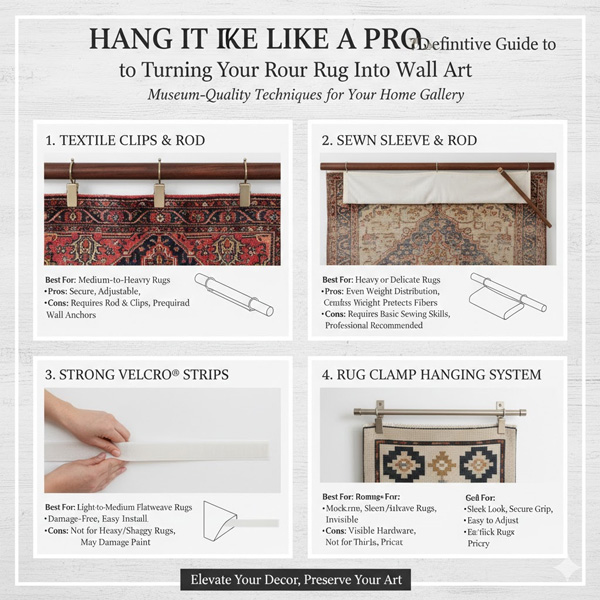
System A: Rug Hanging Clips
How They Work:
Clips grip the rug edge and hang from wall hooks or a rail.
Tools You’ll Need
- Rug hanging clips (rated above rug weight)
- Hooks or rail system
- Level
Step-by-Step Installation
- Space clips evenly along the top edge (every 6–8 inches).
- Attach clips gently—never crush or fold fibers.
- Mount hooks or rail into studs or anchors.
- Hang and level the rug.
Bloom Nestify Pro Tip:
Place a thin strip of felt between clip and rug to reduce pressure marks.
Potential Drawbacks
- Visible hardware
- Weight limits
- Long-term sagging possible
>>> Get Inspired: 10 Unexpected Ways to Transform Your Space with a Decorative Rug
System B: Heavy-Duty Velcro™ (Hook & Loop)
This method is often misunderstood. Done correctly, it can be effective. Done wrong, it can be disastrous.
WARNING:
Never apply adhesive Velcro directly to the rug. Adhesives can permanently damage fibers and finishes.
Correct Approach
- Sew the loop (soft) side to a cotton backing strip
- Mount the hook side to the wall using screws (not adhesive)
Step-by-Step Installation
- Sew backing strip to rug using loose, reversible stitches.
- Mount hook strip into studs or anchors.
- Press rug into place, checking level.
Bloom Nestify Pro Tip:
Extend Velcro nearly the full width of the rug to distribute weight evenly.
Potential Drawbacks
- Limited weight capacity
- Not suitable for valuable or antique rugs
>>> No-Nail Solutions: 5 Damage-Free Ways to Hang a Heavy Rug on Any Wall
System C: Tension Rods (For Tapestry-Style Rugs Only)
Best for rugs with existing sleeves or open weaves.
Drawbacks:
Limited sizes, limited weight, limited control over tension.
Method 2: Secure & Semi-Permanent (The Homeowner’s Choice)
Best For
- Medium-weight rugs
- Vintage or sentimental pieces
- Long-term display
- Most homeowners seeking a gallery-quality look
System A: Sewn-On Sleeve & Dowel Rod
This is one of the most trusted methods for hanging rugs as wall art.
Tools & Materials
- Cotton or linen fabric sleeve
- Needle & thread (or professional sewing)
- Wooden or metal dowel rod
- Wall brackets or hooks
- Level, stud finder
Step-by-Step Installation
- Sew a fabric sleeve across the top back of the rug
- Use wide, loose stitches
- Sleeve should support the full width
- Insert the dowel rod.
- Mount brackets into studs or heavy-duty anchors.
- Hang rod and adjust tension evenly.
Bloom Nestify Pro Tip:
The sleeve should be slightly wider than the rod—this prevents puckering and stress.
Potential Drawbacks
- Requires sewing
- Rod must be strong enough to resist bowing
>>> ot Just for Floors: 10 Unexpected Ways to Use Rugs in Your Home Decor
System B: French Cleat or Z-Bar System
This is the gallery standard for a clean, flush look.
Why It Works
- Distributes weight across the entire width
- Locks the rug securely to the wall
- Allows easy removal
Toolkit Checklist
- French cleat or Z-bar (rated above rug weight)
- Drill + bits
- Stud finder
- Heavy-duty anchors
- Level
- Screws
- Optional: rug binding tape
Step-by-Step Installation
- Attach one side of the cleat to a mounting board or sleeve system on the rug.
- Mount the wall cleat into studs or anchors—perfectly level.
- Lower rug into place so cleats interlock.
Bloom Nestify Pro Tip:
Always mount the cleat to a support board or sleeve, never directly through the rug.
Potential Drawbacks
- Precise installation required
- More hardware involved
>>> Professional Hanging Methods: How to Securely Mount a Large or Antique Rug
Method 3: Professional & Preservation-Grade (The Custodian’s Standard)
Best For
- Heavy antique rugs
- Fragile silks
- High-value investments
- Oversized or irreplaceable pieces
This is where museum practices come in.
The Museum Approach
Professionals use:
- Museum stretcher frames
- Stress-free mounting boards
- Acid-free materials
- Conservation sewing (fully reversible)
The rug is supported evenly, with zero load on any single edge.
The Role of a Professional
A certified installer or conservator:
- Assesses structural integrity
- Designs a custom support system
- Uses reversible, non-invasive attachment
- Ensures perfect tension and alignment
Why It’s Worth It
- Preserves monetary and historical value
- Prevents distortion over time
- Provides maximum security
- Offers peace of mind
Bloom Nestify Pro Tip:
Ask any installer: “Is every attachment reversible without damage?”
If the answer isn’t yes—walk away.
>> Wet Rug Crisis: How to Dry Any Rug Fast and Prevent Mold
Pro Tips for Perfect Presentation
Height & Placement
- Center the rug at eye level (about 57–60 inches from floor)
- Avoid direct sunlight—UV fades dyes
- Keep away from heat vents or fireplaces
Lighting
- Use picture lights or wall washers
- Never use hot, direct bulbs close to fibers
Maintenance
- Vacuum gently with low suction
- Rotate seasonally to relieve fiber stress
When to Take It Down
If you see rippling, sagging, or edge curl—it’s time to reassess the mounting.
Display with Confidence
Hanging a rug on the wall isn’t risky when it’s done correctly. With the right assessment, the right hardware, and respect for the textile, your rug can transition from floor to fame—securely, beautifully, and without damage.
Your rug deserves a stage.
