

The beautiful face of your rug gets all the credit. But the unsung hero—the part deciding whether that rug will behave in your home—is underneath it. If you want to understand a rug honestly, you don’t start by admiring the pattern. You flip it over.
Rug backing is the interface between your rug and your floor. It’s where problems start—or are prevented. Slipping, buckling corners, scratched hardwood, trapped moisture, discoloration, even indoor air quality issues often trace back to one overlooked factor: the wrong backing (or no proper pad at all).
Choosing the wrong backing is like building a house on a bad foundation. Everything suffers.
This guide pulls back the curtain. We’ll define what rug backing really does, compare the major types with clarity (not marketing spin), and connect each choice directly to real-world outcomes: safety, floor protection, and long-term performance.
This isn’t just about the rug. It’s about what’s underneath it.
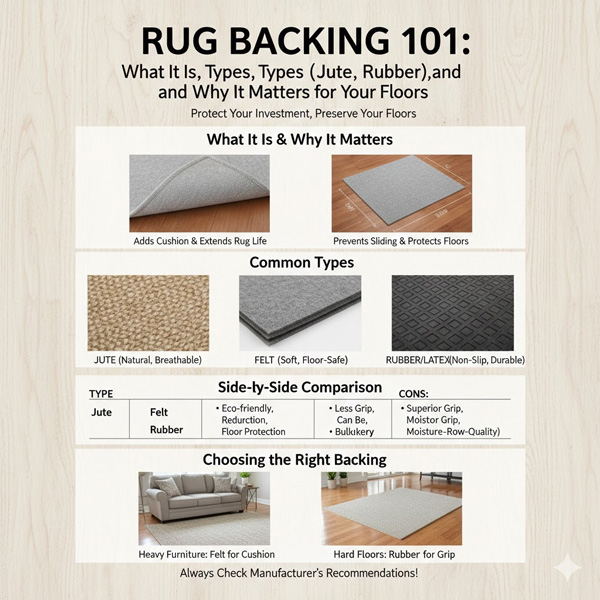
Backing at a Glance: Quick Comparison
| Backing Material | Grip | Cushion | Floor Safety | Breathability | Best For |
|---|---|---|---|---|---|
| Jute | Low | Low | Good (with pad) | Excellent | Hand-knotted rugs, traditional use |
| Cotton Felt | Moderate | High | Excellent | Moderate | Hardwood floors, comfort |
| Synthetic Felt | Moderate | Moderate | Good | Moderate | Budget-friendly floor protection |
| Natural Rubber | Excellent | Moderate | Excellent (when dry) | Low | Slip resistance on smooth floors |
| Felt + Rubber Blend | Excellent | High | Excellent | Moderate | Best all-around solution |
| PVC / Vinyl Coating | Poor | Low | Risky | None | ❌ Avoid on hardwood |
| Vinyl (Outdoor) | Good (outdoor) | Low | N/A | Low | Patios, decks, wet zones |
The 3 Non-Negotiable Jobs of a Rug Backing
Before we talk materials, we need to establish why backing matters. Every rug backing—or rug pad—must do three jobs simultaneously. Fail at any one, and the entire system fails.
Structural Integrity (How the Rug Behaves)
Backing stabilizes the rug.
Without proper support:
- Corners curl
- Edges ripple
- The rug “walks” across the room
- Wear concentrates in traffic lanes
A stable backing (or pad) helps the rug lie flat, distributes weight evenly, and prevents distortion over time.
Bottom line: A rug that won’t stay flat isn’t a design problem—it’s a foundation problem.
>>> Hand-Knotted, Tufted, or Power-Loomed? A Beginner’s Guide to Rug Construction
Grip & Safety (The #1 Priority)
This is non-negotiable.
A rug without adequate grip is a slip hazard, especially on hardwood, tile, vinyl, or laminate. Falls caused by sliding rugs are one of the most common preventable home injuries—particularly for children, pets, and older adults.
Backing contributes friction. A proper rug pad creates mechanical resistance between rug and floor.
If a rug moves when you push it with your foot, it is unsafe. Period.
>>> Flatweave vs. Pile Rugs: Choosing Between Kilim, Dhurrie & Plush Styles
Floor Protection (What Happens Under Pressure)
Your floor bears the consequences.
Proper backing:
- Buffers grit that acts like sandpaper
- Prevents dents from furniture legs
- Allows airflow to avoid moisture trapping
- Reduces dye transfer and discoloration
Improper backing—especially plastic or PVC—can trap moisture, off-gas chemicals, or even chemically react with floor finishes.
This is where expensive damage happens quietly.
The Backing Breakdown: A Guide to Every Type
Let’s decode the most common rug backing materials using a clear, honest framework.
Natural Backings
Jute Backing
The Good:
Jute is a woven plant fiber traditionally used on hand-knotted and handwoven rugs. It’s breathable, biodegradable, and historically correct for oriental rugs.
The Grip:
Low. Jute provides structure, not traction.
The Warning:
Jute sheds fibers and offers no slip resistance on smooth floors. It must be paired with a rug pad.
Best Use:
As a rug backing—not a substitute for a pad.
>>> Handmade vs. Machine-Made Rugs: How to Tell the Difference and What It Means for Value
Cotton Felt Backing / Pads
The Good:
Soft, dense, and excellent at cushioning. Cotton felt protects hardwood floors from scratches and dents and makes rugs feel more substantial underfoot.
The Grip:
Moderate. Felt grips through weight and friction, not adhesion.
The Warning:
Cotton can retain moisture. Not ideal for damp basements or kitchens.
Best Use:
Hardwood floors where comfort and floor protection matter most.
>>> What is an Accent, Area, or Runner Rug? Defining Rug Types by Function
Synthetic & Coated Backings
Synthetic Felt (Polyester or Olefin)
The Good:
Affordable, mildew-resistant, and widely available. Provides decent cushion and protection.
The Grip:
Moderate. Depends heavily on thickness and density.
The Warning:
Quality varies dramatically. Thin versions compress quickly and lose effectiveness.
Best Use:
Budget-conscious setups with light to moderate traffic.
>>> What Is a Rug Pile? Understanding Cut, Loop, and Cut-Loop Constructions
Natural Rubber / Latex Backing
The Good:
Outstanding non-slip performance. Rubber grips smooth floors better than any other material.
The Grip:
Excellent. This is the gold standard for slip resistance.
The Warning:
Rubber is not breathable. If moisture gets trapped, it can discolor some floor finishes. Always test in an inconspicuous corner.
Best Use:
Tile, laminate, vinyl, or as part of a felt-rubber blend for hardwood.
>>> Terms & Features: Decoding Rug Design, Construction & Market Lingo
Felt + Rubber Blend (The Ideal Hybrid)
The Good:
Combines cushion and grip. Felt faces the rug; rubber faces the floor. This balances safety, comfort, and protection.
The Grip:
Excellent.
The Warning:
Slightly higher cost—but negligible compared to floor repair.
Best Use:
The best all-around solution for most homes, especially hardwood.
PVC / Vinyl-Coated Backing (Major Red Flag)
The Good:
Cheap to manufacture. Prevents fraying on low-end rugs.
The Grip:
Surprisingly poor. Often slippery.
The Warning (Critical):
- Off-gasses VOCs (chemical smell)
- Traps moisture
- Can permanently stain or soften hardwood finishes
- Becomes brittle over time
Bloom Nestify Red Flag:
A strong plastic or chemical odor is a warning sign. Never place PVC-backed rugs directly on hardwood floors—ever.
Best Use:
Avoid indoors. Period.
Vinyl Backing (Outdoor Rugs)
The Good:
Water-resistant and mold-resistant for outdoor environments.
The Grip:
Adequate outdoors.
The Warning:
Not designed for finished interior floors.
Best Use:
Patios, decks, screened porches only.
How to Choose: Matching Backing to Your Floors & Lifestyle
The Golden Rule
Always use a separate, quality rug pad.
The backing on the rug itself is rarely sufficient.
Backing stabilizes construction.
Pads provide grip, cushioning, and floor protection.
They are not interchangeable.
Floor-Specific Prescriptions
Hardwood & Engineered Wood
Prescription:
✔ Felt-rubber blend pad or natural rubber with felt surface
Never Use:
✘ PVC, vinyl, plastic mesh, or latex-coated rugs directly on wood
Why:
Hardwood needs cushioning, airflow, and chemical neutrality.
Laminate & Tile
Prescription:
✔ Non-slip rubber pad
Why:
These surfaces are slick. Grip matters more than breathability.
Vinyl / LVP Flooring
Prescription:
✔ Manufacturer-approved rubber or felt-rubber pad
Why:
Some vinyl reacts to rubber or plasticizers. Always verify compatibility.
Carpet-on-Carpet
Prescription:
✔ Thin mesh or carpet-to-carpet pad (no cushion)
Why:
You want stability, not softness, to prevent buckling.
Lifestyle Add-Ons
- Kids & Pets: Prioritize non-slip rubber + cushion
- Allergies: Look for low-VOC, hypoallergenic materials
- Heavy Furniture: Thicker felt to distribute weight
- Renters: Pads that won’t leave residue or marks
Build a Strong Foundation
A rug is only as good as what supports it.
The right backing—and more importantly, the right pad—prevents accidents, protects your floors, extends the life of your rug, and keeps your home healthier. It is a small, often invisible investment with outsized impact.
Don’t let a poor foundation undermine beautiful floors.
