

This is the first and most important choice in your rug journey: the dimension of your decor. Before color, before pattern, before size—there is a deeper, more consequential decision to make. It is not about which rug you like more, but about how you want your space to feel, function, and live.
At Bloom Nestify’s Rug Care Academy, we see every rug fall into one of two great artistic and functional movements:
- The Tactile, Voluminous World of Pile Rugs — rugs you walk on, sink into, and experience primarily through comfort.
- The Graphic, Architectural World of Flatweaves — rugs you live with as surface, structure, and visual rhythm.
We’re not just comparing rugs; we’re comparing experiences.
Do you want your rug to be a soft landing or a graphic statement? Do you want cushioning—or clarity? Do you want volume—or precision? The answer lies in the weave.
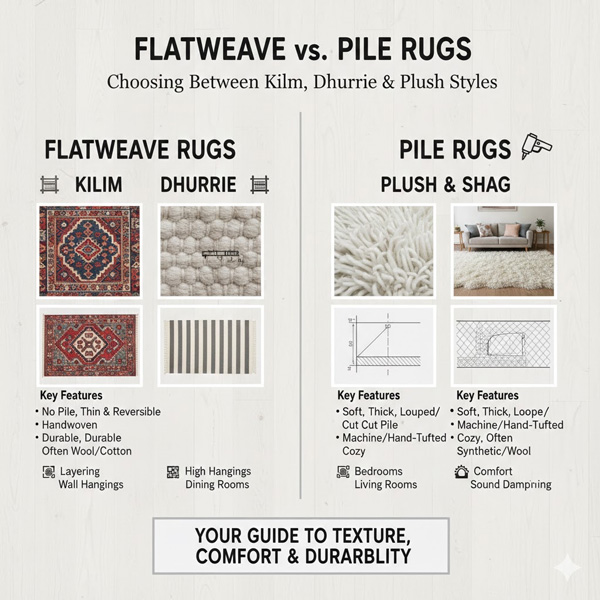
Decision at a Glance: The Big Choice
Flatweave vs. Pile Rugs — The Essential Contrast
Profile
- Flatweave: Ultra-thin, low-profile, sits close to the floor
- Pile: Thick to medium thickness with visible pile height
Feel Underfoot
- Flatweave: Firm, textured, tactile
- Pile: Soft, cushioned, plush
Best For
- Flatweave: Layering, high-movement homes, graphic impact
- Pile: Comfort zones, warmth, lounging spaces
Overall Vibe
- Flatweave: Global, architectural, modern-casual
- Pile: Cozy, classic, luxurious
If you already feel pulled to one side, trust that instinct. Now let’s sharpen it into certainty.
>>> Hand-Knotted, Tufted, or Power-Loomed? A Beginner’s Guide to Rug Construction
The Core Dichotomy: A Side-by-Side Showdown
| Dimension | Flatweave Rugs | Pile Rugs |
|---|---|---|
| Construction | Woven flat; no pile | Fibers extend upward to form pile |
| Thickness | Very thin | Medium to thick |
| Feel Underfoot | Firm, lightly textured | Soft, springy, cushioned |
| Weight | Lightweight, easy to move | Heavier, more grounded |
| Warmth | Visual warmth | Physical insulation |
| Sound Control | Minimal | Excellent sound dampening |
| Furniture Movement | Easy to slide | Can indent or resist |
| Layering Potential | Excellent | Limited (usually top layer only) |
| Allergy Friendliness | High (less dust trapping) | Moderate (pile can trap debris) |
| Style Identity | Graphic, global, architectural | Cozy, traditional, plush |
This is the flatweave vs pile rug decision in its purest form.
>>> Terms & Features: Decoding Rug Design, Construction & Market Lingo
The Flatweave Realm: Kilim, Dhurrie & Beyond
This is the world of line, pattern, and intention.
Flatweaves are not about sinking in—they’re about defining space, adding texture without volume, and letting the floor remain part of the design conversation.
Hallmarks of the Flatweave Realm
- No pile (completely flat construction)
- Low-profile rug that hugs the floor
- Lightweight and reversible
- Graphic patterns over plush texture
- Often casual, global, or modern in spirit
Flatweaves are architectural. They behave like textiles stretched across the floor, not cushions placed on top of it.
>>> Handmade vs. Machine-Made Rugs: How to Tell the Difference and What It Means for Value
Icons of the Style
The Kilim: The Patterned Storyteller
- Constructed using a slit-weave technique
- Known for bold geometrics and symbolic motifs
- Rooted in tribal and nomadic traditions
- Completely flat, often reversible
A kilim vs plush rug comparison makes the divide obvious: kilims speak in pattern and history, not softness. They are visual anchors—perfect when you want your rug to say something.
The Dhurrie: The Versatile Workhorse
- Loom-woven, typically cotton or wool
- Often striped, checked, or subtly patterned
- Extremely durable and balanced
- One of the most practical flatweaves available
When discussing dhurrie rug pros and cons, the pros dominate: durability, ease of care, and adaptability. The “con” is simple—it’s not plush. And it’s not trying to be.
Soumak & Tapestry Weaves
- Slightly raised texture from wrapped weft threads
- More tactile than kilims, still flat overall
- Rich, artisanal appearance without true pile
>>> What is an Accent, Area, or Runner Rug? Defining Rug Types by Function
Why You Enter the Flatweave Realm
You choose flatweaves if you value:
- Best rug for layering (they form the perfect base)
- Easy cleaning with no pile to trap debris
- A graphic, intentional aesthetic
- Homes with kids, pets, or frequent rearranging
- Showing off hardwood or tile floors
Flatweaves don’t dominate a room—they organize it.
>>> What Is a Rug Pile? Understanding Cut, Loop, and Cut-Loop Constructions
The Pile Realm: Plush, Textured & Cozy
This is the world of comfort, absorption, and softness.
Pile rugs exist to change how a room feels physically. They add depth, warmth, and a sense of luxury that you experience immediately—often barefoot.
Hallmarks of the Pile Realm
- Noticeable pile height
- Cushioned, forgiving underfoot
- Excellent heat retention
- Superior sound dampening
- Adds visual and physical weight to a room
Pile rugs are emotional. They invite you to linger.
Icons of the Style
Cut Pile Rugs
Includes Plush, Saxony, and Frieze styles.
- Plush / Saxony:
Uniform fibers cut to the same height
Velvety, smooth, and formal
Feels luxurious but shows footprints - Frieze:
Tightly twisted fibers
Casual, resilient, hides wear well
These are the heart of the cozy rug experience.
Loop Pile Rugs
Includes Berber and Level Loop styles.
- Loops remain uncut
- Nubby, textured surface
- Excellent durability
- Casual, inviting look
Loop piles balance comfort with practicality, especially in busy homes.
>>> Rug Backing 101: What It Is, Types (Jute, Felt, Rubber), and Why It Matters for Your Floors
Why You Enter the Pile Realm
You choose pile rugs if you want:
- Maximum comfort underfoot
- Warmth in colder rooms or climates
- Acoustic softness in echo-prone spaces
- A classic, cozy, or luxurious atmosphere
- Rugs that define lounging areas
Pile rugs don’t just sit in a room—they change its mood.
Bloom Nestify Cross-Examination
Let’s put the two realms under direct questioning.
- Do you need to slide furniture often?
→ Flatweave wins. - Do you want to sink your toes in after a long day?
→ Pile wins. - Do you love bold patterns and global style?
→ Flatweave wins. - Does your room feel cold or echoey?
→ Pile wins. - Are allergies or easy cleaning a priority?
→ Flatweave wins.
These are not small preferences—they’re lifestyle signals.
The Verdict: How to Make Your Final Choice
Here is your decisive moment.
The If–Then Scenario Guide
IF you have heavy furniture you rarely move, love cozy textures, and want a formal or luxurious living room…
THEN choose a Pile Rug, ideally a Plush or Saxony cut pile.
IF you have an open-plan space, enjoy rearranging, have kids or pets, and love a global or modern aesthetic…
THEN choose a Flatweave, especially a Dhurrie or durable Kilim.
IF you have beautiful hardwood floors you want to showcase but still need definition…
THEN choose a Flatweave—it frames without covering.
IF your room feels cold, loud, or uninviting…
THEN choose a Pile Rug to add warmth and sound absorption.
IF you love the look of both worlds…
THEN embrace layering: a large flatweave base with a smaller pile rug on top for contrast and comfort.
This is strategy, not compromise.
Your Floor, Your Foundation
There is no universally “better” rug—only the rug that aligns with how you live and what you want to feel.
Flatweaves offer clarity, flexibility, and graphic presence.
Pile rugs offer comfort, warmth, and emotional softness.
Once you understand the divide, the confusion disappears. The choice becomes confident. Intentional. Yours.
