

Trying to decide between quality and cost? Learn Handmade vs. Machine-Made Rugs in this insightful guide from Bloom Nestify. From how to spot the differences to what they mean for durability, craftsmanship, and value, this article gives you the clarity you need. As part of our Rug Buying Guides, it helps you make smarter, more confident buying decisions.
What Is a Handmade Rug?
Handmade rugs are crafted by skilled artisans using traditional techniques. Each piece is unique, often taking weeks or even months to complete.
Types of Handmade Rugs:
- Hand-knotted: Individual knots tied by hand (highest quality)
- Hand-tufted: Fibers punched into a backing using a tool
- Handwoven (flatweave): Woven on a loom without knots
Key Characteristics:
- Slight imperfections (a sign of authenticity)
- Unique patterns and variations
- High craftsmanship
What it means: Handmade rugs are often considered long-term investments due to their durability and artistry.
>> Hand-Knotted, Tufted, or Power-Loomed? A Beginner’s Guide to Rug Construction
What Is a Machine-Made Rug?
Machine-made rugs are produced using automated looms, allowing for fast and consistent manufacturing.
Key Characteristics:
- Perfectly uniform patterns
- Lower cost
- Widely available
Common Materials:
- Polypropylene
- Polyester
- Nylon
What it means: These rugs are practical, affordable, and ideal for everyday use—but they typically don’t last as long as handmade options.
>>> Flatweave vs. Pile Rugs: Choosing Between Kilim, Dhurrie & Plush Styles
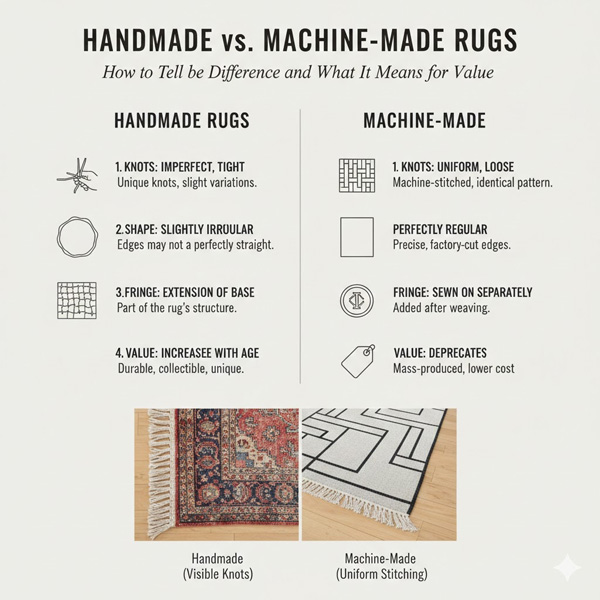
How to Tell the Difference: A Simple Checklist
Check the Back of the Rug
- Handmade: Pattern visible on the back, slightly uneven knots
- Machine-made: Uniform backing, often with a mesh or latex layer
Look for Imperfections
- Handmade: Small irregularities in design or shape
- Machine-made: Perfect symmetry
Examine the Fringe
- Handmade: Fringe is part of the rug’s foundation
- Machine-made: Fringe is often sewn on
Feel the Texture
- Handmade: Softer, more natural feel
- Machine-made: Can feel more synthetic or stiff
Consider the Price
- Handmade rugs are generally more expensive due to labor and materials
- Machine-made rugs are budget-friendly
>>> Terms & Features: Decoding Rug Design, Construction & Market Lingo
Durability: Which One Lasts Longer?
Handmade Rugs:
- Can last decades (or even generations)
- Fibers are individually secured
- Age gracefully over time
Machine-Made Rugs:
- Typically last 5–10 years with regular use
- Fibers may wear down more quickly
- Less resistant to heavy traffic
Verdict: Handmade rugs win in long-term durability.
>>> Rug Backing 101: What It Is, Types (Jute, Felt, Rubber), and Why It Matters for Your Floors
Value: Investment vs. Convenience
Handmade Rugs:
- Higher upfront cost
- Potential to increase in value (especially hand-knotted)
- Considered heirloom pieces
Machine-Made Rugs:
- Lower initial cost
- Easy to replace
- Great for short-term or practical use
Think of it this way: Handmade rugs are investments, while machine-made rugs are everyday solutions.
>>> What is an Accent, Area, or Runner Rug? Defining Rug Types by Function
Which One Should You Choose?
Choose Handmade If:
- You want a long-lasting piece
- You value craftsmanship and uniqueness
- You’re decorating a formal or low-traffic space
Choose Machine-Made If:
- You need something affordable
- The rug will be in a high-traffic area
- You have pets or kids
>>> What Is a Rug Pile? Understanding Cut, Loop, and Cut-Loop Constructions
Common Myths About Handmade and Machine-Made Rugs
Myth 1: Handmade Rugs Are Always Better
Not necessarily—they’re better for longevity, but not always practical for every lifestyle.
Myth 2: Machine-Made Rugs Are Low Quality
Many modern machine-made rugs are durable and stylish.
Myth 3: You Can’t Tell the Difference
With a little knowledge, the differences become clear.
Know What You’re Paying For
Choosing between handmade and machine-made rugs comes down to your priorities: value vs. convenience, craftsmanship vs. practicality.
If you’re looking for something timeless that can last for decades, a handmade rug is worth the investment. But if you need something functional, affordable, and easy to maintain, a machine-made rug is a smart choice.
