

Not sure what determines a rug’s texture and feel? Learn What Is a Rug Pile in this easy-to-understand guide from Bloom Nestify. From cut and loop to cut-loop constructions, this article explains how each type affects comfort, durability, and style. As part of our Rug Buying Guides, it helps you choose the perfect rug with confidence and clarity.
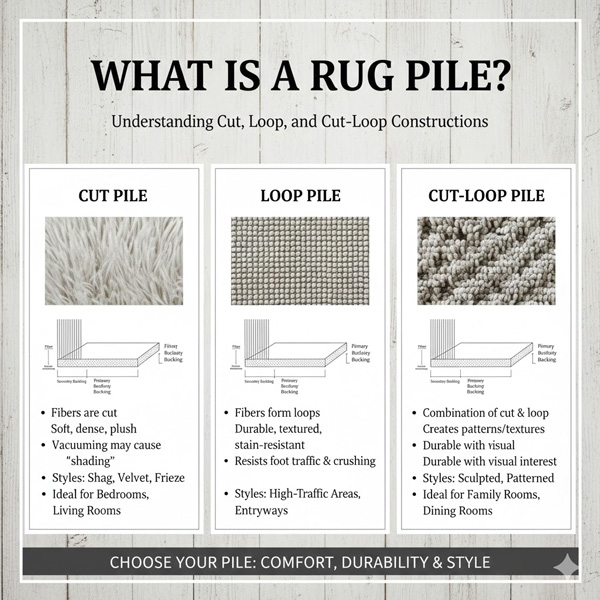
Pile Personality Matrix: A Quick Feel Guide
| Pile Type | Feel Underfoot | Durability | Visual Style | Pet & Kid Friendliness |
|---|---|---|---|---|
| Cut Pile | Soft, plush, cushioned | Moderate–High (with high twist) | Classic, cozy, refined | Good (shows tracks) |
| Loop Pile | Firm, textured, structured | High | Casual, modern, tailored | Very good (watch snags) |
| Cut & Loop | Mixed, sculptural | Moderate–High | Patterned, dimensional | Good (depends on loops) |
Think of:
- Cut pile as a velvet robe
- Loop pile as a well-knit sweater
- Cut & loop as a patterned chenille throw
>>> Rug Backing 101: What It Is, Types (Jute, Felt, Rubber), and Why It Matters for Your Floors
Pile 101: Height, Density, and Twist — The Quality Trio
Before we break down constructions, let’s define the three physical factors that shape how pile behaves.
Pile Height
The length of the fibers from the backing to the tip.
- Low pile: Sleek, easier to clean, more formal
- Medium pile: Balanced comfort and durability
- High pile: Plush, cozy, relaxed—but shows wear more easily
Height affects comfort—but not durability on its own.
Pile Density
How many fibers are packed into a given area.
This is the single most important indicator of durability.
A dense rug:
- Feels substantial when pinched
- Wears evenly
- Resists crushing
A sparse rug:
- Feels limp
- Mats quickly
- Shows wear faster
>>> Hand-Knotted, Tufted, or Power-Loomed? A Beginner’s Guide to Rug Construction
Twist (Cut Pile Only)
How tightly the yarn is twisted before the tips are cut.
- High twist: More resilient, textured (e.g., frieze)
- Low twist: Softer, smoother, more prone to showing footprints
Twist controls how well a cut pile rug bounces back.
Construction 1: Cut Pile — The Classic Comfort
The Look & Feel
In a cut pile rug, yarn loops are cut at the top, creating individual tufts. This produces a surface that feels soft, plush, and inviting.
Depending on yarn and twist, cut pile can range from silky-smooth to richly textured.
Common Cut Pile Styles:
- Plush: Smooth, velvet-like, formal
- Saxony: Soft with visible twists
- Frieze: Tightly twisted, slightly curly, casual
Durability & Performance
Cut pile rugs excel at comfort but vary in performance.
- Softer piles show footprints and vacuum tracks
- Higher twist improves resilience
- Dirt tends to sit on the surface (easier to vacuum)
Bloom Nestify Tactile Tip:
Pinch the pile between your fingers. It should feel dense and spring back—not thin or wispy.
>>> Flatweave vs. Pile Rugs: Choosing Between Kilim, Dhurrie & Plush Styles
Best Rooms & Lifestyles
- Bedrooms
- Formal or low-traffic living rooms
- Areas where barefoot comfort matters most
Cut pile is about sensory luxury.
Care Considerations
- Vacuum regularly (beater bar is fine for high-twist piles)
- Expect some initial shedding
- Blot spills promptly; don’t rub
Construction 2: Loop Pile — The Durable Workhorse
The Look & Feel
Loop pile rugs leave yarn uncut, forming continuous loops. The result is a firm, textured, and structured surface.
You’ll feel definition underfoot rather than plushness.
Common Loop Styles:
- Level Loop: Even, uniform height
- Multi-Level Loop: Varied heights create pattern
- Berber: Chunky loops, often thicker yarns
>>> What is an Accent, Area, or Runner Rug? Defining Rug Types by Function
Durability & Performance
This is where loop pile shines.
- Excellent resistance to crushing
- Hides footprints and vacuum marks
- Disguises dirt and wear patterns
The trade-off: loops can snag if caught by pet claws or sharp furniture edges.
Best Rooms & Lifestyles
- Hallways
- Family rooms
- Playrooms
- Home offices
If your rug sees constant traffic, loop pile is a reliable ally.
Care Considerations
- Vacuum regularly
- Trim snags—never pull them
- Ideal for homes with kids; use caution with pets that have sharp claws
>>> Terms & Features: Decoding Rug Design, Construction & Market Lingo
Construction 3: Cut & Loop — The Patterned Innovator
The Look & Feel
Cut & loop rugs combine both constructions in one surface. Designers use contrast in height and texture to “draw” patterns—often without changing color.
The feel is multi-textural and sculptural.
Durability & Performance
Performance depends on balance and density.
- Loop sections add structure and soil-hiding ability
- Cut sections add softness and visual emphasis
Well-made cut & loop rugs perform well in moderate to high traffic.
Best Rooms & Lifestyles
- Living rooms where you want pattern without bold color
- Dining rooms
- Transitional spaces
Cut & loop offers design depth with practical benefits.
Care Considerations
- Similar to loop pile
- Watch for snags in looped areas
- Vacuum with care to avoid catching loops
The Flip Side Test: How to Confirm Pile Type
Flip the rug over.
- Cut pile: You’ll see individual tufts anchored in the backing
- Loop pile: You’ll see continuous loops on the reverse
- Cut & loop: A mix of both structures is visible
The back tells the truth.
>>> Handmade vs. Machine-Made Rugs: How to Tell the Difference and What It Means for Value
Problem-Solver Guide: Match the Pile to the Problem
Problem: You hate footprints and vacuum lines
Solution: Loop pile or high-twist frieze cut pile
Problem: You want maximum softness
Solution: Plush or Saxony cut pile
Problem: Heavy traffic, kids, and daily wear
Solution: Dense loop pile or cut & loop
Problem: Pet claws
Solution: Tight loop (with care) or high-twist cut pile—avoid loose loops
Choosing Your Touchpoint
Pile is your daily point of contact with a rug.
It dictates how your home feels as much as how it looks.
Choosing the right pile is a balance between:
- Sensory comfort
- Practical durability
- Maintenance tolerance
- Design intent
Don’t just choose a rug you like to see. Choose one you love to touch.
