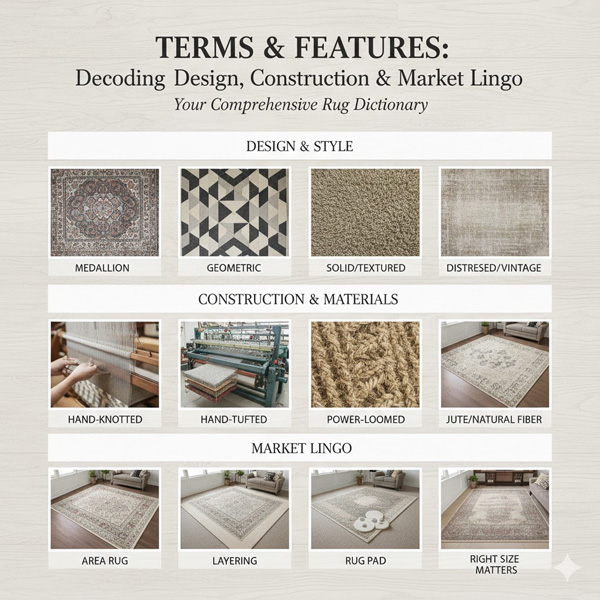
The language of rugs is a code. Here is the cipher.
Every rug carries three stories at once: how it was made, how it has lived, and how it is being presented to you now. Sellers, designers, auction houses, and marketers compress those stories into a compact vocabulary—words like abrash, patina, hand-carved, or overdyed. To the untrained eye, these terms can feel ornamental or vague. To an informed reader, they are precise signals.
This guide is a translation manual for rug descriptions. We are moving from seeing to understanding. We will decode the descriptive words that define a rug’s appearance, construction, and condition, and we will link each term to what you can actually observe—visually and physically—when evaluating a listing or standing in front of a rug.
Is “distressed” a style or damage? Is “heavy pile” a benefit or a liability? Does “high KPSI” always mean higher quality? Let’s define the line.

Category 1: Aesthetic & Character Terms – The “Look”
These terms describe what the rug communicates at first glance: color behavior, surface quality, and visual personality.
Term: Abrash
- Category: Aesthetic
- Definition: Natural or intentional variation in color within the same dyed yarn batch, resulting in subtle bands or shifts of tone across a rug’s field.
- What to Look For: Gentle horizontal or linear changes in shade—light to dark—within a single color area. These shifts feel organic, not blotchy.
- Quality Signal: High. Abrash is a hallmark of hand-dyeing, especially with vegetal dyes. Highly valued by collectors.
- Commonly Confused With: Fading, water damage, or uneven wear.
Bloom Nestify Decoder:
Authentic abrash is rhythmic and integrated into the weave. Damage-related discoloration is random and localized. Abrash reads as intentional harmony, not accident.
Pairing Principle:
Vegetal (natural) dyes almost always produce abrash. They are cause and effect.
Term: Patina
- Category: Aesthetic
- Definition: The softened surface sheen and mellowed coloration that develops through decades of use, oxidation, and gentle abrasion.
- What to Look For: A subtle glow, slightly muted colors, and a surface that feels calm rather than crisp.
- Quality Signal: High for antique and vintage rugs. Indicates age and a gentle life.
- Commonly Confused With: Dirt, stains, or artificial distressing.
Bloom Nestify Decoder:
Authentic patina is earned, not applied. It is evenly distributed across the rug, not concentrated in traffic lanes or corners.
Term: Luster
- Category: Aesthetic
- Definition: The way light reflects off the surface of the pile, influenced by fiber type, spin, and pile direction.
- What to Look For: Shimmering or directional light play when you move around the rug.
- Quality Signal: Contextual. High luster in silk or mercerized wool can indicate refinement; excessive shine in synthetics may signal lower quality.
- Commonly Confused With: Glossy finishes or chemical sheen.
Term: Vegetal (Natural) Dyes
- Category: Aesthetic
- Definition: Dyes derived from plants, minerals, or insects (e.g., indigo, madder root, cochineal).
- What to Look For: Depth of color, tonal complexity, and subtle variation rather than flat uniformity.
- Quality Signal: High. Traditionally associated with hand-knotted rugs and long-term color stability.
- Commonly Confused With: “Eco dyes” or muted synthetic dyes.
Term: Synthetic Dyes
- Category: Aesthetic
- Definition: Chemically manufactured dyes developed in the late 19th century and now widely used.
- What to Look For: Bright, uniform colors with minimal variation.
- Quality Signal: Neutral. Modern synthetics are stable and consistent; quality depends on execution, not dye type alone.
- Commonly Confused With: Cheap dyeing. Synthetic does not automatically mean low quality.
Term: Distressed / Antiqued
- Category: Aesthetic
- Definition: A contemporary design treatment intended to simulate age, wear, or fading.
- What to Look For: Intentional color wash-outs, abrasions, or uneven pile height that appear stylistic rather than functional.
- Quality Signal: Style-Dependent. Not a quality upgrade; purely aesthetic.
- Commonly Confused With: Genuine age-related wear.
Bloom Nestify Decoder:
If a rug is labeled “distressed” but also “new,” the wear is decorative, not historical.
>>> Handmade vs. Machine-Made Rugs: How to Tell the Difference and What It Means for Value
Category 2: Construction & Density Terms – The “Build”
These terms describe how the rug is made and how it will perform over time.
Term: Knots Per Square Inch (KPSI)
- Category: Construction (Hand-Knotted)
- Definition: A measurement of knot density in a hand-knotted rug.
- What to Look For: Fine pattern detail on the front; small, tight knots on the back.
- Quality Signal: Generally High, but not absolute. Must be evaluated alongside wool quality and dyeing.
- Commonly Confused With: Overall durability.
Bloom Nestify Decoder:
High KPSI allows for detail, not durability by itself. A low-KPSI rug with excellent wool can outlast a dense rug made with brittle fiber.
>>> Hand-Knotted, Tufted, or Power-Loomed? A Beginner’s Guide to Rug Construction
Term: Gauge (Tufted Rugs)
- Category: Construction
- Definition: The number of tufts per inch across the width of a tufted rug.
- What to Look For: Closer rows of tufts indicate a finer gauge.
- Quality Signal: Moderate to High within tufted categories.
- Commonly Confused With: KPSI (they are not interchangeable).
Term: Pile Height
- Category: Construction
- Definition: The length of the yarn measured from the backing to the tip of the pile.
- What to Look For: Visual thickness and tactile depth.
- Quality Signal: Neutral. A design and use choice.
- Commonly Confused With: Quality or luxury.
Bloom Nestify Decoder:
High pile equals comfort, not superiority. Low pile equals clarity, not cheapness.
>>> Flatweave vs. Pile Rugs: Choosing Between Kilim, Dhurrie & Plush Styles
Term: Loop Pile vs. Cut Pile
- Category: Construction
- Definition:
- Loop Pile: Yarn loops remain uncut, creating texture and durability.
- Cut Pile: Loops are cut, producing a softer, more uniform surface.
- What to Look For: Visible loops versus plush softness.
- Quality Signal: Use-Dependent. Loop pile is durable; cut pile is luxurious.
- Commonly Confused With: Pile height.
Term: Hand-Carved
- Category: Construction / Finish
- Definition: A finishing technique where portions of the pile are sheared to different heights to emphasize pattern.
- What to Look For: Raised motifs and recessed backgrounds you can feel with your hand.
- Quality Signal: Style-Dependent. Indicates labor and design intent, not structural quality.
- Commonly Confused With: Embossing.
Term: Embossed
- Category: Construction / Finish
- Definition: Pattern definition achieved through heat, pressure, or mechanical means rather than carving.
- What to Look For: Pattern relief without pile depth variation.
- Quality Signal: Lower to Neutral. Often used in machine-made rugs.
- Commonly Confused With: Hand-carving.
Category 3: Market & Condition Terms – The “Story”
These terms explain age, intervention, and historical integrity.
Term: Overdyed
- Category: Market / Condition
- Definition: A rug that has been re-dyed—often in a solid, modern color—allowing the original pattern to faintly show through.
- What to Look For: Strong contemporary colors with ghosted motifs beneath.
- Quality Signal: Style-Dependent. Aesthetic transformation, not inherent upgrade.
- Commonly Confused With: Naturally dark or monochrome rugs.
Bloom Nestify Decoder:
Overdyeing can conceal stains or uneven wear. Always assess the base rug’s condition.
>>> Rug Backing 101: What It Is, Types (Jute, Felt, Rubber), and Why It Matters for Your Floors
Term: Antique
- Category: Market / Age
- Definition: A rug that is 100 years old or more.
- What to Look For: Structural wear consistent with age, natural patina, historical design language.
- Quality Signal: High, if condition is stable.
- Commonly Confused With: Vintage.
Term: Vintage
- Category: Market / Age
- Definition: Typically 20–99 years old.
- What to Look For: Mature materials without extreme fragility.
- Quality Signal: High to Moderate, depending on condition.
- Commonly Confused With: New rugs in vintage style.
>>> What is an Accent, Area, or Runner Rug? Defining Rug Types by Function
Term: Semi-Antique
- Category: Market / Age
- Definition: Generally 60–99 years old, bridging vintage and antique categories.
- What to Look For: Early signs of patina with relatively intact structure.
- Quality Signal: High, especially for collectors.
- Commonly Confused With: Fully antique.
Term: Repaired
- Category: Condition
- Definition: Functional mending to stabilize damage (holes, edge wear, fringe loss).
- What to Look For: Slight irregularities or color differences in repaired areas.
- Quality Signal: Neutral to Positive if professionally done and disclosed.
- Commonly Confused With: Restored.
Term: Restored
- Category: Condition
- Definition: Extensive work aimed at returning a rug to an earlier appearance, often involving re-knotting and re-dyeing.
- What to Look For: Areas that appear newer than the rest of the rug.
- Quality Signal: Contextual. Necessary for preservation, but excessive restoration can reduce collector value.
- Commonly Confused With: Repaired.
Bloom Nestify Decoder:
Transparency matters more than perfection. Honest repair preserves trust and value.
>>> What Is a Rug Pile? Understanding Cut, Loop, and Cut-Loop Constructions
Term: Found Condition
- Category: Market / Condition
- Definition: The rug is sold as-is, with visible wear and no corrective intervention.
- What to Look For: Honest signs of age and use.
- Quality Signal: Collector-Dependent. Appreciated by purists.
- Commonly Confused With: Neglect.
Term: Mint
- Category: Condition
- Definition: Near-perfect condition with minimal wear.
- What to Look For: Crisp edges, full pile, clean structure.
- Quality Signal: High, especially rare for older rugs.
- Commonly Confused With: New.
From Vocabulary to Discernment
You now hold the key to the lexicon.
When you read a rug description, you are no longer decoding marketing poetry—you are reading a technical document, a condition report, and a design brief at once. Each term points to something observable. Each adjective carries implications for longevity, value, and authenticity.
This is how confident buyers are made: not by memorizing buzzwords, but by understanding what those words do.