

Not sure how rugs are actually made? Discover A Beginner’s Guide to Rug Construction in this essential guide from Bloom Nestify. From hand-knotted craftsmanship to tufted and power-loomed options, this article breaks down the differences in quality, durability, and price. As part of our Rug Buying Guides, it helps you choose the right rug with confidence and clarity.
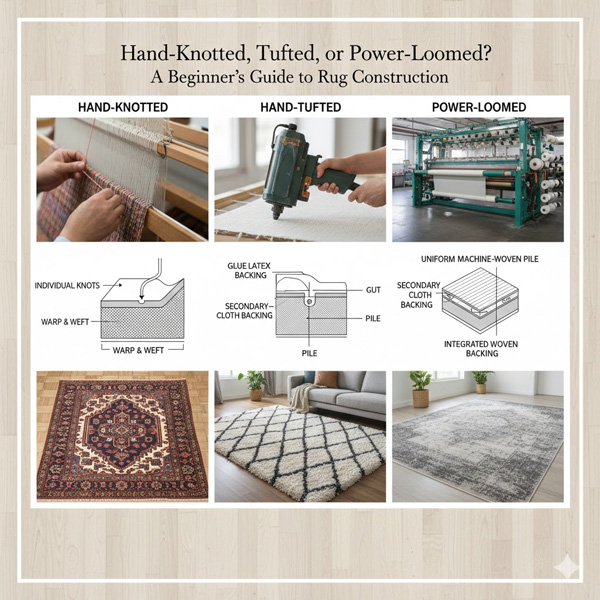
Quick-Answer Chart
| Construction Method | Time to Make | Key Feature | Ideal For | Typical Price Range |
|---|---|---|---|---|
| Hand-Knotted | Months to years | Individual knots tied by hand | Heirloom pieces, formal rooms | $1,000 – $20,000+ |
| Hand-Tufted | Weeks | Yarn punched + glued backing | Plush style on a budget | $500 – $3,000 |
| Power-Loomed (Machine-Made) | Hours | Computer-woven, synthetic fibers | Busy homes, easy care | $100 – $1,500 |
If you want the why behind these differences—and how to spot each one—read on.
>>> Flatweave vs. Pile Rugs: Choosing Between Kilim, Dhurrie & Plush Styles
Method 1: Hand-Knotted — The Heirloom
Analogy: Like a hand-stitched quilt, made one stitch at a time.
The Process Explained
A skilled artisan ties thousands (sometimes millions) of individual knots by hand onto a traditional loom. These knots are secured around the warp and weft threads—the rug’s structural skeleton. Nothing is glued. The design is literally built into the rug.
Feel & Look
Hand-knotted rugs feel dense, substantial, and alive. You’ll often notice subtle variations—slight irregularities that confirm human craftsmanship. Patterns can be incredibly detailed, especially in higher KPSI (Knots Per Square Inch) rugs.
>>> Handmade vs. Machine-Made Rugs: How to Tell the Difference and What It Means for Value
Durability & Lifespan
Exceptional. With basic care, a hand-knotted rug can last 50 to 100+ years. Many become more beautiful over time, developing a soft patina. This is true heirloom quality.
The Price Point
High. You’re not just buying materials—you’re buying hundreds or thousands of hours of skilled labor. This is an investment piece with strong value retention.
The Tell-Tale Sign: The Flip Test
Turn the rug over.
You should see the pattern clearly mirrored on the back, though slightly fuzzier. The fringe is part of the rug itself, extending directly from the foundation—not sewn on.
Best for: Formal living rooms, dining rooms, collectors, and anyone seeking a long-term investment.
>>> Terms & Features: Decoding Rug Design, Construction & Market Lingo
Method 2: Hand-Tufted — The Customizable Favorite
Analogy: Like using a sewing machine and glue—faster, plush, and stylish.
The Process Explained
An artisan stretches a canvas backing on a frame and draws the design onto it. Using a handheld tufting gun, yarn is punched through the canvas. Afterward, a latex or cloth backing is glued on to hold the yarn in place.
Feel & Look
Hand-tufted rugs can be very soft and thick underfoot. This method allows for bold designs, high piles, and dramatic carving. They often look luxurious at first glance.
Durability & Lifespan
Good, but not eternal. The weak point is the glued backing, which can dry out or loosen over time. Expect 10–20 years with normal use.
The Price Point
Mid-range. Faster production means lower cost, making tufted rugs popular for bedrooms and style-forward spaces.
>>> Rug Backing 101: What It Is, Types (Jute, Felt, Rubber), and Why It Matters for Your Floors
The Tell-Tale Sign: The Flip Test
Turn it over.
You’ll see a solid fabric or latex backing. The design is not visible as knots. The fringe (if present) is sewn on separately—a key giveaway.
Best for: Bedrooms, home offices, or anyone wanting a plush, custom look without heirloom pricing.
>>> What is an Accent, Area, or Runner Rug? Defining Rug Types by Function
Method 3: Power-Loomed (Machine-Made) — The Practical Workhorse
Analogy: Like printed fabric from a giant factory—fast, consistent, and efficient.
The Process Explained
A computer-controlled loom weaves the rug at high speed, usually using synthetic fibers like polypropylene (olefin). The entire process is automated, producing thousands of identical rugs.
Feel & Look
Modern machines can convincingly mimic hand-made styles. Patterns are perfectly uniform. The feel is often slightly stiffer, especially in low-end versions.
Durability & Lifespan
Variable. These rugs handle spills and heavy use well, especially low-pile styles. Expect 5–15 years. They don’t develop patina and may show wear or crushing over time.
The Price Point
Low to mid. Excellent value for busy households where easy cleaning matters more than legacy.
The Tell-Tale Sign: The Flip Test
Turn it over.
The back looks almost identical to the front, like the underside of a blanket. The pattern is fully woven through and perfectly consistent.
Best for: Kids’ rooms, playrooms, rentals, high-traffic areas, and budget-conscious buyers.
>>> What Is a Rug Pile? Understanding Cut, Loop, and Cut-Loop Constructions
Side-by-Side Comparison & Your Perfect Match
| Feature | Hand-Knotted | Hand-Tufted | Power-Loomed |
|---|---|---|---|
| Labor | Fully artisanal | Semi-handmade | Fully automated |
| Durability | Excellent (50–100+ yrs) | Good (10–20 yrs) | Moderate (5–15 yrs) |
| Feel | Dense, balanced | Plush, soft | Consistent, firm |
| Cost | High | Mid | Low |
| Value Retention | Strong | Low | None |
| Best Rooms | Formal, showcase | Bedroom, office | Playroom, rental |
The Bloom Nestify Buyer’s Decision Tree
- Want an heirloom or long-term investment? → Hand-Knotted
- Want plush comfort and custom style on a budget? → Hand-Tufted
- Need durability, easy cleaning, and low cost? → Power-Loomed
A Word on “Hand-Loomed” & “Semi-Handmade”
These are marketing terms, not strict categories. They often describe rugs that are not hand-knotted but sound artisanal. Always rely on construction details and the Flip Test, not labels alone.
Shop with Your Eyes (and Fingers) Open
You’re not just buying a pattern—you’re buying structure, labor, and lifespan. Now you know how to read the signs, ask the right questions, and choose a rug that truly fits your home and budget.
