

Professional cleaning for a silk rug can cost several hundred dollars. A single DIY mistake can erase thousands in value—instantly and permanently.
This is the paradox every silk rug owner eventually faces. The impulse to “handle it yourself” feels economical, even responsible. Yet from the perspective of an auctioneer, conservator, and risk advisor, the calculus is simple:
On one side of the scale is a known, finite professional fee. On the other side is an open-ended risk of irreversible loss.
This article exists to give you a decision framework, not instructions driven by optimism. When you finish reading, you should never again hesitate about whether to call a professional—because your rug’s profile will dictate the answer for you.
Understanding the Stakes: Why Silk Is the Ultimate “Pro-Required” Fiber
Silk is a protein fiber, not a plant fiber. Its molecular structure—built from fibroin chains—forms delicate dye bonds that are highly sensitive to pH, heat, moisture, and friction.
In practical terms:
- Color bleeding can occur without visible warning
- Water marking alters light reflection permanently
- Fiber distortion weakens pile integrity
- Shrinkage compromises symmetry and value
Now add construction into the equation.
Most silk rugs of value are hand-knotted, often with tens or hundreds of knots per square inch. Each knot represents labor, history, and provenance. From an auction standpoint, damage does not merely reduce beauty—it destroys investment value and heirloom status.
Attempting to clean such a rug without training is akin to performing surgery with a kitchen knife. The intent may be good. The outcome rarely is.
>>> Delicate Rug Warning: How to Safely Clean Viscose, Silk & Polyester Rugs
The Decision Matrix: Your At-a-Glance Guide
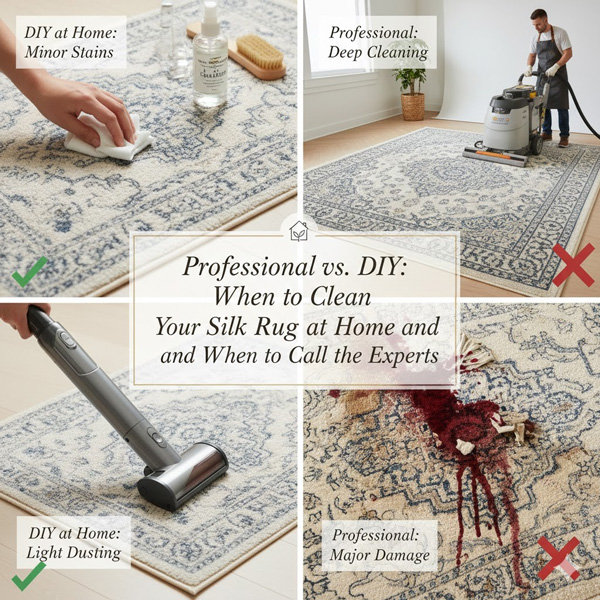
Before you touch your rug, walk through this mental Decision Flowchart:
Start Here: What is the problem?
Is it only dry surface dust or loose debris?
→ Proceed to the DIY Safe Zone (with strict limits).
Is it a spill, stain, odor, discoloration, or overall dullness?
→ Continue below.
>> The Truth About Jute Rugs and Water: Can They Get Wet?
Ask Three Questions (Answer Honestly):
- Is the rug antique, heirloom, or appraised at high value?
- Is the stain old, spreading, or unknown in origin?
- Do you know with certainty how the dyes will react to moisture or pH?
👉 If the answer to ANY of these is “yes” or “I don’t know,” STOP. Call a professional.
Uncertainty is not a green light—it is a warning signal.
>>> Cowhide Rug Care 101: To Vacuum or Not to Vacuum? And Other Essential Tips
The DIY Safe Zone: Minimalist Surface Maintenance ONLY
Let us be precise.
The DIY zone for silk rugs is extremely narrow.
Acceptable Scope (Non-Negotiable):
- Surface dust
- Pet hair
- Dry soil
- Very fresh, clear-water spills only if addressed immediately
This applies only to newer, structurally sound silk rugs with no prior damage, bleeding, or fringe issues.
>>> Wool Rug Love: How to Reduce Shedding & Keep Your Investment Looking New
The Minimalist Surface Maintenance Protocol
Vacuum with Supreme Caution
- Use a vacuum without a beater bar
- Only a suction head with soft bristles
- Vacuum lightly, in one direction
- Never over fringes (they are cleaned separately by professionals)
>>> The Truth About Viscose Rugs: Luxe Look vs. High-Maintenance Reality
The Dry, White Cloth Blot (Fresh Water Spills ONLY)
- Use a white, dry microfiber cloth
- Blot vertically—never rub
- Replace cloths frequently
- This is the only permitted liquid intervention
Gentle Brushing
- Use a soft horsehair brush
- Brush lightly to lift pile
- No back-and-forth motion
If at any point the fiber stiffens, darkens, or resists movement—stop immediately.
>>> Viscose Rug Nightmare? Why Water is the Enemy & How to Spot Clean Safely
The Professional Mandate: Where DIY Ends and Risk Begins
The professional mandate is broad—and for good reason.
Below is a Direct Comparison: DIY vs. Professional Cleaning
| Scenario | DIY Risk Level | Professional Outcome | Our Verdict |
|---|---|---|---|
| Overall dullness & soil | High (uneven cleaning, dye shift) | Balanced wash, restored luminosity | Pro |
| Unknown or aged stain | Very High | Stain identification & targeted treatment | Pro |
| Pet accident | Catastrophic (odor setting, fiber damage) | Enzyme treatment, controlled drying | Pro |
| Color bleeding risk | Extreme | Pre-testing & pH control | Pro |
| Fringe discoloration | Certain damage | Separate fringe restoration | Pro |
What You’re Really Paying For with a Professional
Professional cleaning is not about equipment alone—it is about risk transfer.
You are paying for:
- Colorfastness testing before cleaning begins
- pH-controlled solutions matched to silk protein chemistry
- Low-moisture systems designed to avoid water stress
- Stain identification expertise (organic, oil-based, synthetic)
- Controlled drying environments that prevent distortion
- Insurance coverage if something goes wrong
From a financial advisory standpoint, this is not a service fee.
It is insurance for your asset.
>>> Sisal & Jute Rug Care: The Absolute Do’s and Don’ts for Natural Beauty
Making the Smart Investment in Your Rug’s Future
The logic is consistent across every appraisal I have ever conducted:
- Rugs lose value through damage, not through care
- DIY risk scales exponentially with silk
- The cost of caution is always lower than the cost of regret
When owners hesitate, it is rarely because they cannot afford professional care. It is because they underestimate the downside risk.
Your Next Smart Step (Primary CTA)
Do not experiment with an investment.
Schedule a free online assessment with our certified rug specialists.
Send clear photos of:
- The entire rug
- The affected area (close-up)
- The back of the rug if possible
We will tell you—clearly and honestly—whether DIY is safe, and provide a transparent professional quote if it is not.
>>> Rug Care 101: How to Clean Every Rug Material
Not Ready for Full Silk Ownership? (Secondary CTA)
If you love the elegance of silk but want lower maintenance risk:
Explore our viscose-silk blends or premium merino wool rugs.
They deliver refined aesthetics with far greater tolerance for daily life.
Further Reading & Academy Resources
- Delicate Rug Warning: How to Safely Clean Viscose, Silk & Polyester Rugs
- Bloom Nestify’s Rug Care Academy – Strategic guidance for high-value textiles
>>> Natural Fiber Rug Care: Your Guide to Wool, Sisal, Jute & Braided Rugs
Prudence Is Part of Ownership
Owning a silk rug means accepting a truth many learn too late:
With silk, the cost of caution is always lower than the cost of correction.
Trusting professionals is not a sign of excess—it is a hallmark of intelligent stewardship. The wisest collectors, heirs, and homeowners understand that preservation is not about saving money today, but about protecting value for decades to come.
When in doubt, choose the decision you will never regret.
