

You’ve seen it—probably more than once. A rug with a dazzling, liquid-like sheen. Elegant color shifts. A label that whispers “art silk,” “viscose silk,” or “bamboo silk.” And then the price tag stops you in your tracks—in a good way. It looks like a million bucks. It costs a fraction of real silk.
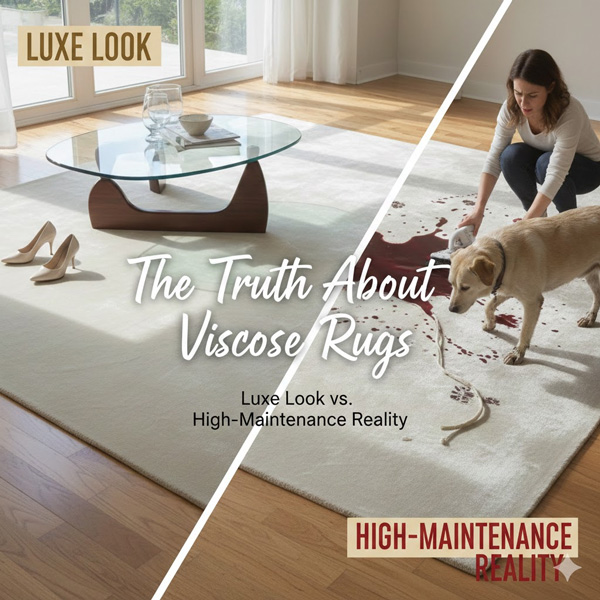
Here’s the catch: that glow comes with strings attached—and for many households, those strings turn into daily stress, permanent damage, and buyer’s remorse.
Let’s cut through the glossy marketing. This isn’t to scare you—it’s to arm you with the facts, so you can decide with open eyes whether a viscose rug fits your life, or whether it’s setting you up for frustration.
Bloom Nestify Bottom Line Up Front
Viscose offers unparalleled sheen for the price—but it is arguably the most high-maintenance, fragile rug material on the market.
It performs beautifully only in very controlled, low-use environments. For active homes with pets, kids, spills, or real foot traffic, viscose is usually the wrong choice.
What Is Viscose, Really? (Spoiler: It’s Not Silk)
Despite how it’s marketed, viscose has nothing to do with real silk from a fiber-science standpoint.
The Science—Plain English Version
Viscose (also called rayon) is a manufactured regenerated cellulose fiber. It starts as:
- Wood pulp (from trees like beech, pine, or eucalyptus)
- Dissolved using a chemical process
- Extruded through spinnerets to form smooth fibers
This makes viscose man-made, even though it originates from natural cellulose.
Silk, by contrast, is a natural protein fiber produced by silkworms—strong, elastic, and naturally resilient when cared for properly.
>>> Delicate Rug Warning: How to Safely Clean Viscose, Silk & Polyester Rugs
Why Viscose Looks So Luxurious
Viscose fibers are:
- Extremely smooth
- Round and uniform
- Able to reflect light evenly
That structure creates the famous silk-like sheen, dramatic color variation, and fluid drape that seduces so many shoppers.
>>> Rug Care 101: How to Clean Every Rug Material
Common (and Confusing) Names You’ll See
- Art Silk
- Faux Silk
- Rayon
- Bamboo Silk (often just viscose made from bamboo pulp)
Different names. Same underlying material.
>>> Natural Fiber Rug Care: Your Guide to Wool, Sisal, Jute & Braided Rugs
The Brutally Honest Pros & Cons
Viscose rugs aren’t “bad.”
They’re just sold without context.
Below is the reality—side by side.
>>> Professional vs. DIY: When to Clean Your Silk Rug at Home and When to Call the Experts
The Trade-Off: Beauty vs. Behavior
| The Alluring Pro | The Harsh Con |
|---|---|
| Breathtaking silk-like sheen | Fibers are brittle. Pile crushing is permanent, especially under furniture or traffic. |
| Cool, silky feel underfoot | Extremely hydrophilic—absorbs water instantly. Even plain water can cause dark, irreversible stains. |
| Affordable luxury look | Short functional lifespan in real-world conditions. Often a decorative, not durable purchase. |
| Dramatic color depth and luster | Sun fading happens quickly; light permanently dulls the sheen. |
| Lightweight, elegant drape | Professional cleaning is risky; many methods can worsen damage instead of fixing it. |
Why Water Is Viscose’s Achilles’ Heel
When viscose fibers get wet:
- They swell
- Lose already-low wet strength
- Dry unevenly
Result? Permanent watermarking, dark patches, or texture distortion—even from a single spill.
There is no “blot it and it’s fine” with viscose.
>>> The Truth About Jute Rugs and Water: Can They Get Wet?
🚩 RED FLAG SCENARIOS
- You have a dog that slobbers or a cat that might have an accident → Do not buy viscose
- You want it for a dining room or breakfast nook → Do not buy viscose
- You live in a humid climate or use a steam mop → Do not buy viscose
- You expect the rug to age gracefully → Do not buy viscose
>>> Sisal & Jute Rug Care: The Absolute Do’s and Don’ts for Natural Beauty
The “Only If” Rules: When a Viscose Rug Might Work
For the right person, in the right place, viscose can work—but the rules are strict.
Rule 1: The Low-Traffic “Museum Room”
Acceptable spaces include:
- A formal adult sitting room
- A bedroom corner with minimal foot traffic
- Under a bed (mostly decorative exposure)
- Even as a wall hanging
If people walk across it daily, the clock is already ticking.
Rule 2: The No-Liquid Covenant
This space must be:
- Drink-free
- Plant-free
- Pet-free
- Kid-free
One spill can permanently alter the rug’s appearance.
>>> Cowhide Rug Care 101: To Vacuum or Not to Vacuum? And Other Essential Tips
Rule 3: The “Accept the Fate” Mindset
You must be okay with:
- The rug being temporary
- Changes in sheen and texture over time
- Replacing it sooner than a wool or silk rug
Viscose works best when treated as short-term décor, not a long-term investment.
>>> Wool Rug Love: How to Reduce Shedding & Keep Your Investment Looking New
Smart Alternatives: Getting the Look Without the Drama
If you love the look of viscose but not the stress, here’s the good news: you have better options.
The Upgrade Path
For Bedrooms & Formal Spaces
→ Wool–Silk Blends (e.g., 80% wool / 20% silk)
- 80% of the sheen
- 400% more durability
- Far better stain resistance
- Ages gracefully instead of collapsing
This is our top recommendation for “real luxury.”
For Subtle Sheen & Everyday Living
→ High-Luster Wool
- Certain wools (like Tibetan or New Zealand high-grade) naturally reflect light
- No chemical weakness
- Excellent resilience and longevity
A quiet, grown-up alternative.
>>> Viscose Rug Nightmare? Why Water is the Enemy & How to Spot Clean Safely
For Spill-Friendly Shine
→ Solution-Dyed Polyester
- Stain resistant
- Colorfast
- Surprisingly soft
- Great for busy homes wanting a polished look
Yes, it’s synthetic—but far more honest about its performance.
For Texture with a Gentle Glow
→ Chenille or Performance Velvet Rugs
- Often cotton/poly blends
- Soft hand feel
- Subtle light play
- Much easier maintenance
An Informed Choice Is a Happy Choice
Viscose rugs aren’t villains.
They’re specialist materials sold as generalists—and that mismatch causes most of the heartbreak.
When you understand the science, the care demands, and the limitations, viscose becomes what it truly is: a decorative option for controlled environments, not a miracle “affordable silk.”
Knowledge protects your wallet—and your peace of mind.
