

Jute rugs are beloved for good reason. They bring warmth, texture, and an effortless, earthy calm into a space. They signal natural living, coastal ease, eco-conscious taste. A jute rug can make a room feel grounded and serene in a way synthetic materials never quite achieve.
But here’s where the romance often turns into regret. The first spilled glass of water. A plant drip. A humid summer week. Suddenly, there’s a dark watermark that won’t disappear. The fibers feel stiff. A faint musty odor lingers. Panic sets in.
And the question follows:
Can jute rugs get wet?
Let’s be direct, because this is non-negotiable:
Jute and water are enemies. Understanding this is the key to not ruining your rug.
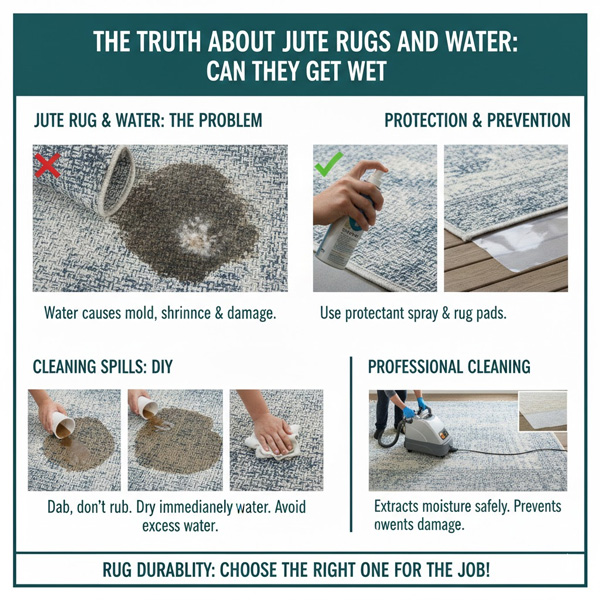
Jute & Water: The Incompatibility Scale
Think of moisture exposure on a sliding scale. None of these are “safe”—only varying degrees of damage.
Low Risk (but not no risk):
High ambient humidity → Risk of odor, mildew over time.
High Risk:
Any liquid spill (water, wine, juice) → Permanent water marks, fiber swelling, shrinkage.
Critical Risk:
Soaking, pet accidents, flooding → Structural failure, warping, mold growth. Often total loss.
This isn’t about stains alone.
We’re talking about structural decay.
>>> Delicate Rug Warning: How to Safely Clean Viscose, Silk & Polyester Rugs
The Core Truth: Jute Is a Plant, Not a Plastic
Jute rugs aren’t “natural” in the casual lifestyle sense. They are made from lignocellulosic plant fibers—the same fundamental building blocks found in wood, paper, and dried grasses.
The Science You Need to Know
Jute is hygroscopic
It doesn’t just get wet on the surface. It absorbs moisture into its cellular structure, like a sponge.
High absorbency
Liquid travels quickly along the fibers, spreading stains far beyond the original spill point.
Swelling → Shrinking cycle
When wet, jute fibers swell. When they dry, they shrink—but not evenly. This causes rippling, distortion, and edge pull.
Perfect environment for microbes
Jute is organic. Add moisture and warmth, and mold and mildew see food, shelter, and time.
Analogy:
Treat a jute rug the way you would a valuable book or important document.
You wouldn’t pour water on a book to clean it. You shouldn’t do it to jute either.
>>> Natural Fiber Rug Care: Your Guide to Wool, Sisal, Jute & Braided Rugs
The Golden Rules: Preventing Water Damage Before It Starts
If you own a jute rug, prevention isn’t optional—it’s your primary care strategy.
Strategic Placement Is Everything
Jute belongs in dry, low-risk environments only.
Right Rooms
- Living rooms
- Bedrooms
- Home offices
- Formal dining rooms (with caution)
Wrong Rooms
- Bathrooms
- Kitchens
- Entryways
- Basements
- Mudrooms
- Direct sunrooms with humidity swings
If water exposure is likely, jute is the wrong material.
>> Rug Care 101: How to Clean Every Rug Material
The Essential Barrier: Rug Pad with Moisture Block
This is non-negotiable.
A premium rug pad with a moisture barrier layer:
- Protects jute from damp subfloors
- Improves airflow
- Reduces mold risk
- Prevents friction wear
Bare jute on hardwood or concrete is an invitation for moisture wicking from below.
>>> Professional vs. DIY: When to Clean Your Silk Rug at Home and When to Call the Experts
Climate Control Matters
In humid climates or seasons:
- Use a dehumidifier
- Maintain stable indoor humidity
- Avoid placing jute near HVAC condensation points
Remember: jute reacts to air moisture, not just spills.
>>> Sisal & Jute Rug Care: The Absolute Do’s and Don’ts for Natural Beauty
The “No Liquid Cleaners” Edict
Never use:
- Steam cleaning
- Carpet shampoo
- Wet extraction
- Water-based sprays
- DIY vinegar solutions
These methods are designed for synthetic carpets—not plant fibers.
>>> The Truth About Viscose Rugs: Luxe Look vs. High-Maintenance Reality
Damage Control: What to Do When Water or Spills Happen
Accidents happen. What you do in the first minutes matters more than anything else.
Spill Response Decision Tree (Jute-Specific)
Liquid spill?
→ Immediately BLOT with dry towels
→ DO NOT POUR WATER
Powder or grease?
→ Use dry absorbent compound (cornstarch)
→ Vacuum gently after absorption
>>> Cowhide Rug Care 101: To Vacuum or Not to Vacuum? And Other Essential Tips
Step 1: Immediate Dry Blotting
- Use clean, dry, absorbent towels.
- Press firmly. Do not rub.
- Replace towels as they become saturated.
Your goal is transfer, not cleaning.
Step 2: Promote Airflow & Dry Thoroughly
- Elevate the rug slightly to allow airflow underneath.
- Use fans aimed across (not directly down).
- Add a dehumidifier if available.
Drying must be fast, even, and complete.
>>> Wool Rug Love: How to Reduce Shedding & Keep Your Investment Looking New
Step 3: For Dry Soils or Grease
- Sprinkle cornstarch or a professional dry rug compound.
- Let it sit several hours.
- Vacuum gently using suction only (no beater bar).
When to Call a Professional Immediately
- Large spills
- Pet accidents
- Soaking or flooding
- Strong odor after drying
Professionals can dry jute flat, evenly, and under controlled humidity, minimizing distortion.
>> Viscose Rug Nightmare? Why Water is the Enemy & How to Spot Clean Safely
Bloom Nestify Autopsy Report
Jute Rug #3301
Red wine spill blotted with water.
Result: Tannins spread outward, creating a permanent pink stain. Wet area later shrank by 3%, causing visible rippling across the rug. Damage irreversible.
What NOT to Do: The Quick Path to Ruin
These mistakes are common—and fatal to jute.
- DO NOT “rinse” stains with water
- DO NOT use vinegar, soap, or liquid cleaners
- DO NOT steam clean
- DO NOT carpet-shampoo
- DO NOT soak or hose off
- DO NOT bake dry in direct sun (uneven shrinkage and brittleness)
Sunlight can help gentle drying, but prolonged, intense exposure after wetting causes fiber stress.
Loving Jute for What It Is: The Right Place & Mindset
Jute rugs are not failures of design. They’re simply honest materials.
Reframe Their Purpose
A jute rug is:
- A textural foundation
- A visual anchor
- A natural aesthetic layer
It is not:
- A spill-resistant surface
- A kitchen workhorse
- A pet-friendly rug
- A high-traffic utility floor covering
Embrace the Patina
Some color variation, softening, and aging are natural. Trying to “reset” jute with water leads to destruction, not renewal.
The Verdict
You can absolutely own and love a jute rug—but only if you commit to being its guardian against moisture.
Conclusion: An Informed Love Affair
Jute offers beauty, sustainability, and character—but it demands respect.
The foundational truth is simple and unavoidable:
Jute is a hygroscopic plant fiber. Water damages it.
Once you understand that, everything else becomes clear: where to place it, how to protect it, and when to call for help.
