

Every home has strategic zones that work harder than the rest: the hallway that carries constant foot traffic, the kitchen where spills are inevitable, and the staircase where safety is non-negotiable.
These are not decorative spaces. They are functional, transitional spaces—and this is where runner rugs earn their reputation as the workhorse of the rug world. A properly chosen runner rug does three critical jobs at once:
- Controls traffic flow
- Protects flooring
- Reduces noise and slip risk
A poorly chosen one becomes a trip hazard, buckles underfoot, or wears out too quickly. This guide is your technical and practical map. We’ll break down exact sizing formulas, safety rules, and material standards for runner rugs in hallways, kitchens, and stairs—so you can choose once, install correctly, and never think about it again.
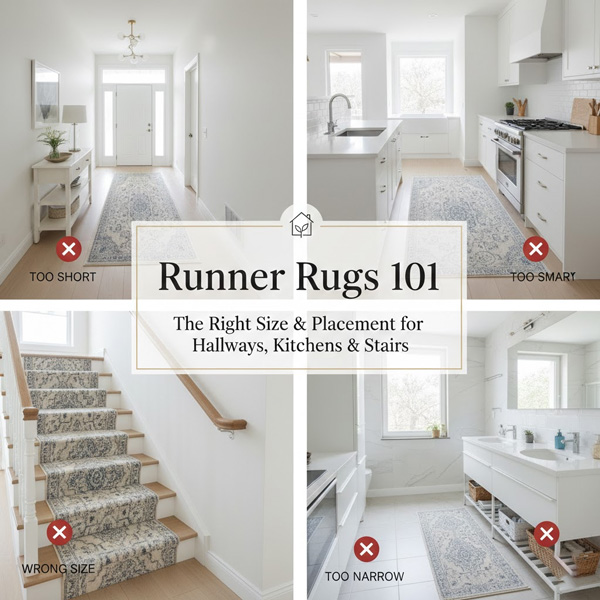
The Foundation: Universal Runner Rug Rules
Before we talk about specific rooms, there are non-negotiable rules that apply to all runner rugs, regardless of location.
Golden Rule of Border Clearance
Always leave 4–6 inches of bare floor on each side of your runner rug.
This border clearance is essential because it:
- Creates visual balance
- Prevents edge curling and buckling
- Makes cleaning along baseboards easier
- Reduces the risk of tripping in narrow spaces
If a runner touches the wall on either side, it’s too wide.
Area Rug Placement Rules: A Foolproof Guide for Living Rooms & Bedrooms
Rug Pads Are Mandatory, Not Optional
In high-traffic areas, a rug pad is not an upgrade—it’s a safety requirement.
A proper non-slip rug pad:
- Prevents sliding and trip hazards
- Improves floor protection
- Enhances noise reduction (acoustics)
- Extends the rug’s lifespan by reducing friction
For stairs, hallways, and kitchens, skipping a rug pad is the fastest way to turn a solution into a problem.
Material Rules for High-Traffic Zones
Runner rugs must prioritize durability and stability over softness.
Always choose:
- Low-pile construction
- Tight weave
- Materials like polypropylene, olefin, nylon, or durable wool
Avoid:
- High-pile or shag runners
- Loose weaves that shift underfoot
- Delicate fibers in moisture-prone areas
Can a Rug Be Too Big? (And 5 Other Rug Sizing Mistakes to Avoid)
Dining Room Rug Size Calculator: How to Choose (So Chairs Don’t Catch)
Part 1: Hallway & Entryway Runners (The Connectors)
Hallways are classic high-traffic areas and essential transitional spaces. A runner here guides movement, absorbs sound, and protects long stretches of exposed flooring.
Primary Goals
- Direct foot traffic
- Reduce noise from hard flooring
- Protect against wear in narrow corridors
Hallway Runner Size Formula
Length Rule:
Hallway length – 12 inches
(Leave ~6 inches of bare floor at each end.)
Width Rule:
Hallway width – 8 to 12 inches
(This preserves the 4–6 inch border clearance on both sides.)
Standard runner widths:
- 2 ft (24”) → very narrow hallways
- 2.5–3 ft (27–36”) → most standard hallways
Design & Practical Tips
- A patterned runner hides foot traffic marks and minor stains.
- In a long, narrow hallway, a runner creates visual flow and elongates the space.
- Pair with a console table or bench only if clearance remains safe.
- Natural fiber runners (jute, sisal) work only in dry entryways—never near moisture.
Visual Guide: How Big Are Common Rug Sizes? (3×5, 5×7, 6×9 & More)
What Size Rug for a Queen Bed? (And King, Full, Twin) – Layouts That Work
Part 2: Kitchen Runners (The Practical Heroes)
Kitchens are spill zones, standing zones, and constant movement corridors. A kitchen runner must perform under pressure.
Primary Goals
- Cushion feet during prep and cleanup
- Contain spills and crumbs
- Define work zones (sink, stove, island)
Ideal Kitchen Runner Sizing
Width:
- 27–30 inches is the standard
This prevents interference with cabinet doors and appliances.
Length:
- Match the length of your galley kitchen
- Or place runners only where you stand most (sink or cooktop)
Never wall-to-wall a kitchen runner.
The Definitive Guide to Rug Sizes & Placement for Every Room
Material Is Everything in Kitchens
Top choices:
- Indoor/outdoor runner rugs
- Washable runner rugs
- Stain-resistant polypropylene or nylon
These materials excel at:
- Spill containment
- Moisture resistance
- Easy cleanup
Safety Rule:
Non-slip backing is mandatory in kitchens.
A sliding runner near water is a serious fall risk.
Part 3: Stair Runners (The Safety Specialists)
Stairs are the most dangerous surface in the home. A stair runner is a safety system, not a style accent.
Critical Warning
Stair runner installation requires precision. Poor installation increases—not reduces—risk. When in doubt, professional installation is recommended.
Key Stair Terms
- Tread: The horizontal part you step on
- Riser: The vertical face between treads
- Landing: Flat platform at the top or bottom
Rug Sizing & Selection for Living Room Layouts
Sectional Sofa Rug Sizing: The Definitive Guide for L-Shaped and U-Shaped Layouts
Stair Runner Measurement Formula
- Measure one step: tread + riser
- Multiply by the number of steps
- Add at least 12 inches extra for fitting and adjustments
Width Rule:
- Leave 2–4 inches of exposed wood on each side for balance and safety
Mandatory Safety Components
- Stair-specific rug pad
- Carpet tape or stair rod installation
- Secure fastening at every tread
These elements:
- Prevent slipping
- Eliminate bunching
- Improve long-term durability
- Enhance perceived home value
Practical Guides: How to Measure for a Rug, Buy Your First, & Start Off Right
What Size Rug Under a Couch? Rules for Standard Sofas, Loveseats & Sectionals
Runner Rug Sizing Guide by Space
| Space | Primary Function | Ideal Width | Length Rule | Material Tip |
|---|---|---|---|---|
| Hallway | Traffic control, noise reduction | 27–36” | Hallway length – 12” | Low-pile wool or polypropylene |
| Entryway | Floor protection, durability | 27–30” | Leave 6” at each end | Stain-resistant synthetic |
| Kitchen | Anti-fatigue, spill control | 27–30” | Fit sink/island zone | Indoor/outdoor polypropylene |
| Galley Kitchen | Workflow definition | 27” | Continuous run | Washable runner rug |
| Stairs | Safety, traction | Stair width – 4–8” | Step formula + 12” | Tight weave + stair pad |
Pre-Purchase Safety Checklist
- Measured length and width accurately
- Confirmed border clearance
- Selected material appropriate for moisture level
- Chosen a rug pad
- Considered cleaning and rotation for even wear
Invest in Flow, Safety, and Style
Runner rugs are not interchangeable decor pieces.
Each space—hallway, kitchen, stair—has its own technical formula and material requirement.
When chosen correctly, runner rugs:
- Protect floors
- Reduce noise
- Improve safety
- Make transitional spaces work better every day
Ready to Choose the Right One?
Choosing the right runner is about more than style—it’s about safety, durability, and performance.
👉 Filter Bloom Nestify’s Runner Rugs collection by width, easy-to-clean materials, and non-slip features to find the right solution for your hallway, kitchen, or stairs.
