

Buying the wrong size round rug is one of the most common (and frustrating) decorating mistakes. It’s easy to think, “How hard can it be? It’s just a circle.”
But once you start shopping, confusion kicks in fast.
Here’s the good news: measuring a round rug is much simpler than it seems. You only need one key measurement and a clear, step-by-step method. Follow the process below, and you’ll never second-guess your round rug size again.
This guide is designed to be your fail-proof formula—no math anxiety, no guesswork, no returns.
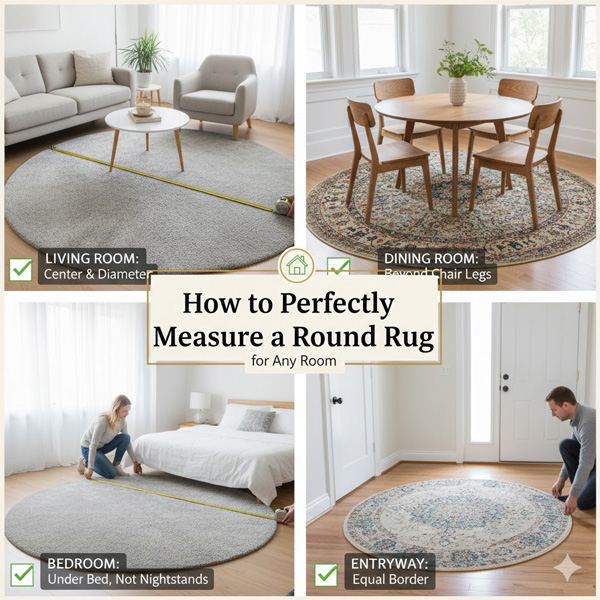
The ONE Measurement You Need to Know: Diameter
Let’s simplify everything right away.
When you measure a round rug, only one number matters:
👉 the Diameter.
What Is Diameter?
Diameter is the distance straight across the circle, from one edge, through the center, to the opposite edge.
That’s it.
- A 6′ round rug means 6 feet across
- An 8′ round rug means 8 feet across
What Diameter Is Not
To avoid confusion:
- ❌ Not the radius (center to edge)
- ❌ Not the circumference (distance around the circle)
Retailers size round rugs by diameter only, so this is the number you’ll always shop by.
Once you understand that, the rest becomes surprisingly easy.
Area Rug Placement Rules: A Foolproof Guide for Living Rooms & Bedrooms
Can a Rug Be Too Big? (And 5 Other Rug Sizing Mistakes to Avoid)
Your Foolproof, 3-Step Measuring Guide
This is the heart of the guide. Follow these three steps in order, and you’ll know exactly how to measure a round rug for any space.
Step 1: Find Your “Furniture Zone”
Start by identifying the Furniture Zone—the area you want the rug to visually and functionally anchor.
Think of this as the job your rug needs to do.
For a Dining Table
Your Furniture Zone must include:
- The table
- All chairs even when pulled out
This is essential for comfort and balance.
For a Living Room
Decide what the rug should anchor:
- A round coffee table?
- A pair of accent chairs?
- A full seating conversation area?
The rug should connect these pieces—not float underneath them.
For an Entryway or Accent Area
Your Furniture Zone might simply be:
- The walking path
- The visual center of the space
👉 You’re not measuring the room yet. You’re defining the purpose.
Dining Room Rug Size Calculator: How to Choose (So Chairs Don’t Catch)
Practical Guides: How to Measure for a Rug, Buy Your First, & Start Off Right
Step 2: Add Crucial “Breathing Room” Margins
This is the step most people skip—and it’s why rugs often end up too small.
Once you’ve identified your Furniture Zone, you must add Walkway Margin.
The Golden Rule
Add 24–30 inches of space beyond your furniture on all sides.
Why this matters:
- Creates comfortable walkways
- Prevents a cramped look
- Makes the rug feel intentional and well-sized
Example (Dining Table)
- Table width with chairs pulled out: 60 inches
- Add 24–30 inches on each side
- Resulting circular area: ~108–120 inches
That number becomes your ideal rug diameter.
This step determines the final size. Do not skip it.
Sectional Sofa Rug Sizing: The Definitive Guide for L-Shaped and U-Shaped Layouts
The Definitive Guide to Rug Sizes & Placement for Every Room
Step 3: Translate to Rug Diameter & Shop Confidently
Now comes the easiest part.
- Take the total circular measurement you calculated
- That number equals the diameter you need
- Match it to a standard round rug size
Important Rule:
If you’re between sizes, always round UP.
For example:
- You calculate 7.5 feet → choose an 8′ round rug
- You calculate 9 feet → choose a 10′ round rug
A slightly larger rug:
- Looks more balanced
- Feels more luxurious
- Is far easier to style than a rug that’s too small
This is the secret to confidently choosing round rug sizing without regret.
Rug Sizing & Selection for Living Room Layouts
Runner Rugs 101: The Right Size & Placement for Hallways, Kitchens & Stairs
Pro Tips & Visual Cheat Sheet
⭐ Pro Tip: Map It Out Before You Buy
Use a piece of string and painter’s tape to draw a circle on your floor.
- Tape the diameter you calculated
- Walk around it
- Pull out chairs
- View it from multiple angles
If it feels right taped out, it will feel right in real life.
The Ultimate Rug Sizing & Placement Guide
Visual Guide: How Big Are Common Rug Sizes? (3×5, 5×7, 6×9 & More)
⭐ Pro Tip: Always Check Exact Dimensions
Never rely on labels like:
- “Small”
- “Medium”
- “Large”
Always confirm the exact diameter in inches or feet in the product description.
This is a simple habit that prevents costly mistakes.
Quick Guide: Round Rug Sizes for Common Spaces
| Room / Area | Suggested Diameter | Why It Works |
|---|---|---|
| Round coffee table | 4’–5′ | Frames table without crowding |
| Entryway | 5’–6′ | Defines space and allows movement |
| Dining table (4 chairs) | 6’–8′ | Chairs stay on rug when pulled out |
| Small living room | 8′ | Anchors seating area |
| Large living room | 9’–10′ | Creates a full conversation zone |
| Bedroom accent | 6’–8′ | Softens space at foot or center |
Use this as a quick reference when deciding what size round rug you need.
What Size Rug for a Queen Bed? (And King, Full, Twin) – Layouts That Work
What Size Rug Under a Couch? Rules for Standard Sofas, Loveseats & Sectionals
Ready to Find Your Perfect Round Rug?
Let’s recap the simple formula:
- Find your Furniture Zone
- Add 24–30 inches of breathing room
- That final number is your rug’s diameter
That’s all there is to it.
