

You spent hours choosing the rug. The color works. The pattern is beautiful. The quality feels right. And yet—once it’s on the floor—the room still looks… off. Here’s the surprising truth most homeowners don’t want to hear:
In over 90% of these cases, the problem isn’t color or style. It’s scale and proportion.
Rug size mistakes quietly sabotage visual balance, distort furniture grouping, and break the natural traffic flow of a room. The result? A space that feels awkward, smaller than it is, or inexplicably uncomfortable—even if every individual piece is “nice.”
Think of this article as a diagnostic scan for your space. We’ll answer the controversial question “can a rug be too big?” honestly, then diagnose the five most common rug size problems, explain exactly why they fail, and prescribe clear, practical fixes.
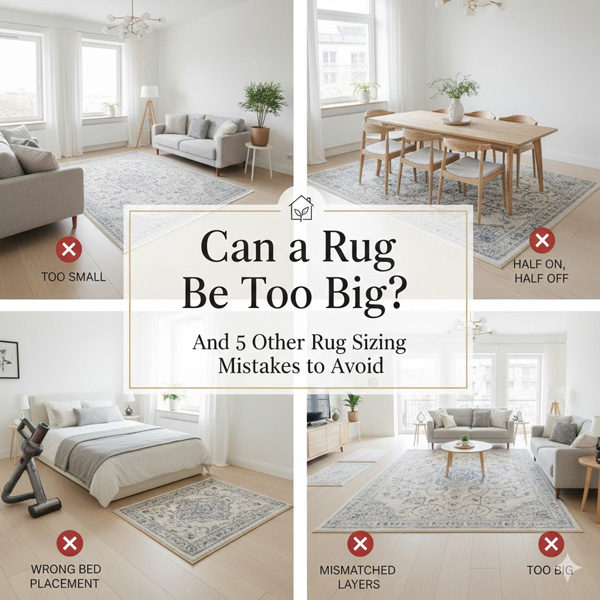
The Big Question: Can a Rug Be Too Big?
Design advice often repeats the mantra: “Bigger is better.”
And while that’s usually true compared to a rug that’s too small, it’s not an absolute rule.
Yes—A Rug Can Be Too Big When It Breaks Function or Proportion
Let’s be precise.
When It Interferes With Function
A rug becomes too big when it:
- Blocks door swing clearance
- Covers HVAC vents or floor registers
- Cuts across natural traffic flow
- Interrupts room transitions (for example, between a living room and hallway)
At that point, the rug isn’t grounding the room—it’s creating friction. That friction is felt subconsciously every time someone walks, opens a door, or navigates the space.
How to Perfectly Measure a Round Rug for Any Room
Practical Guides: How to Measure for a Rug, Buy Your First, & Start Off Right
When It Destroys Proportion in a Small Room
In compact rooms, a rug pushed nearly wall-to-wall can:
- Eliminate essential negative space
- Increase visual weight
- Make the room feel boxed in or flat
Instead of expanding the room, it can actually choke the room, making it feel tighter and less intentional.
When It Exposes Structural Flaws
An oversized rug can also:
- Highlight uneven floors
- Emphasize crooked walls
- Reveal layout inconsistencies you’d rather disguise
In these cases, bigger doesn’t hide flaws—it magnifies them.
📌 Conclusion Box: The Honest Answer
Yes, a rug can be too big if it:
- Blocks door swings or HVAC vents
- Leaves less than 6 inches of bare floor to the wall (the “wall-to-wall” look)
- Chokes the natural flow of a small room
The goal isn’t to cover every inch of floor.
The goal is a rug that’s large enough to unify furniture while preserving balance, breathing room, and movement.
The 5 Most Common Rug Sizing Mistakes (& How to Fix Them)
Think of these as the most frequent “diagnoses” designers see in real homes.
Mistake #1: The “Postage Stamp” Rug (A.K.A. Rug Too Small)
Visual Description:
A tiny rug sits in the middle of the room, touching nothing—like a lonely island surrounded by furniture.
This is the classic rug too small for room problem.
Why It Fails:
- Breaks furniture grouping
- Disconnects seating pieces
- Makes the room look smaller and cluttered
- Creates the feeling that everything is floating independently
It’s like framing a painting with a mat that’s too narrow—your eye never settles.
Here’s the Fix (Non-Negotiable):
Follow the Furniture Leg Rule.
- Living rooms:
- Best: All front legs of sofas and chairs on the rug
- Acceptable: At least the front legs on
- Never leave all furniture completely off the rug
This instantly restores visual balance, anchors the layout, and solves most area rug placement errors in one move.
Area Rug Placement Rules: A Foolproof Guide for Living Rooms & Bedrooms
Dining Room Rug Size Calculator: How to Choose (So Chairs Don’t Catch)
Mistake #2: The “Floating Island” Dining Room Rug
Visual Description:
The rug fits neatly under the dining table—until someone pulls out a chair. Then the chair legs catch the edge, wobble, or slide off.
Why It Fails:
- Ignores chair clearance
- Creates a subtle tripping hazard
- Breaks the rhythm of movement
- Feels cheap and poorly planned
This mistake is one of the most common rug size problems in dining rooms.
Here’s the Fix:
Apply the 24-inch dining chair clearance rule.
- Measure your table
- Add 24–36 inches on all sides
- This ensures chairs stay fully on the rug whether pushed in or pulled out
The rug should support the activity, not just the furniture footprint.
Rug Sizing & Selection for Living Room Layouts
Runner Rugs 101: The Right Size & Placement for Hallways, Kitchens & Stairs
Mistake #3: Ignoring the Room’s Shape & Natural Flow
Visual Description:
A long rectangular rug shoved into a square room—or a rug placed in a way that slices through walkways.
Why It Fails:
- Disrupts scale and proportion
- Breaks traffic flow
- Creates awkward furniture placement
- Makes the room feel choppy instead of cohesive
A rug should echo the room layout, not fight it.
Here’s the Fix:
- Match rug shape to room function:
- Round rug → round table
- Rectangular rug → linear seating or dining layouts
- Keep clear walking paths around the rug
- Never force people to step over a rug corner to move naturally
Think of rugs as guides, not obstacles.
What Size Rug for a Queen Bed? (And King, Full, Twin) – Layouts That Work
What Size Rug Under a Couch? Rules for Standard Sofas, Loveseats & Sectionals
Mistake #4: The “Almost There” Bedroom Rug
Visual Description:
The rug peeks out just 2–3 inches from the sides of the bed—barely visible, barely functional.
Why It Fails:
- Looks skimpy and accidental
- Loses any sense of luxury
- Provides no real comfort underfoot
- Undermines balance and symmetry
This is one of the most visually disappointing common rug mistakes.
Here’s the Fix:
Follow the 18–24 inch bedside rule.
- Your rug should extend at least 18–24 inches beyond each side of the bed
- This ensures your feet land on the rug when you get up—every time
If space is tight, consider properly sized runners on each side instead.
Sectional Sofa Rug Sizing: The Definitive Guide for L-Shaped and U-Shaped Layouts
The Definitive Guide to Rug Sizes & Placement for Every Room
Mistake #5: Forgetting the “Breathing Room” (Border Space)
Visual Description:
A rug pushed right up against the walls, especially noticeable in hallways or small rooms.
Why It Fails:
- Eliminates negative space
- Makes the room feel heavy and overwhelming
- Reduces visual interest
- Makes cleaning around edges harder
- Mimics wall-to-wall carpeting without the benefits
This mistake is subtle—but incredibly common.
Here’s the Fix:
Always leave a visible border of bare floor.
- Small rooms: minimum 6 inches
- Medium to large rooms: 12–18 inches is ideal
- Hallways: consistent border on both sides
That border is what allows the rug—and the room—to breathe.
The Ultimate Rug Sizing & Placement Guide
Visual Guide: How Big Are Common Rug Sizes? (3×5, 5×7, 6×9 & More)
Your Pre-Purchase Checklist: Measure, Visualize, Decide
Before buying, slow down and run this quick diagnostic:
- Measure the room and key furniture with a measuring tape
- Use painter’s tape to visualize the rug size on the floor
- Check door swing clearance and HVAC vents
- Walk the traffic paths—nothing should feel blocked
- Apply the rules above (legs on, clearance, borders)
This five-minute process prevents years of regret.
Shop Smarter, Not Guessier (CTA)
Now that you know what to avoid, you’re no longer shopping blind.
Instead of hoping a rug will “work,” you can choose with intention and confidence.
Use Bloom Nestify’s Rug Size Guide or filter by exact dimensions to find rugs that respect scale, proportion, and real-life function—so they look right from day one.
For a complete A–Z foundation, start here:
The Definitive Guide to Rug Sizes & Placement for Every Room
Final Diagnosis: The Right Rug Should Disappear
A perfectly sized rug is rarely the star of the room.
It doesn’t shout for attention.
Instead, it:
- Connects furniture effortlessly
- Supports movement naturally
- Balances visual weight quietly
If you notice the rug too much, something’s probably off.
And when in doubt?
Tape it out. Painter’s tape is cheaper than replacing a rug—and it’s the smartest design tool you’re probably not using yet.
Once scale and proportion are right, everything else finally falls into place.
