

Thinking “Can I Bleach My White Rug?“ This guide from Bloom Nestify gives you the clear answer – plus safer, smarter alternatives to brighten your rug and remove stains without causing damage. Part of our Rug Care & Cleaning series, it helps you protect delicate fibers while keeping your white rug looking fresh, clean, and beautifully maintained.
The Bleach Autopsy: A Chemical Breakdown
Text-Based Infographic Description
- Fiber A (Healthy): Smooth surface, intact cuticle (wool) or uniform polymer chains (synthetics). Light reflects evenly → appears bright.
- Fiber B (After Bleach): Pitted surface, fractured bonds, yellow discoloration within the fiber core.
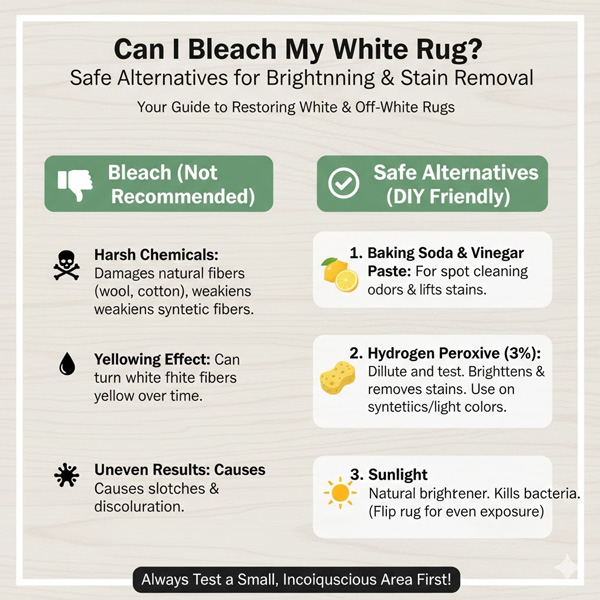
Caption: Bleach doesn’t remove stains—it destroys the fiber itself. The damage is permanent and cumulative.
The Hard Truth: Why Bleach Is a Catastrophic Choice
Bleach—whether chlorine (sodium hypochlorite) or oxygen-based used incorrectly—is a blunt oxidizer. Rugs require precision chemistry, not a nuclear option.
What Bleach Does at the Molecular Level
On Wool & Other Natural Fibers
Bloom Nestify Lab Note:
Chlorine bleach reacts with wool’s keratin proteins, forming chloroamines. These compounds cause instant yellowing and brittleness. The fiber is chemically weakened the moment contact occurs.
- Protein chains break (hydrolysis)
- Fibers lose elasticity
- Wear accelerates dramatically
A bleached wool rug may look lighter for weeks—then sheds, thins, and fails.
On Synthetic Fibers (Nylon, Polyester)
Bleach can:
- Strip factory-applied optical brighteners
- Cause patchy whitening or dulling
- Create uneven reflection (the rug looks “flat”)
White synthetics are not colorless—they are engineered. Bleach dismantles that engineering.
Dog Urine on Your Rug? The Step-by-Step Rescue Guide for Wool & Cowhide
On Dyes (Even in “White” Rugs)
Most white rugs contain subtle undertones—ivory, cream, warm gray.
Bleach oxidizes these unevenly, leading to:
- Patchiness
- Yellow halos
- Pink or gray shifts
Once dyes are altered, there is no reversal.
The Safe Brightening Pyramid: Your 4-Tier Strategy
Think of white rug care as a hierarchy. Skip the base, and no treatment at the top will hold.
TIER 1: PREVENTION (The Foundation)
- Use high-quality rug pads to prevent soil grinding
- Enforce a no-shoes policy
- Install UV-filtering window film
- Blot spills immediately—never rub
Physics fact: Most “graying” is soil abrasion, not staining.
Ink & Marker Magic: How to Lift Pen Stains from Your Carpet
Red Wine on the Rug? Don’t Panic, Follow These Steps for Wool & Synthetics
TIER 2: MAINTENANCE (Regular Upkeep)
- Vacuum 2–3x weekly with HEPA filtration
- Vacuum slowly; suction only
- Rotate rugs quarterly
This prevents particulate buildup that dulls white fibers.
TIER 3: TARGETED TREATMENT (Safe DIY Toolkit)
This is where chemistry replaces bleach.
Safe Whitening Solution Recipe Box
For General Brightening (Synthetic or Colorfast Wool Only):
- 1 part 3% hydrogen peroxide
- 4 parts distilled water
- 1 drop clear, pH-neutral dish soap
Lightly blot. Never soak. Always test first.
Important: Hydrogen peroxide is an oxygen cleaner—not bleach—when properly diluted and pH-controlled.
>> Laughing Buddha with Five Children Statue – 3.3 ft Huong Stone Wood
TIER 4: PROFESSIONAL REVITALIZATION (The Peak)
Annual or bi-annual professional care resets the rug without damage.
This is not optional for white rugs—it is preservation.
Stain-Specific Playbook for White Rugs
Stain Decision Tree
Organic Stain (wine, coffee, food)? → Enzymatic cleaner
Mineral/Mud Stain? → Let dry completely, vacuum first
Greasy/Unknown? → Absorbent compound
Ink or Dye? → Stop. Professional only.
How To Get Cooking Oil Stains Out Of Carpet?
Grease & Oil Stain Removal: From Kitchen Splatters to Beauty Products
Organic Stains: The Enzyme Attack
Enzymes digest proteins and sugars instead of bleaching them.
- Apply enzyme cleaner
- Allow dwell time (10–15 min)
- Blot, rinse lightly, dry
This removes the stain source, not the fiber.
Yellowing & Graying: The Gentle Lift
Yellowing = oxidation + residue.
- Light oxygen-based solution
- Follow with pH-balancing rinse
- Use absorbent compounds to lift loosened soil
Bloom Nestify Lab Note:
Yellowing often worsens after bleach because oxidation continues unchecked.
Pet Accidents: The Two-Step
- Enzyme treatment to neutralize proteins
- Mild acidic rinse (vinegar diluted for pH balance—not whitening)
Skipping step two guarantees yellow return.
The Ultimate Whitening: When to Call the Professionals
Professional rug whitening is not stronger chemicals—it’s controlled chemistry.
What Professionals Do Differently
- Fiber and dye analysis
- Immersion washing with pH-controlled detergents
- Safe optical brighteners that reflect blue light
- Controlled hydrogen peroxide systems
- Neutralizing rinses to stop oxidation
The result: white that lasts.
Embrace the Care, Enjoy the White
A white rug is not fragile—but it is unforgiving of shortcuts.
Bleach trades short-term lightening for long-term damage. Science gives you a better path.
Bloom Nestify thanks you for reading our blog!
