

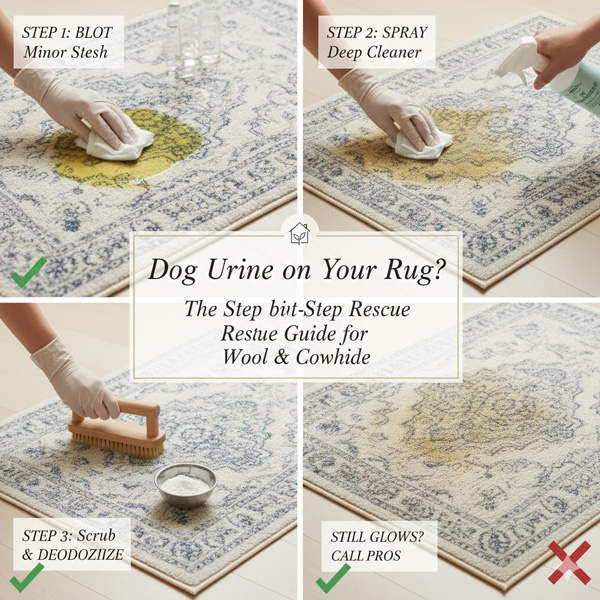
Accidents happen—but don’t worry. In Dog Urine on Your Rug?, Bloom Nestify walks you through a clear, step-by-step rescue plan to tackle stains and odors on both wool and cowhide rugs. As part of our Rug Care & Cleaning series, this guide helps you act quickly, clean safely, and restore freshness without damaging delicate fibers.
Emergency Prep Table (If You Own a Dog, Buy These NOW)
If you don’t have an accident yet—pause and prepare. These three items decide outcomes.
Your Must-Have Arsenal:
- Enzyme Cleaner (Non-ammonia, pet-specific) – Non-negotiable
- White absorbent towels or microfiber cloths
- Baking soda
Highly Recommended:
- Wet-dry vacuum
- Distilled white vinegar (for wool ONLY)
- Club soda (for cowhide)
- Mild, leather-safe soap
Can I Bleach My White Rug? Safe Alternatives for Brightening & Stain Removal
Why Dog Urine Is So Destructive (The Science You Must Understand)
Dog urine is not just water plus smell.
It contains:
- Urea → breaks down into ammonia
- Uric acid crystals → microscopic, insoluble, and odor-reactivating
- Bacteria → feed on residue and multiply
- Alkaline salts → damage dyes and fibers
When urine dries:
- Crystals remain embedded
- Odor returns with humidity
- Heat permanently sets both stain and smell
Covering the odor fails. Masking the odor fails.
Only enzymatic digestion works.
THE FIRST 3 STEPS (FOR ALL RUGS — DO THIS IMMEDIATELY)
STEP 1: CONTAIN & BLOT
- Grab white, dry towels
- Place them over the wet area
- Press straight down with your body weight
- Replace towels until no more liquid transfers
❗ Do NOT scrub. Scrubbing drives urine deeper.
>> Laughing Buddha with Five Children Statue – 3.3 ft Huong Stone Wood
STEP 2: LOCATE THE FULL CONTAMINATION ZONE
Urine spreads farther than you see.
- Feel for dampness beyond the visible spot
- If needed, lightly press around the perimeter
- Treat the entire affected zone, not just the center
How To Get Cooking Oil Stains Out Of Carpet?
Ink & Marker Magic: How to Lift Pen Stains from Your Carpet
STEP 3: IDENTIFY YOUR MATERIAL — NOW CHOOSE A PATH
👉 For WOOL, follow Path A
👉 For COWHIDE, follow Path B
Do not mix protocols. They are biologically and structurally different materials.
PATH A: WOOL RUG RESCUE (ABSORBENT & HIGH RISK)
Wool is a protein fiber. It absorbs urine deeply and reacts chemically with alkalinity.
STEP A1: APPLY ENZYME CLEANER (THE CRITICAL MOVE)
- Saturate the urine zone with enzyme cleaner
- Yes—saturate. Enzymes must reach the crystals
- Follow the dwell time on the label (usually 10–15 minutes)
🧬 This is the only step that destroys uric acid crystals.
STEP A2: BLOT — AGAIN
- Use clean, dry towels
- Press firmly
- Remove as much moisture as possible
If you own a wet-dry vacuum, use it now. This dramatically improves success.
STEP A3: NEUTRALIZE ALKALINE RESIDUE
After enzyme treatment:
- Mix 1 part distilled white vinegar + 2 parts water
- Lightly apply (do NOT soak)
- Blot immediately
⚖️ This restores wool’s natural acidic balance and protects dyes.
STEP A4: ABSORB & DRY PROPERLY
- Press with dry towels
- Sprinkle baking soda lightly
- Allow to sit overnight
- Vacuum gently the next day (no beater bar)
🚫 NEVER use heat. No hair dryers. No sunlight. No heaters.
Red Wine on the Rug? Don’t Panic, Follow These Steps for Wool & Synthetics
Grease & Oil Stain Removal: From Kitchen Splatters to Beauty Products
If the Stain Is OLD
Older urine may require multiple enzyme treatments over 24–48 hours.
If odor persists after two full cycles:
STOP. Call a professional rug cleaner immediately.
PATH B: COWHIDE RUG RESCUE (NON-ABSORBENT BUT FRAGILE)
Cowhide is leather. It does not absorb urine—but hair follicles and backing trap residue.
STEP B1: IMMEDIATE SURFACE WIPE
- Use a clean, dry cloth
- Blot and wipe the surface gently
- Remove all visible moisture
STEP B2: LIGHT ENZYME APPLICATION (CONTROLLED)
- Apply enzyme cleaner to a cloth—not directly to the hide
- Dab the affected area
- Do not oversaturate
🧠 Leather hates excess moisture.
STEP B3: WIPE WITH CLUB SODA
- Lightly dampen a cloth with club soda
- Gently wipe to lift residue
- Immediately pat dry
STEP B4: DRY & CONDITION
- Air dry completely
- Once dry, apply a leather conditioner sparingly
This prevents stiffness and cracking.
COMMON MISTAKES THAT RUIN RUGS (READ THIS TWICE)
🚫 NEVER use ammonia-based cleaners
They smell like urine to dogs → repeat marking.
🚫 NEVER scrub
Mechanical force + urine = deeper contamination.
🚫 NEVER use steam or heat
Heat “cooks” proteins and locks in odor permanently.
🚫 NEVER ignore the rug pad or subfloor
Urine wicks downward. Untreated padding = odor returns.
When DIY STOPS and Professionals Take Over
Call a professional IMMEDIATELY if:
- The rug stayed wet for hours
- The odor returns after drying
- The urine soaked through to padding
- The rug is antique, hand-knotted, or high-value
- You see dye bleeding or yellowing
Professional cleaners use:
- Submersion enzyme baths
- Controlled pH rinses
- Odor-neutralizing chambers
- Insurance-backed handling
This is not a cost—it is damage control.
Bloom Nestify thanks you for reading our blog!
