

Dealing with a Viscose Rug Nightmare? This essential guide from Bloom Nestify explains why water can damage delicate viscose fibers and how to spot clean safely without causing permanent marks. As part of our Rug Care & Cleaning, it helps you protect your rug’s look and extend its lifespan with the right care techniques.
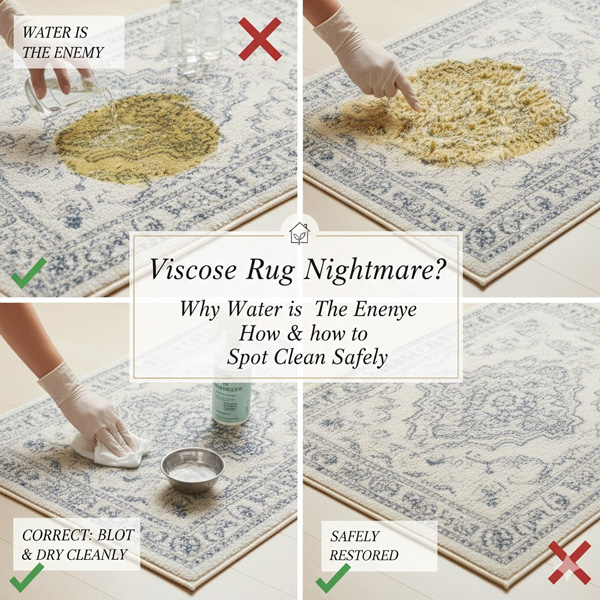
The Anatomy of a Fiber’s Fear: Why Viscose and Water Don’t Mix
Thought Experiment: Dry Pasta vs. Cooked Pasta
Imagine two strands of spaghetti.
- Dry spaghetti: stiff, strong, holds its shape.
- Cooked spaghetti: swollen, limp, fragile, easily torn.
This is the most accurate mental model for viscose fiber behavior.
Dry viscose fibers appear silky, structured, and strong.
Wet viscose fibers behave like overcooked pasta under mechanical stress.
>>> Delicate Rug Warning: How to Safely Clean Viscose, Silk & Polyester Rugs
At a Molecular Level: Regenerated Cellulose Under Stress
Viscose (also called rayon) is a regenerated cellulose fiber.
That means it originates from plant cellulose but is chemically dissolved and re-formed into fibers.
During regeneration, the cellulose chains do not reassemble into a perfectly ordered crystalline structure. Instead, the fiber contains large amorphous regions—zones where polymer chains are loosely arranged.
These amorphous regions are where the nightmare begins.
This is not coincidence—it is polymer science.
>>> Natural Fiber Rug Care: Your Guide to Wool, Sisal, Jute & Braided Rugs
Hydrogen Bonding: Water’s Point of Attack
- Cellulose is rich in hydroxyl (–OH) groups
- Water forms hydrogen bonds aggressively with these groups
- The moment water touches viscose, it penetrates these amorphous regions
Immediate Effects
- Fiber swelling occurs within seconds
- Water acts as a plasticizer, softening the fiber
- Loss of tensile strength can reach 50–80% when wet
In engineering terms:
The load-bearing capacity of the fiber collapses while still under load.
>>> Rug Care 101: How to Clean Every Rug Material
The Lifecycle of a Water Droplet on Viscose (A Destructive Timeline)
Second 0 – Contact
The droplet touches the pile. No visible damage yet.
Seconds 1–5 – Rapid Penetration
Water is wicked deep into the fiber through hydrogen bonding.
Seconds 5–30 – Structural Failure Begins
Fibers swell, soften, and lose internal cohesion. Dye molecules begin to mobilize.
Minutes 1–10 – Optical Distortion
Light reflects differently from swollen fibers. A dark ring appears—not dirt, but physics.
Drying Phase – The Point of No Return
As water evaporates:
- Fibers collapse irregularly
- Shrinkage locks them into distorted positions
- The surface dries stiff, matted, and brittle
Result:
A permanent water stain that cannot be washed out—because nothing is “on” the fiber.
The fiber itself has changed.
>>> Professional vs. DIY: When to Clean Your Silk Rug at Home and When to Call the Experts
The Unforgiving Consequences: What “Ruin” Really Looks Like
Scenario 1: The Permanent Water Ring
This is the most common viscose rug nightmare.
The ring is not residue.
It is permanent pile distortion.
Swollen fibers dry at different heights and angles, altering how light reflects. No cleaner can realign collapsed cellulose chains without re-wetting—and re-wetting makes it worse.
Trying to “blend it out” almost always enlarges the damage zone.
>>> The Truth About Jute Rugs and Water: Can They Get Wet?
Scenario 2: The Stiff, Shrunken Mat
When a larger area becomes wet:
- Fibers lose alignment
- Pile becomes matted
- Drying causes shrinkage
- The rug may feel like pressed cardboard
This is structural collapse, not surface contamination.
>>> Cowhide Rug Care 101: To Vacuum or Not to Vacuum? And Other Essential Tips
Scenario 3: Color Bleeding & Fiber Breakage
Most viscose rugs use fugitive dyes—chosen for brilliance, not durability.
When water is introduced:
- Dyes partially dissolve
- Colors migrate unpredictably
- Weak, wet fibers snap under mechanical stress
This is why any rubbing or scrubbing is catastrophic.
>> Wool Rug Love: How to Reduce Shedding & Keep Your Investment Looking New
Your “One-Millimeter” Safe Zone: The Viscose Spot Cleaning Protocol
Let us be absolutely clear:
This protocol exists only for:
- Extremely small, localized incidents
- Immediate response
- Situations where professional help is not yet available
If you feel uncertain at any point—stop.
>>> The Truth About Viscose Rugs: Luxe Look vs. High-Maintenance Reality
Step 0: The Mandatory Invisible Test
Before touching the visible area:
- Choose a hidden spot (under furniture or rug edge)
- Perform the exact action you plan to use
- Wait 24 hours
- Inspect for stiffness, darkening, or texture change
No test = no cleaning.
The 3-Step Emergency Protocol for Liquid Spills
BLOT FURIOUSLY WITH DRY (No Exceptions)
- Use a white, dry microfiber cloth or paper towel
- Press straight down—do not rub
- Replace cloths continuously
- Goal: absolute moisture minimization
Your only objective is to remove liquid before it enters the fiber core.
>>> Sisal & Jute Rug Care: The Absolute Do’s and Don’ts for Natural Beauty
BRUSH GENTLY (Dry Debris Only)
For dry contaminants only:
- Use a soft, dry bristle brush
- Brush lightly in one direction
- Never back-and-forth
Mechanical stress + weakened fiber = breakage.
ACCEPT THE “PATINA”
This is the hardest step psychologically.
A faint mark may remain.
That is acceptable.
Attempting to “perfect” a viscose rug often escalates minor damage into total loss.
What You Absolutely CANNOT Do (The Forbidden List)
⚠️ No liquid cleaners
⚠️ No steam
⚠️ No shampoo
⚠️ No vinegar solutions
⚠️ No soap
⚠️ No wet vacs
⚠️ No rubbing or scrubbing
⚠️ No “slightly damp cloth”
Each of these introduces moisture deeper into the fiber network and accelerates failure.
Living with (and Loving) a Viscose Rug: The Required Mindset Shift
A viscose rug is not a utility textile.
It is a decorative surface engineered for visual impact, not durability.
Think of it as:
- A silk painting underfoot
- A sculptural installation
- A textile diva
Low traffic. Dry environment. Minimal intervention.
Your Smartest Move: Professional Intervention & Prevention
This knowledge is not meant to scare you away from viscose—it is meant to protect you from false confidence.
For any stain beyond a few drops of clear water,
your only truly safe option is professional dry solvent cleaning performed by experts trained in cellulose fiber behavior.
Save the contact of a dry-solvent rug specialist now.
That phone number is the most important accessory you can own as a viscose rug owner.
Prefer Beauty Without Anxiety? Choose Wisely
If you love the silky sheen but want peace of mind:
Explore our luxury acrylic or nylon luxe rug collections.
They replicate viscose’s luster while offering:
- True water resistance
- Colorfast dyes
- Safe, user-friendly maintenance
Further Reading & Academy Resources
- Delicate Rug Warning: How to Safely Clean Viscose, Silk & Polyester Rugs
- Bloom Nestify’s Rug Care Academy – Your center for material-level rug intelligence
Respect the Diva
Viscose is one of the most beautiful—and fragile—fibers in the rug world.
Its elegance comes at a cost:
- Extreme water sensitivity
- Minimal margin for error
- Zero tolerance for casual cleaning
Treat it with respect.
Keep it dry.
Intervene minimally.
And when in doubt—do nothing until a professional steps in.
Because with viscose, the most dangerous action is often the one taken with the best intentions.
