

Tired of chairs catching on your rug? Use the Dining Room Rug Size Calculator to get the proportions just right. In this helpful guide from Bloom Nestify, you’ll learn how to choose the perfect rug size so chairs slide smoothly and your dining space feels balanced. As part of our Rug Buying Guides, it’s your go-to resource for combining function with flawless style.
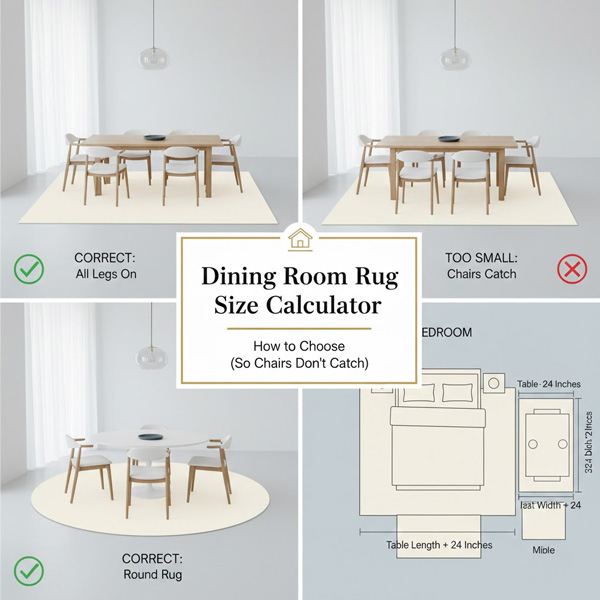
The Golden Rule: Understanding “Chair Clearance”
Before any calculator, you need one core principle.
What Is the Chair Clearance Zone?
The Chair Clearance Zone is the minimum distance a rug must extend beyond the table edge on all sides so that:
- Chairs remain completely on the rug when pulled out
- Chair legs don’t catch on the rug edge
- Guests can sit and stand comfortably without resistance
Area Rug Placement Rules: A Foolproof Guide for Living Rooms & Bedrooms
Can a Rug Be Too Big? (And 5 Other Rug Sizing Mistakes to Avoid)
The Universal Rule Is This:
A dining room rug must extend at least 24–36 inches beyond the table on all sides.
- 24 inches → absolute minimum (tight apartment dining areas)
- 30 inches → comfortable, everyday use
- 36 inches → optimal clearance for formal dining rooms and larger dining sets
This clearance also preserves traffic flow around the table and protects surrounding flooring from chair movement.
If you remember only one thing from this article, remember this rule.
Your Step-by-Step Dining Room Rug Size Calculator
Think of this as a manual calculator you can run in under five minutes.
Step 1: Measure Your Dining Table (Correctly)
Use a measuring tape and record:
- Table length
- Table width or diameter
- Include table leaves (extensions) if you use them regularly
Always size your rug for the table at its largest configuration.
How to Perfectly Measure a Round Rug for Any Room
Practical Guides: How to Measure for a Rug, Buy Your First, & Start Off Right
Step 2: Apply the Formula Based on Table Shape
Quick Formula Box (Save This)
Add 24–36 inches to each side of your table’s dimensions.
(That equals 48–72 inches total added to both length and width.)
This formula ensures full chair clearance and eliminates chair legs catching.
For Rectangular & Square Tables
Formula:
(Table Length + 48–72”) × (Table Width + 48–72”)
Example:
- Table size: 72” × 40”
- Ideal rug size: 9’ × 12’
This ensures chairs stay on the rug even when fully pulled out—critical for formal dining and frequent hosting.
Rug Sizing & Selection for Living Room Layouts
Runner Rugs 101: The Right Size & Placement for Hallways, Kitchens & Stairs
For Round & Oval Tables
Formula:
Rug Diameter = Table Diameter + 48–72”
Why shape matters:
A round rug under a round dining table maintains visual balance and avoids awkward corners interrupting chair movement.
Example:
- 60” round dining table
- Ideal rug diameter: 10’ round
Oval tables follow the same logic but typically look best with oval or large rectangular rugs.
Sectional Sofa Rug Sizing: The Definitive Guide for L-Shaped and U-Shaped Layouts
The Definitive Guide to Rug Sizes & Placement for Every Room
Step 3: Visualize Before You Buy
Designers rarely guess. We test.
Do this:
- Use painter’s tape to mark the calculated rug size on your floor
- Pull chairs out fully
- Walk around the table
If all chair legs remain inside the taped zone, your rug size works.
Dining Rug Size Calculator Reference Table
Dining Rug Size Calculator at a Glance
| Table Size | Table Shape | Minimum Rug Size | Ideal Rug Size | Why It Works |
|---|---|---|---|---|
| 60” × 36” | Rectangular | 6’ × 9’ | 8’ × 10’ | Allows 30” chair clearance, smooth traffic flow |
| 72” × 40” | Rectangular | 8’ × 10’ | 9’ × 12’ | Prevents chair legs catching, ideal for formal dining |
| 84” × 44” | Rectangular | 9’ × 12’ | 10’ × 14’ | Full clearance with table leaves extended |
| 48” | Round | 8’ round | 9’–10’ round | Balanced proportions, no corner interference |
| 60” | Round | 9’ round | 10’ round | Chairs stay fully on rug when pulled out |
| 72” | Oval | 9’ × 12’ | 10’ × 14’ | Maintains clearance and visual harmony |
Use this table as your fast-reference dining room rug size calculator.
The Ultimate Rug Sizing & Placement Guide
Visual Guide: How Big Are Common Rug Sizes? (3×5, 5×7, 6×9 & More)
Beyond Size: Critical Choices for Function & Style
Correct size solves 80% of dining room rug problems. The remaining 20% comes down to material, construction, and safety.
Choosing the Right Rug Material for Dining Rooms (Critical)
Dining rooms demand performance.
Best options:
- Low-pile rug – Chairs slide easily
- Flatweave rug – No resistance, easy cleaning under table
- Stain-resistant materials like polypropylene or nylon
- Indoor/outdoor rugs for maximum durability and spill containment
These materials are:
- Easy-to-clean
- Resistant to spills and crumbs
- Designed for high traffic and durability
Avoid:
- High-pile rugs
- Shag rugs
- Soft, plush piles that trap food and catch chair legs
The Non-Negotiable: Use a Rug Pad
A non-slip rug pad is mandatory in dining rooms.
It provides:
- Floor protection from heavy dining sets
- Stability (prevents rug shifting)
- Reduced tripping hazard
- Quieter chair movement
Never place a dining rug directly on hard flooring without a pad.
What Size Rug for a Queen Bed? (And King, Full, Twin) – Layouts That Work
What Size Rug Under a Couch? Rules for Standard Sofas, Loveseats & Sectionals
Solutions for Small Spaces & Open Floor Plans
Apartment dining area:
- Use the minimum 24–30” clearance
- Consider compact rectangular rugs with flatweave construction
Open floor plan:
- The rug visually defines the dining zone
- Size should relate to the table—not the entire room
Long banquet tables:
- A wide runner rug can work only if chairs slide parallel, not outward
Function always comes first in dining spaces.
Calculate, Measure, and Find Your Perfect Dining Rug
Let’s simplify the process:
- Measure your table (including leaves)
- Add 24–36 inches per side for chair clearance
- Confirm with painter’s tape
- Choose low-pile, stain-resistant materials
That’s it. No guessing. No chair legs catching. No regrets.
Ready to Apply Your Formula?
You’ve done the math. Now make it easy.
👉 Filter Bloom Nestify’s dining room rug collection by exact size and “easy-to-clean” features to find a rug designed for spills, chairs, and real life.
For inevitable accidents, continue here:
How to Clean Common Dining Room Rug Stains (Wine, Grease & More)
Chair Clearance Is Comfort
Dining rooms are not decorative spaces—they’re functional environments where movement matters.
When you respect the Chair Clearance Zone, you get:
- Safer seating
- Smoother chair movement
- Better floor protection
- A dining area that feels right every day
Measure carefully. Calculate confidently.
Your dining room will thank you—quietly, comfortably, and without a single chair catching on the rug.
