

Every rug has a pattern, a construction, and a story—but material is its DNA. Fiber determines how a rug feels underfoot, how it ages, how it reacts to spills and sunlight, and whether it becomes a lifelong companion or a short-term surface solution.
In this guide, we trade marketing language for material science. We put each fiber under the microscope—literally and figuratively—to understand why it behaves the way it does, where it excels, and where it fails. This is the material science foundation of rug knowledge: a forensic, practical excavation designed to help you become a true material matchmaker, pairing fiber properties to real homes, real people, and real lifestyles.
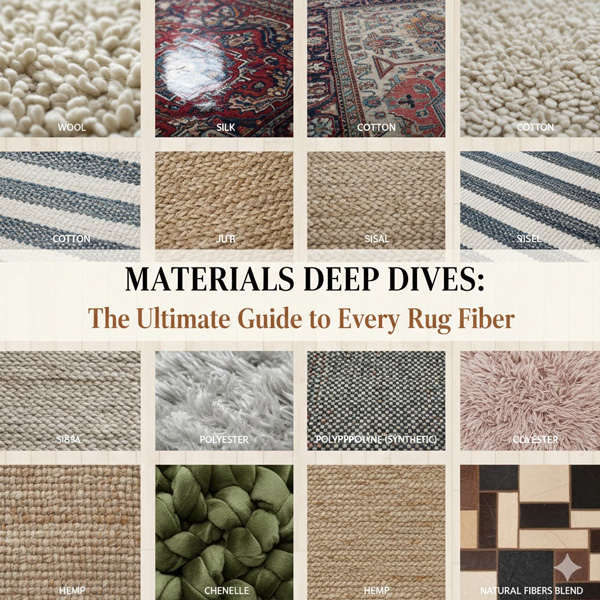
Master Fiber Comparison Matrix (At a Glance)
| Fiber | Source | Feel | Durability | Stain Resistance | Sun Resistance | Cost |
|---|---|---|---|---|---|---|
| Wool | Animal (Sheep) | Warm, elastic | Very High | High (natural) | Moderate | $$$ |
| Silk | Animal (Silkworm) | Cool, lustrous | Moderate | Low | Low | $$$$ |
| Cotton | Plant | Soft, matte | Low–Moderate | Low | Moderate | $$ |
| Jute | Plant | Coarse, earthy | Low | Very Low | Moderate | $$ |
| Sisal | Plant | Firm, textured | Moderate | Very Low | High | $$ |
| Olefin (PP) | Synthetic | Smooth, light | High | Very High (water-based) | High | $ |
| Polyester | Synthetic | Soft, plush | Moderate | Moderate | Moderate | $ |
| Nylon | Synthetic | Resilient | Very High | Moderate | High | $$ |
| Hide/Leather | Animal | Organic, variable | Moderate | Low | Moderate | $$$ |
Fiber 1: Wool – The Time-Tested Titan
Origin & Extraction
Wool is harvested through shearing sheep, typically once a year. Raw fleece undergoes scouring to remove lanolin, dirt, and vegetable matter, then is carded and spun into yarn. The quality varies dramatically based on breed, climate, and processing—New Zealand, Tibetan, and highland wools are prized for resilience.
The Science of Its Strength
Wool is composed primarily of keratin, a fibrous protein also found in human hair and nails. Each wool fiber has:
- Microscopic surface scales (like shingles)
- A natural crimp (waviness)
- Residual lanolin, a waxy lipid
Molecular Advantage:
The crimp creates millions of tiny air pockets, giving wool its elastic recovery, insulation, and cushioning. The scales and lanolin make wool hydrophobic (water-repellent) on the surface while still absorbing moisture vapor internally—up to ~30% of its weight without feeling wet.
Wool is also naturally flame-resistant; it chars rather than melts or ignites.
>>> Beyond Wool: Understanding Olefin (Polypropylene) & Other Budget-Friendly Rug Options
Real-World Performance Profile
| Superpower | Kryptonite | The Reality Check |
|---|---|---|
| Natural stain resistance | Moth susceptibility | Needs regular vacuuming & prevention |
| Excellent resilience | Can felt with heat + agitation | Improper cleaning is the real enemy |
| Thermal & acoustic insulation | Sensitive to high alkalinity | pH-neutral care is non-negotiable |
Ideal Habitat & Use Cases
- Living rooms
- Bedrooms
- Hallways and stairs
- Any space needing comfort + durability
The Care Protocol: Do’s & Absolute Don’ts
Do:
- Vacuum regularly (with pile direction)
- Rotate annually for even wear
- Professionally clean every 1–3 years
Don’t:
- Use high-pH cleaners
- Steam clean aggressively
- Store without moth protection
Bloom Nestify Authentication Tip:
Real wool smells like burnt hair when singed; synthetics melt and smell chemical.
>>> Nylon & Polyester Rugs: The Stain-Resistant Heroes for Busy Homes
Fiber 2: Silk – The Luxurious Luminary
Origin & Extraction
Silk comes from the cocoons of silkworms (Bombyx mori). Long continuous filaments are reeled from the cocoon, sometimes thousands of feet long. Reeling preserves strength; spun silk (from shorter fibers) is weaker but more affordable.
The Science of Its Strength
Silk is made of fibroin protein, arranged in crystalline structures that provide an astonishing strength-to-weight ratio. The fiber’s triangular cross-section acts like a prism, refracting light and creating silk’s legendary sheen.
Molecular Advantage:
High tensile strength with extreme fineness allows silk to hold razor-sharp detail and saturated dyes.
Real-World Performance Profile
| Superpower | Kryptonite | The Reality Check |
|---|---|---|
| Unmatched luster | Water spotting | One spill can leave a mark |
| Exceptional dye affinity | Sun fading | UV exposure is cumulative |
| Fine detail capability | Abrasion sensitivity | Traffic dulls silk quickly |
Ideal Habitat & Use Cases
- Formal living rooms
- Primary bedrooms
- Dressing rooms
- Wall-hung or collector rugs
The Care Protocol: Do’s & Absolute Don’ts
Do:
- Use no-shoes policy
- Block UV light completely
- Dry clean only (specialist)
Don’t:
- Wet clean
- Place in traffic zones
- Attempt spot treatment
Bloom Nestify Authentication Tip:
Real silk burns to a fine, crushable ash smelling like hair. “Art silk” melts into beads.
>>> Natural Fiber Rug Guide: Wool, Cotton, Silk, Jute & Sisal Compared
Fiber 3: Plant-Based Naturals – The Earthy Essentials (Cotton, Jute, Sisal)
Origin & Extraction
Derived from plant cellulose:
- Cotton: Seed fibers
- Jute: Stalk fibers
- Sisal: Agave leaves
Fibers are retted, dried, and spun. These are among the most biodegradable rug materials.
The Science of Its Strength
Cellulose fibers are:
- Highly absorbent
- Low in elasticity
- Structurally straight (no crimp)
Molecular Advantage:
High absorbency makes plant fibers breathable and matte—but also vulnerable.
Real-World Performance Profile
| Superpower | Kryptonite | The Reality Check |
|---|---|---|
| Eco-friendly | Prone to staining | Spills soak in instantly |
| Casual texture | Mildew risk | Moisture is the enemy |
| Affordable | Low resilience | Fibers crush permanently |
Ideal Habitat & Use Cases
- Sunrooms
- Casual bedrooms
- Layering under wool rugs
- Dry, low-risk environments
The Care Protocol: Do’s & Absolute Don’ts
Do:
- Vacuum frequently
- Keep absolutely dry
- Use rugs pads for airflow
Don’t:
- Steam clean
- Place in basements
- Use liquid cleaners freely
Bloom Nestify Authentication Tip:
Natural plant fibers feel cool and papery; synthetics feel slick and uniform.
Fiber 4: Synthetic Polymers – The Engineered Allies (Olefin, Polyester, Nylon)
Origin & Extraction
Synthetic fibers are created from petrochemical polymers, melted and extruded through spinnerets into filaments. Many are solution-dyed, meaning color is embedded at the polymer stage.
The Science of Its Strength
- Olefin (Polypropylene): Highly hydrophobic, UV-stable
- Polyester: Soft hand, good color clarity
- Nylon: Exceptional elastic recovery
Molecular Advantage:
Solution-dyeing locks pigment inside the polymer chain, making colorfastness intrinsic.
Real-World Performance Profile
| Superpower | Kryptonite | The Reality Check |
|---|---|---|
| Stain resistance | Oleophilic (oil-loving) | Grease stains persist |
| Fade resistance | Static buildup | Especially in dry climates |
| Budget-friendly | Environmental footprint | Not biodegradable |
Ideal Habitat & Use Cases
- Playrooms
- Kitchens
- Basements
- Outdoor & patio spaces
- Vacation homes
The Care Protocol: Do’s & Absolute Don’ts
Do:
- Clean spills promptly
- Use mild detergent
- Hose-clean outdoor rugs
Don’t:
- Use oil-based cleaners
- Expect patina or aging grace
Bloom Nestify Authentication Tip:
Check backing and uniform fiber diameter—synthetics are perfectly consistent.
Fiber 5: Hides & Leather – The Organic Wildcards
Origin & Extraction
Derived from animal skins, preserved through tanning:
- Chrome tanning: Softer, less stable long-term
- Vegetable tanning: Firmer, ages better
Primary protein: collagen.
The Science of Its Strength
Collagen fibers form interlocking bundles, giving hides tear resistance but low flexibility.
Molecular Advantage:
Natural grain patterns create unique visual character—no two are identical.
Real-World Performance Profile
| Superpower | Kryptonite | The Reality Check |
|---|---|---|
| Unique aesthetics | Moisture sensitivity | Water stains permanently |
| Durable surface | Temperature changes | Can curl or stiffen |
| Natural texture | Requires conditioning | Neglect shows quickly |
Ideal Habitat & Use Cases
- Low-traffic areas
- Offices
- Accent layering
- Climate-controlled spaces
The Care Protocol: Do’s & Absolute Don’ts
Do:
- Condition periodically
- Keep humidity stable
Don’t:
- Wet clean
- Place in sun-heavy rooms
Composing Your Fiber Symphony
Rarely is the answer one fiber alone. Blends matter:
- Wool + Silk: Durability with sheen
- Wool + Nylon: Longevity with resilience
- Synthetic blends: Performance-first solutions
Read labels critically. Percentages matter. Processing matters. And context—your context—matters most.
At Bloom Nestify, we believe the right material is the first—and most important—step to a rug you’ll love for a lifetime.
