

A rug is not merely underfoot; it is a landscape for your living space. For decades, rugs have been treated as functional afterthoughts—objects chosen last, placed flat, and asked only to be durable. This view is not just outdated; it is creatively limiting.
As Creative Director and Editor-in-Chief of a high-end interior design magazine, I invite you to reconsider the rug as one of the most expressive, versatile, and emotionally resonant design elements in the modern home.
A decorative rug can be:
- A painting, commanding a wall
- A sculpture, draped or layered
- A historical document, carrying centuries of human craft
- A visual anchor, grounding a room’s entire color story
Think expansively.
The floor is only the beginning.
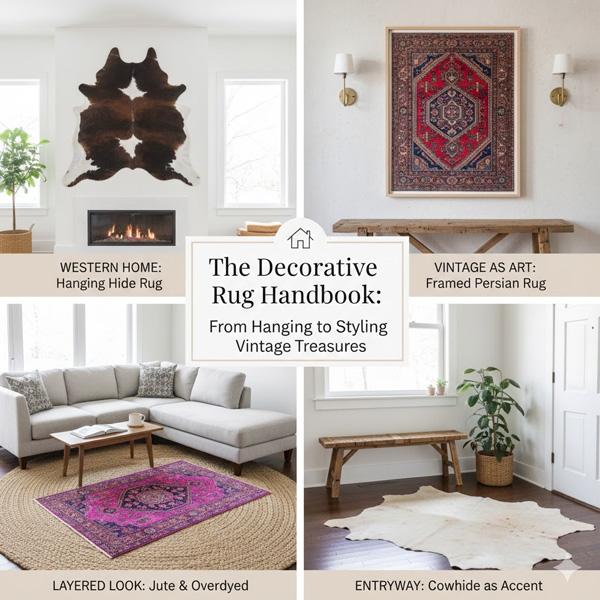
Quick-Nav Guide (Bookmark This)
- Chapter 1: The Foundation – Selecting Your Decorative Canvas
- Chapter 2: The Art of the Wall – Hanging Rugs as Tapestries
- Chapter 3: Living with History – Styling Vintage & Antique Rugs
- Chapter 4: Accent & Sculpture – Hide Rugs & Small Statement Pieces
- Chapter 5: Preservation & Care for Heirloom Pieces
- Conclusion: Your Home, Your Gallery
Chapter 1: The Foundation – Selecting Your Decorative Canvas
Before placement comes perception. Every successful decorative rug begins with intentional selection.
Purpose & Scale: Define the Role First
Ask one essential question before buying:
What is this rug meant to do?
- Focal Point: Command attention (bold pattern, strong contrast)
- Anchor: Ground furniture and space (balanced scale, quieter tones)
- Texture Layer: Add depth without visual noise
- Accent: Provide punctuation, not paragraphs
Scale Formula (Wall Hanging):
Rug width ≈ 60–75% of the wall width it occupies
This ensures presence without overpowering the architecture.
A rug that is too small feels apologetic. One that is too large feels oppressive.
The Color & Pattern Dialogue
Think of a rug not as something that matches a room—but something that initiates a conversation.
- Pull one secondary color from the rug and echo it in pillows or art
- Let a statement rug define the palette, not respond to it
- Use vintage rugs to introduce unexpected color harmonies refined by time
A rug is often the most sophisticated color editor in a room.
Texture as Narrative
Texture communicates emotion before color does.
- Wool: Warm, grounded, timeless
- Silk: Reflective, elegant, ceremonial
- Jute: Earthy, architectural, calm
- Hide: Organic, sculptural, tactile
Mixing textures creates a layered sensory experience—essential in minimal or neutral interiors.
The A–Z Rug Glossary: Your Ultimate Guide to Materials, Construction & Styles
Rug Dictionary: Demystifying Rug Types, Terms & Materials
Chapter 2: The Art of the Wall – Hanging Rugs as Tapestries
The wall is your gallery. The rug is your textile masterpiece.
Why Hang a Rug?
- Introduces softness to hard architectural planes
- Improves acoustic balance in large or minimalist spaces
- Allows rare or delicate rugs to be enjoyed without foot traffic
Historically, rugs were wall art. We are simply returning them home.
Choosing the Right Rug for the Wall
Best candidates:
- Kilim & Dhurrie rugs (flatwoven, lightweight)
- Vintage Persian or Turkish rugs with strong central medallions
- Textured weaves with visible craftsmanship
Avoid very thick pile rugs unless professionally mounted.
Hanging Methods, Demystified
Non-Invasive (Ideal for Renters & Collectors)
- Rug hanging rods
- Specialized rug clips
- Industrial-grade Velcro™ (museum-approved when applied correctly)
Permanent & Secure (For Heavier Pieces)
- Stretch-mounted frames (conservation standard)
- Anchored hooks with weight distribution
Always support weight evenly. Uneven tension damages fibers over time.
Styling the Wallscape
- Solo Statement: One rug, centered, museum-style
- Curated Cluster: Multiple smaller rugs in a grid or salon arrangement
- Mixed Media: Rug + framed art + ceramics for visual rhythm
Negative space is not emptiness—it is breathing room.
Can I Do This to My Rug? Your DIY Decision Guide to Spot Cleaning, Fringe Repair & More
Bloom Nestify’s Rug Care Academy: The Complete Guide to Cleaning, Stain Removal & Maintenance
Chapter 3: Living with History – Styling Vintage & Antique Rugs
Think of a vintage rug not as a floor covering, but as a tapestry of history.
The Allure of Patina
Patina is not wear—it is character earned through time.
- Fading creates softness no factory can replicate
- Repairs tell stories of value and care
- Color variations reflect natural dyes and human hands
Perfection is forgettable. Patina is unforgettable.
Sourcing with Integrity
Always ask:
- Has the rug been over-dyed?
- What restoration has been performed?
- Is provenance documented?
Always source vintage rugs from reputable dealers who are transparent about restoration.
Modern Meets Vintage
One of today’s most compelling design tensions:
- Antique Persian under a modern sofa
- Moroccan Berber in a concrete loft
- Turkish runner in a minimalist bathroom
Contrast is not conflict—it is sophistication.
Layering Masterclass (Verbal Formula)
Base Layer: Large neutral jute
Hero Layer: Medium vintage Persian
Accent: Sheepskin or small patterned rug at the corner
Layering protects valuable rugs and multiplies visual depth.
Chapter 4: Accent & Sculpture – Hide Rugs & Small Statement Pieces
The Organic Statement: Hide Rugs
Cowhide, sheepskin, and other hides function like sculpture.
- Embrace asymmetry
- Let natural contours remain visible
- Avoid centering—off-axis placement feels intentional and modern
Perfect for:
- Under coffee tables
- At the foot of beds
- In reading corners
Beyond the Floor
Hides and small rugs can be:
- Draped over sofas or lounge chairs
- Used as bed throws
- Hung casually over railings
This is relaxed luxury—designed, not careless.
The Power of the Small Rug
Small rugs:
- Define micro-zones (desk, vanity, entry)
- Act as visual punctuation
- Allow bolder pattern experimentation
A small rug is often where designers take their biggest risks—and win.
Chapter 5: Preservation & Care for Heirloom Pieces
Art deserves stewardship.
Caring for Decorative & Wall-Hung Rugs
- Dust gently; never beat
- Avoid direct sunlight
- Maintain stable humidity
- Rotate periodically, even on walls
A decorative rug is still a textile. Environment matters.
When to Call a Conservator
Seek professional care if you notice:
- Fiber weakness or splitting
- Insect activity
- Structural distortion
- Significant water exposure
Early intervention preserves value—and history.
Style Pairing Guide: Rugs & Design Themes
| Design Style | Ideal Rug Pairings |
|---|---|
| Mid-Century Modern | Geometric Dhurries, solid cowhide |
| Minimalist | Textured neutral kilims |
| Bohemian | Layered vintage Persians & Berbers |
| Contemporary Luxury | Silk blends, tonal statement rugs |
| Rustic Modern | Flatweaves, organic hides |
Your Home, Your Gallery
Decorative rugs do more than complete a room.
They connect emotion, memory, texture, and story within four walls.
When you treat a rug as art:
- You gain flexibility
- You gain narrative depth
- You gain a space that feels collected, not decorated
Bloom Nestify thanks you for reading our blog!
