

You’ve done the hard part: you’ve learned the language of rugs. You now understand materials, construction, backing, styles, and sizing logic. But knowledge alone doesn’t protect your floors, elevate your room, or prevent regret.
This is the moment of truth.
This is where theory meets tape measure. What follows is not inspiration. It’s a plan. Follow these phases in order, and you cannot fail.
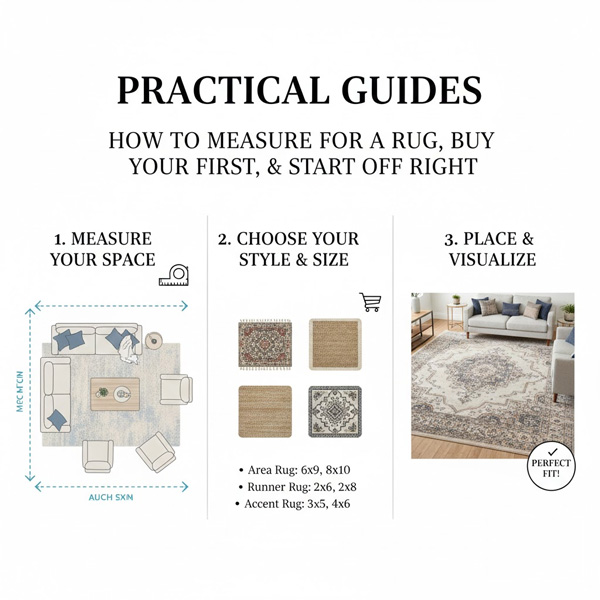
Project Overview: Your 3-Phase Rug Mastery Map
Think of this as a simple project with a clear beginning, middle, and end:
Phase 1: Measure correctly so the rug fits the job
Phase 2: Buy confidently so the rug performs as promised
Phase 3: Start care immediately so the rug lasts for years
Let’s move from knowing → doing.
Phase 1: The Perfect Fit – How to Measure Any Room for a Rug
This phase answers the most expensive question people get wrong:
“What size rug do I need?”
Stop guessing. Start assigning function and measuring deliberately.
Area Rug Placement Rules: A Foolproof Guide for Living Rooms & Bedrooms
Can a Rug Be Too Big? (And 5 Other Rug Sizing Mistakes to Avoid)
Step 1: Choose Your Layout Style (Before You Measure Anything)
Do not touch a tape measure yet.
First, decide what the rug’s job is in this room.
Ask yourself:
- Is this rug meant to anchor furniture? (Area rug)
- Is it meant to guide traffic? (Runner)
- Is it meant to add comfort or style in a small zone? (Accent)
For area rugs, choose one layout style:
- All Furniture On – Best for large rooms, formal layouts
- Front Legs On (Most Common) – Balanced, modern, forgiving
- Floating (Rare) – Only for very large rugs or layered looks
👉 If you’re unsure, choose Front Legs On. It works in 80% of homes.
Dining Room Rug Size Calculator: How to Choose (So Chairs Don’t Catch)
Step 2: Clear, Measure, and Visualize the Rug’s Footprint
Now grab:
- A tape measure
- Painter’s tape (non-damaging, removable)
Measure the usable floor area, not wall-to-wall:
- Measure from where the rug should start to where it should end
- Ignore baseboards
Then do this critical step:
Outline the rug on your floor using painter’s tape.
Walk around it.
Sit on the sofa.
Pull out a chair.
Bloom Nestify Pro Hack
Live with the taped outline for 24 hours.
If it feels too big, it’s probably perfect. If it feels small, it is small.
Rug Sizing & Selection for Living Room Layouts
Runner Rugs 101: The Right Size & Placement for Hallways, Kitchens & Stairs
Step 3: Apply the Golden Rules (Room by Room)
These rules override personal doubt.
Living Room
- Rug should extend 6–18 inches beyond the sofa
- All front legs of seating must rest on the rug
Pitfall Alert:
A “postage stamp” rug floating under only the coffee table will fracture the room visually.
Dining Room
- Measure the table
- Add 24 inches on all sides (minimum)
Why? Because chairs must stay on the rug when pulled out.
Pitfall Alert:
If chair legs catch the rug edge, the rug is too small — period.
Bedroom
- Rug should extend 18–24 inches beyond the sides and foot of the bed
Common options:
- One large rug under the bed
- Two accent rugs as bedside landing pads (budget-friendly)
Sectional Sofa Rug Sizing: The Definitive Guide for L-Shaped and U-Shaped Layouts
The Definitive Guide to Rug Sizes & Placement for Every Room
Step 4: Select a Standard Size (Then Size Up)
Rugs come in standard sizes for a reason:
- 5×8
- 6×9
- 8×10
- 9×12
The Golden Rule:
👉 If you’re between sizes, go up one size.
A rug that’s slightly too big feels intentional.
A rug that’s too small feels like a mistake.
The Ultimate Rug Sizing & Placement Guide
Visual Guide: How Big Are Common Rug Sizes? (3×5, 5×7, 6×9 & More)
Phase 2: The Confident Purchase – Your Pre-Buy Checklist & Inspection Guide
This phase prevents buyer’s remorse.
Whether online or in-store, you are now performing a professional-level audit.
A. The Online Listing Checklist (Before You Click “Buy”)
Use your glossary knowledge. Do not skim.
Confirm:
- Material is clearly stated (wool, cotton, synthetic — not “fabric”)
- Construction is named (hand-knotted, tufted, flatweave)
- Backing is disclosed (avoid vague “latex-coated” language)
- Pile height is specified
- Reviews mention shedding, odor, or colorfastness (read the bad ones)
Pitfall Alert:
If critical information is missing, assume the worst — or ask before buying.
What Size Rug for a Queen Bed? (And King, Full, Twin) – Layouts That Work
What Size Rug Under a Couch? Rules for Standard Sofas, Loveseats & Sectionals
B. The In-Person 5-Minute Rug Audit (If Shopping Physically)
This is your hands-on inspection. Do all five steps.
1. The Touch Test
- Press your fingers into the pile
- Feel density, resilience, and softness
- Check if the backing feels stable or flimsy
Dense pile = longer wear.
2. The Sniff Test
- Smell the rug closely
Red flag: strong chemical or plastic odor
This indicates off-gassing and poor indoor air quality.
Walk away.
3. The Flip Test
- Turn the rug over
Look for:
- Clear structure
- Even stitching
- No excessive glue or cracking backing
This is where quality hides.
4. The Pattern Check
- Look closely at the design
Is it:
- Woven (pattern visible through fibers)?
- Or printed (pattern sits on top)?
Printed rugs fade faster and show wear sooner.
5. The Document Check
- Look for care tags or documentation
- Confirm cleaning instructions match your lifestyle
If care instructions are vague, that’s not confidence — it’s a gamble.
C. The Final Decision Matrix
Balance three things:
- Style & Origin – Does it fit your room’s story?
- Performance – Can it handle traffic, pets, kids?
- Budget Reality – Spend more on size and material, less on trendiness
A simple truth:
A well-sized, well-made neutral rug outperforms a trendy rug that’s too small.
Phase 3: The Right Start – The “First 90 Days” Care Protocol
Most rug damage happens early — not years later.
This phase locks in longevity from day one.
Week 1: Unboxing & Settlement
Step 1: Unroll Carefully
- Do not force curled corners flat
- Let gravity do the work
Step 2: Air It Out
- If there’s any odor, air in a ventilated space for 24–48 hours
Step 3: First Vacuum
- Use suction-only (no beater bar yet)
- Vacuum with the pile, not against it
Expect initial shedding.
This is normal for wool and quality rugs.
Month 1: Establishment
Vacuum Routine
- 1–2 times per week for high-traffic areas
- Introduce beater bar only if recommended for your rug type
First Spill Protocol
- Blot immediately (do not rub)
- Use clean water and a white cloth
- Press, lift, repeat
Prepare a spill response kit now:
- White cloths
- Mild detergent
- Plain water
Critical Step:
Rotate the rug 180 degrees once in the first month.
Months 2–3: Integration
- Establish consistent vacuum schedule
- Confirm rug pad is properly fitted
- Check corners and edges for curling
- Adjust furniture placement if needed
Plan ahead:
- Schedule a professional cleaning assessment for the 12-month mark
Preventive care is cheaper than repair.
Your Rug Mastery Journey – What’s Next?
You are no longer a beginner.
You know how to:
- Measure with intent
- Buy with confidence
- Care with discipline
That makes you a custodian, not just an owner.
From here, you can:
- Refine care techniques by material
- Explore collecting by style or region
- Layer rugs with confidence
- Protect floors proactively
And you don’t have to do it alone.
