

Here’s the core truth that unlocks everything: oil and water don’t mix.
That’s why grease stains laugh at your instinct to grab water and a cloth. Oil is hydrophobic—it actively repels water—so instead of rinsing away, it clings to rug fibers like glue.
But chemistry gives us an advantage. At Bloom Nestify’s Rug Care Academy, we don’t fight oil with more water. We outsmart it. We either:
- Absorb it (pull it out of the fibers like a sponge), or
- Emulsify it (break it into tiny droplets that water can carry away), or
- Dissolve it (for the toughest, oldest stains).
This guide is your applied chemistry lab—designed for real homes, real rugs, and real messes, from cooking oil splatters to body lotion and makeup.
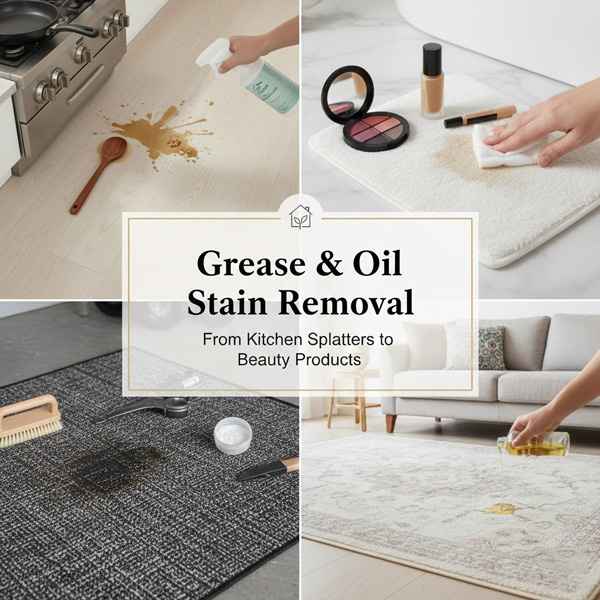
The Golden Rule — Scrape & Blot, NEVER Rub
Before chemistry, discipline.
STEP 0: Scrape (If the Oil Is Solid)
For butter, animal fat, or thick grease:
- Use a plastic spoon or dull edge
- Gently lift excess material off the rug
- Do not press it in
STEP 1: Blot, Don’t Rub
- Use white paper towels or white cloths
- Press straight down
- Lift, rotate to a clean area, repeat
Why this matters:
Rubbing increases surface area and penetration, driving oil deeper into the fiber structure and making removal exponentially harder.
Golden Rule:
If you rub, you bond the stain. If you blot, you remove it.
Your Grease Stain Solver Matrix (by Oil Type)
| Oil Type | Immediate Action | Primary Solver | Advanced Tactic (Test First) |
|---|---|---|---|
| Cooking / Vegetable Oil | Blot + Powder | Dish Soap Solution | Isopropyl Alcohol |
| Animal Fat / Grease | Scrape + Powder | Dish Soap Solution | Repeat Absorbent Cycle |
| Butter | Scrape + Powder | Dish Soap | — |
| Mineral Oil (Lotion, Makeup) | Blot + Powder | Dish Soap | Rubbing Alcohol |
| Heavy / Old Grease | Powder (Overnight) | Dish Soap | Professional Solvent |
This matrix exists for one reason: not all oils behave the same. Viscosity, polarity, and age all matter.
Dog Urine on Your Rug? The Step-by-Step Rescue Guide for Wool & Cowhide
Method 1 — The Absorbent Powder Strategy
(Safest for All Rugs, Especially Wool)
Formula Box: The Cornstarch / Baking Soda Poultice
What You Need
- Cornstarch or baking soda or talcum powder
- Vacuum cleaner
Steps
- Cover the stain generously (extend beyond the visible edge).
- Lightly press the powder into the fibers—do not grind.
- Leave undisturbed for 4–6 hours minimum (overnight is ideal).
- Vacuum thoroughly.
- Repeat if discoloration remains.
Why It Works (The Science)
These powders have massive microscopic surface area. Oil molecules adsorb onto the powder particles, migrating out of the fiber over time.
Think of it as passive extraction—slow, gentle, and extremely effective.
Pro Insight:
If the powder turns yellow or gray, it’s working. That color was in your rug.
Method 2 — The Surfactant Strategy
(Emulsification for Fresh or Semi-Fresh Stains)
Formula Box: The Diluted Dish Soap Elixir
What You Need
- Clear dish soap (no lotion, no fragrance boosters)
- Warm water
- White cloths
Exact Ratio (Critical):
1 drop of dish soap to 1 cup of warm water
Steps
- Mix gently—do not over-foam.
- Dampen (not soak) a white cloth with the solution.
- Blot the stain from the outside inward.
- Let dwell 5–10 minutes.
- Blot repeatedly with a cloth dampened in plain water to rinse.
- Blot dry.
Why It Works (The Science)
Dish soap contains surfactants—molecules with a water-loving head and oil-loving tail. They surround oil droplets, forming micelles, allowing water to carry oil away.
This is emulsification: controlled, elegant chemistry.
Key Principle:
More soap ≠ more cleaning. Excess soap leaves residue that attracts dirt.
Method 3 — The Solvent Strategy
(For Stubborn, Old, or Cosmetic Oils — Use with Respect)
⚠️ Always test in an inconspicuous area first.
Formula A: Rubbing Alcohol for Mineral Oils
Best For
- Lotion
- Makeup
- Hair oil
- Sunscreen
Steps
- Lightly dampen a white cloth with 70% isopropyl alcohol.
- Blot gently—do not saturate.
- Oil will transfer to the cloth.
- Rinse area with plain water (blot).
- Blot dry.
Why It Works
Mineral oils dissolve readily in alcohol due to similar polarity. This is like dissolves like—a fundamental chemical rule.
Can I Bleach My White Rug? Safe Alternatives for Brightening & Stain Removal
Formula B: Dry Cleaning Solvent (Professional Tier)
Mentioned for completeness only. These solvents require controlled application and ventilation. This is where professionals step in.
>> Laughing Buddha with Five Children Statue – 3.3 ft Huong Stone Wood
Special Considerations — Material Matters
Wool & Natural Fiber Rugs
- Start and often end with absorbent powder
- If using dish soap: ultra-dilute, minimal moisture
- Avoid alcohol, peroxide, and aggressive solvents
- Wool fibers swell with water and trap residues
Rule for Wool:
When in doubt, stop early and repeat gently later.
Synthetic Rugs (Nylon, Olefin, Polyester)
- Can tolerate all three methods
- More resistant to solvents and agitation
- Easier to rinse clean
Advantage of Synthetics:
Lower absorption + higher chemical resistance = wider tactical options.
Ink & Marker Magic: How to Lift Pen Stains from Your Carpet
Red Wine on the Rug? Don’t Panic, Follow These Steps for Wool & Synthetics
The General Action Flowchart (In Plain English)
Is there excess oil?
→ Scrape + blot
Is the stain fresh?
→ Absorbent powder first
Still visible?
→ Dish soap solution
Cosmetic or mineral oil?
→ Alcohol (test first)
Still there after drying?
→ Repeat powder or call a professional
Never jump steps. Chemistry rewards patience.
From Stain to Story — Be Prepared, Not Scared
The Philosophy Recap
- Never rub oil
- Absorb first
- Emulsify second
- Dissolve only when necessary
- Understanding the stain beats brute force every time
Bloom Nestify thanks you for reading our blog!
