

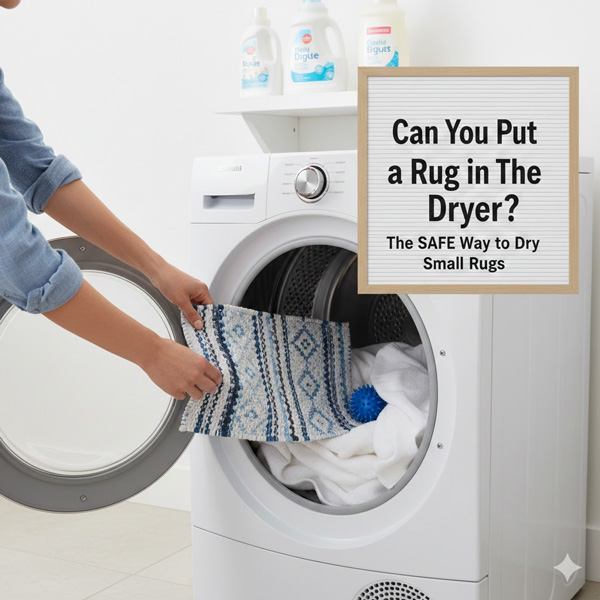
It’s a familiar scene. A bathroom mat fresh from the washer. A small runner you just spot-cleaned. A doormat soaked after a storm. The rug is clean—but now it’s heavy, damp, and sitting on your laundry room floor. The dryer is right there. Warm. Fast. Convenient. And that’s when the real question hits:
Can you put a rug in the dryer without destroying it?
Your dryer is a centrifugal force tornado with a heating element. Some rugs can survive that environment. Most cannot. This guide will help you decide—clearly, decisively, and based on physics, not guesswork.
The Dryer Readiness Quiz (Read This First)
Answer YES to all of the following to even consider using a dryer:
- ✓ Is the rug small (under 3′ x 5′) and able to tumble freely?
- ✓ Is it made of synthetic fibers (polypropylene, polyester, nylon)?
- ✓ Is it machine-woven, not hand-woven or tufted?
- ✓ Does it have a solid rubber or latex backing (not fabric or felt)?
- ✓ Does it have no fringe, no tassels, no glued elements, no delicate pile?
If you answered NO to any question, stop.
The dryer is off-limits. Skip ahead to safer drying methods.
This isn’t about being gentle.
It’s about preventing irreversible structural collapse.
>> Can I Use a Carpet Cleaner on My Area Rug? The Dos and Don’ts
The Quick Answer: A Size & Material Checklist
Let’s be binary and honest:
Small, synthetic rugs (bath mats, kitchen mats, outdoor runners under 3′ x 5′)
→ YES, but only under strict conditions.
Medium rugs (around 5′ x 8′)
→ NO dryer. Flat drying only.
Large area rugs (8′ x 10′ and above)
→ Absolutely not. Professional drying is the only structurally safe option.
If you’ve ever searched “rug shrank in dryer”, this is where those stories begin—when size and construction are ignored.
The Three Killers Inside Your Dryer: Heat, Agitation, and Restriction
To understand why dryers ruin rugs, you need to understand the forces at work.
Killer #1: High Heat
Heat doesn’t just “dry.” It changes materials.
- Wool: Heat + moisture = felting. Fibers interlock permanently, causing dramatic shrinkage.
- Cotton & jute: Heat weakens cellulose fibers, leading to brittleness and tearing.
- Tufted rugs: Heat softens or melts the latex glue holding fibers in place. Once that bond fails, shedding and bald spots are inevitable.
Bloom Nestify Forensics Note:
Case #7614: A wool accent rug dried on “medium.” Result: 18% shrinkage and puckered backing. Damage was permanent.
Killer #2: Mechanical Agitation (Tumbling)
Dryers don’t “spin.”
They drop.
Every rotation lifts the rug and slams it down. If the rug is too large or heavy:
- Fringe gets wrapped, snapped, or torn out.
- Edges experience repeated impact stress.
- Fibers abrade against the drum, accelerating wear.
If a rug can’t tumble freely, agitation turns destructive.
Killer #3: Restrictive Drying (The Silent Destroyer)
This is the most misunderstood force.
When a rug is too large for the drum, it can’t expand and contract evenly as moisture evaporates. The result:
- Internal tension builds.
- Seams stretch.
- Warp threads snap.
Bloom Nestify Forensics Note:
Case #8821: A 4′ x 6′ cotton rag rug forced into a dryer. High heat + restricted movement caused a full-length tear down the center. Total loss.
The “Do” Protocol: How to Dry a Small Rug in a Dryer Safely
If—and only if—your rug passed the readiness quiz, follow this exact protocol.
We are trading convenience for control.
Step 1: Pre-Dry Extraction
Before the dryer ever turns on:
- Lay the rug flat.
- Roll it tightly in clean towels.
- Step on the roll to transfer moisture into the towels.
Less water = less stress inside the dryer.
Step 2: Dryer Prep
- Clean the lint trap completely.
- Add dryer balls (not dryer sheets).
Dryer balls improve airflow and reduce static without coating fibers.
Step 3: Select the Correct Settings
This is non-negotiable.
- Best option: NO HEAT / AIR FLUFF
- If heat is required: PERMANENT PRESS or LOW HEAT only
Never use:
- High heat
- Timed dry on “cotton”
- Sanitize cycles
Step 4: Time & Monitoring
- Set the cycle for 10–15 minutes max.
- Stop and check every cycle.
- The moment the rug is dry to the touch, remove it.
Residual warmth will finish evaporating remaining moisture outside the dryer.
Step 5: Final Shape Reset
Lay the rug flat and gently:
- Square the corners
- Smooth the edges
- Let it cool completely
This prevents heat-set distortion.
The “Don’t” Scenario: Why Large Rugs Require a Different Universe of Care
Trying to dry a large rug in a dryer creates three guaranteed outcomes:
The Physics Problem
A large rug will wrap around the drum instead of tumbling. This concentrates force in one area, overstressing fibers and seams.
The Mildew Guarantee
Thick rugs dry from the outside in.
When bunched, the center stays damp—perfect conditions for mildew within 24–48 hours.
Appliance Damage
We’ve seen dryers destroyed by water-logged rugs that became unbalanced mid-cycle.
This is not a gray area.
Drying large area rugs at home with heat is structurally unsound.
The Right Tool for the Job: Drying Methods Sized Right
Drying Method Decision Tree (Text Description)
- Rug under 3′ x 5′?
- Yes → Check fiber type
- No → Flat or professional drying
- Synthetic fiber?
- Yes → Dryer protocol (low/no heat)
- No → Flat or professional drying
- Natural or delicate fibers?
- → Flat drying (medium) or professional facility (large)
For Small Rugs (Dryer-Safe)
- Follow the Do Protocol exactly.
- Never leave unattended.
- Never exceed low heat.
For Medium Rugs (Around 5′ x 8′) — Flat Drying Guide
Flat drying is mandatory.
How to do it safely at home:
- Lay the rug flat on a clean surface.
- Elevate it using rails, chairs, or a drying rack underneath.
- Use fans for cross-ventilation.
- Flip every 4–6 hours.
- Ensure even airflow above and below.
This method respects gravity and fiber tension.
For Large Rugs (8′ x 10′ and Above) — Professional Territory
Professional rug drying is not a luxury.
It’s the only method that respects scale and structure.
At Bloom Nestify, professional drying includes:
- High-capacity water extraction
- Flat, climate-controlled drying rooms
- Horizontal airflow from below
- Continuous humidity monitoring
- Periodic tension adjustment to maintain shape
This prevents shrinkage, warping, and microbial growth.
Respect the Mass, Preserve the Asset
Drying a rug is not about speed.
It’s about managing heat, moisture, and tension.
Small, synthetic rugs can survive a dryer only under strict controls.
Medium rugs demand patience and flat drying.
Large rugs require professional environments designed for their mass and construction.
Choose the wrong method, and the damage is often catastrophic—and irreversible.
