

Your area rug doesn’t look terrible—just dull. Traffic lanes are visible. Maybe there’s a lingering odor. In the closet or garage sits a familiar promise: a home carpet cleaner or shampooer. Bissell. Hoover. A quick rental from the grocery store. Let’s be blunt.
Your home shampooer is designed for wall‑to‑wall carpet—not for most area rugs. Using it on the wrong rug isn’t deep cleaning. It’s a controlled flood. As textile scientists and cleaning specialists, we see the aftermath weekly. The intention is good. The result is often irreversible. This guide gives you a binary, engineer‑level answer: yes, but only if—or absolutely not.
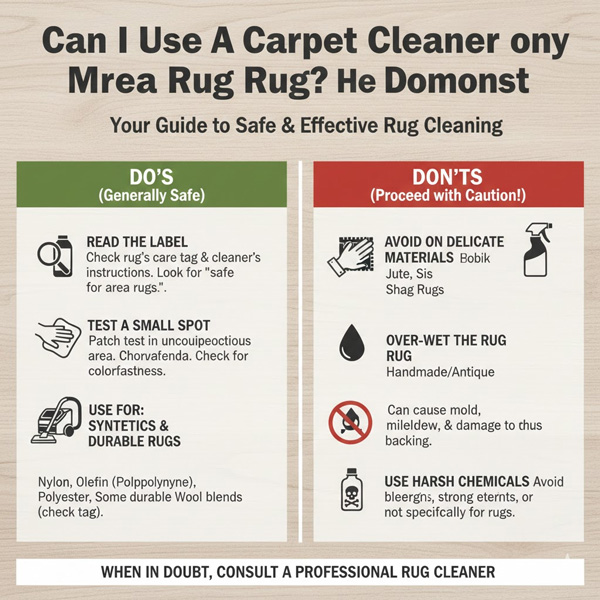
60‑Second Risk Assessment
❌ STOP — Do NOT use a carpet cleaner if your rug has ANY of the following:
- Hand‑knotted or hand‑tufted construction
- Wool, silk, viscose, cotton, or other natural fibers
- A fabric, jute, felt, or canvas backing
- Fringe (especially sewn‑on fringe)
- High pile or shag texture
- Antique, vintage, heirloom, or sentimental value
If even one box is checked, put the machine away.
✔️ PROCEED WITH EXTREME CAUTION ONLY IF your rug has ALL of the following:
- Machine‑woven (not tufted)
- Synthetic fibers only (polypropylene/olefin is safest)
- Low to medium pile
- Solid, non‑absorbent rubber or latex backing
- Inexpensive and easily replaceable
If this describes your rug exactly, continue—slowly.
>>> Can You Put a Rug in the Dryer? The Safe Way to Dry Small Rugs
The Ultimate Rule: Why Most Area Rugs Fail the Shampooer Test
A home carpet cleaner works by:
- Forcing large volumes of water and detergent into fibers
- Agitating mechanically
- Extracting some of the moisture back out
Wall‑to‑wall carpet is glued to a subfloor and dries upward. Area rugs are freestanding textiles with backs, edges, warps, and bindings that trap moisture.
This difference is everything.
Overwetting is the root cause of:
- Dye migration and bleed
- Shrinkage and buckling
- Latex breakdown
- Mold and mildew
- Structural rot in warp threads
Once these start, they cannot be undone.
The “Do” Protocol: A Safe Step‑by‑Step Guide (Approved Rugs Only)
Follow this checklist to the letter—or do not proceed.
Step 1: Pre‑Vacuum Thoroughly
Dry soil turns into mud when wet.
- Vacuum both sides if possible
- No beater bar
- Multiple slow passes
Skipping this step guarantees poor results.
Step 2: Solution & Dilution
- Use manufacturer‑approved solution only
- Dilute more than instructed for carpet (at least 25–50% weaker)
- Never use vinegar, bleach, ammonia, or DIY mixes
More soap ≠ cleaner. It equals residue.
Step 3: The Golden Rule of Moisture
Never saturate.
- Use minimal solution
- One slow wet pass only
- Follow with two to three dry suction passes
If the backing feels damp—not just cool—you are using too much water.
Step 4: Drying Is Everything
Drying must complete within 6–12 hours.
- Elevate the rug on blocks or a drying rack
- Use fans on both sides
- Add a dehumidifier
If it still feels damp the next morning, damage has already begun.
The “Don’t” Disasters: What Happens When the Rules Are Broken
Disaster 1: The Drowned Handmade Rug
Handmade rugs rely on cotton or wool warp threads.
What happens:
- Water wicks deep into the foundation
- Dyes migrate laterally
- Shrinkage pulls the rug out of square
Result: Structural distortion and color bleed—permanent.
Disaster 2: The Delaminated Tufted Rug
Hand‑tufted rugs are held together with latex adhesive.
What happens:
- Moisture re‑emulsifies the glue
- Face fibers detach from the backing
Bloom Nestify Autopsy Report:
Rug #7432: Latex backing dissolved from overwetting. Fiber shedding progressed within weeks. Result: Total loss.
Disaster 3: The Mildew Farm
Dense piles trap moisture internally.
What happens:
- Incomplete drying creates microbial growth
- Odors become permanent
- Health risks emerge
Surface dryness is misleading. Mold grows from the inside out.
Cost Comparison: The Real Math
Described Infographic
- Home shampooer rental: $40–$60
- Replacement synthetic rug: $150–$300
Versus:
- Water‑damaged hand‑tufted wool rug repair: $1,200+ (if salvageable)
- Antique rug damage: Often total loss
The savings are an illusion.
A Safe DIY Alternative for Light Soil
If your rug is lightly soiled but fails the shampooer test:
- Vacuum regularly
- Spot clean spills only
- Use dry compound cleaning designed for area rugs
- Rotate rug for even wear
These methods reduce soil load without introducing dangerous moisture.
The Professional Deep Clean: How It’s Done Right
Professional rug cleaning is not scaled‑up DIY. It is a different discipline.
The Difference
- Full fiber and dye testing
- pH‑controlled immersion washing
- Thorough rinsing
- Hydraulic extraction (far beyond home machines)
- Climate‑controlled drying rooms
This is the only safe deep‑clean method for:
- Handmade rugs
- Wool or silk rugs
- Tufted construction
- Valuable or sentimental pieces
When in Doubt, Dry It Out
The convenience of a home carpet cleaner is rarely worth the risk.
If your rug doesn’t meet every strict criterion, do not gamble. A shampooer can shorten a rug’s life from decades to months.
