

It happens in an instant. A vacuum catches an edge and pulls a thread you can’t unsee. A single ember pops from the fireplace and lands where it shouldn’t, leaving a dark whisper of smoke on the pile. Your first instinct is to fix it—now. Your second instinct is fear: What if I make it worse?
Take a breath. Step away from the glue. This guide is your calm, clinical path forward—a triage manual for rug injuries. We’ll assess the wound, decide whether it’s a scrape or a broken bone, apply safe first aid when appropriate, and draw a bright line where DIY ends and professional, invisible restoration begins. Our goal is not just to fix it—but to fix it so the damage disappears.
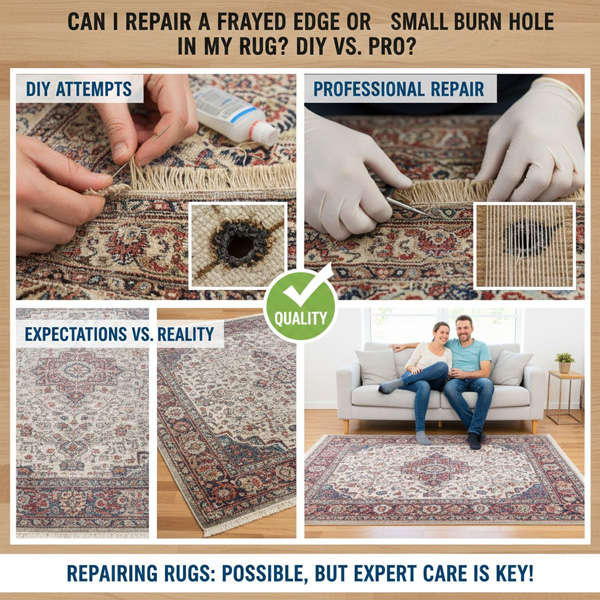
Rug Repair Triage Chart
| Symptom | Verdict |
|---|---|
| Fraying on sewn-on, decorative fringe | DIY: Re-sew and stabilize |
| Fraying on the main body’s edge (no separate fringe) | PRO: Structural repair required |
| Small surface-level singe on synthetic pile | DIY: Careful trimming only |
| Through-and-through burn hole or burn on wool/natural fiber | PRO: Reweaving / re-knotting |
Step 1: Triage – Is This a DIY or Pro Repair?
The Guiding Principle:
If the damage affects only non-structural, decorative elements (like an added fringe) or is a surface-level issue, cautious DIY may be appropriate. If the injury touches the primary backing, warp threads, or knot structure, DIY becomes destructive. A drop of glue in the wrong place can turn a repairable flaw into a permanent disaster.
Think like a clinician: Where is the injury, and what system does it affect?
>>> Can I Re-Dye or Color-Correct a Faded or Stained Rug? The Truth About Transforming Color
Case Study: The Frayed Edge – From Simple Fringe to Structural Failure
Frayed edges are the most common—and the most misunderstood—rug injury. The diagnosis hinges on one critical question: Is the fringe decorative, or is it structural?
Damage Assessment Checklist
- Is there a separate fringe strip sewn on after the rug was made? (Common in machine-made rugs.)
- Or are the fraying threads the continuation of the rug’s own lengthwise warp threads? (Typical of handmade rugs.)
- Is the fray localized, or is it spreading along the edge (selvage)?
Clinical note: If the fringe is the warp, pulling threads is equivalent to breaking bones. Stop.
The “First Aid” DIY Protocol (For Sewn-On Fringe Only)
If—and only if—the fringe is decorative and sewn on:
- Stabilize: Apply a pin-head amount of clear, flexible, water-based fabric glue at the base of the unraveling threads. Avoid soaking the fibers.
- Secure: With a tapestry needle and strong matching thread, whip-stitch along the fringe attachment point to re-anchor it.
- Trim: Neatly trim loose ends with sharp scissors. No tugging.
This is a bandage. It prevents further unraveling; it does not rebuild structure.
The DIY Toolkit for Minor Issues
- Sharp scissors (fabric-only)
- Tapestry needle & matching thread
- Fray Check (sparingly, on decorative fringe only)
- Aleene’s Fabric Fusion (clear, flexible)
Bloom Nestify Restoration Vault — Cautionary Tale:
A client used super glue on a wool fray. Result: a hard, glossy stain that attracted dirt and made professional reweaving impossible. The repair area became permanent damage.
The Professional Restoration Process (For Integral Fringe / Body Damage)
When the fray involves the rug’s body or selvage:
- Analysis: We map the path of broken warp threads.
- Re-threading: Broken warps are re-anchored to the selvage to halt unraveling.
- Re-weaving: The edge structure is recreated—often using yarn harvested from a hidden area—so tension, density, and color match perfectly.
Bloom Nestify Restoration Vault — Before/After:
An heirloom rug with unraveling integral fringe restored to a crisp, stable edge with no visible seam. The repair vanished; the value returned.
Case Study: The Burn Hole – Surface Singe vs. Structural Ash
Burns look dramatic, but the diagnosis is precise. What burned—the pile tips or the foundation?
Damage Assessment Checklist
- Are only the tips of the pile fibers melted or blackened?
- Is there a hole through the rug, with charred backing visible?
- What is the fiber type? (Synthetic melts; wool chars and weakens.)
>>> DIY Rug Surgery: Can You Cut a Rug to Fit Your Space?
The “First Aid” DIY Protocol (For Surface Singe on Synthetic Only)
For small, surface-level singes on synthetic fibers:
- Ventilate: Work outdoors or in a well-ventilated area.
- Scrape: Gently remove any melted bead with a dull knife blade.
- Trim: Using very sharp scissors, carefully trim discolored tips level with the surrounding pile.
Expectation check: This leaves a slight dip. It’s a cosmetic compromise, not invisibility.
Warning: Do not apply heat, solvents, or glue. Melted synthetics reharden; glue locks in damage.
The Professional Restoration Process (For Holes & Natural Fibers)
For burns in wool/natural fibers or any full-thickness hole:
- Prepare the Site: The damaged area is cleaned and squared.
- Patch Grafting: A donor patch (from a remnant or unseen area) is integrated. Pile is re-knotted or re-tufted, knot-by-knot.
- Color Matching: Custom dyeing ensures perfect blend across age and wear.
Bloom Nestify Restoration Vault — Invisible Mending:
A 1-inch fireplace ember hole restored via re-knotting. Under raking light, the repair is undetectable. Underfoot, the density matches.
Making the Call: Cost, Value, and Sentiment
The Equation
- Professional repair cost vs. replacement cost
- Sentimental value (heirloom, gift, memory)
- Risk of DIY (can the damage be reversed?)
Rule of Thumb
- Handmade, antique, or sentimental rugs: Professional repair preserves essence and longevity.
- Low-cost, machine-made rugs with major damage: Replacement may be more economical.
>>> Can I Iron or Steam a Wrinkled or Creased Rug? How to Flatten It Safely
Cost Snapshot: 1-Inch Burn Hole (Mid-Range Rug)
DIY: $15–$40 (tools)
Risk: High. Outcome: Visible dip; color mismatch likely.
Professional: $150–$300 (re-knotting, color match)
Risk: Low. Outcome: Invisible; value preserved.
The Goal Is Invisibility
Successful repair is measured by what you don’t see. DIY can provide safe first aid for minor, non-structural issues. True restoration—where pile, structure, and color heal as one—is a professional art form. Respect the rug’s anatomy, and it will reward you with decades more life.
