

You remember the color it used to be. A deep indigo, warm rust, or soft ivory that once anchored the room. Years of sunlight, foot traffic, or a single stubborn stain have dulled that memory. Now you’re left with a question that feels almost irresistible:
“Can’t I just put the color back?”
The fantasy is understandable—dip the rug into a vat of rich dye, lift it out transformed, reborn. But here is the first, most important truth:
Dye is not paint. It is a molecular bond, not a surface cover.
This guide is the necessary reality check. As a Master Colorist and Dye Chemist, I’ve seen what hope looks like after it collides with chemistry. A faded rug has a story. A badly re-dyed rug has a tragedy. Let’s talk honestly about what is chemically possible, what is professionally achievable, and what should never be attempted at home.
Should You Even Consider It? — The Color Intervention Decision Matrix
Is your rug made of 100% uniform, natural fiber (e.g., all wool)?
→ NO → STOP. Re-dyeing is not viable.
YES ↓
Is the damage isolated (stains, sun spots, borders)?
→ YES → Consider Professional Color Correction (spot treatment).
NO ↓
Is the issue overall, even fading across the entire rug?
→ YES → Maybe a candidate for professional assessment only.
→ NO → Re-dyeing will make it worse.
At-home dye kits are not an option at any point in this chart.
The Hard Chemistry: Why “Re-Dyeing” a Whole Rug Is a Fantasy (For Almost Everyone)
Let’s dismantle the myth with facts.
Myth vs. Reality
Myth: “I can use RIT dye in my bathtub.”
Reality: This creates uneven penetration, dye migration, damaged backing, and a permanently blotchy rug.
Myth: “I’ll just dye it darker to cover the fade.”
Reality: Original dye remains uneven underneath. New dye overlays unpredictably, producing muddy, dead color.
Myth: “If it works on clothes, it will work on rugs.”
Reality: Rugs are dense, multi-layered textile structures. Clothing is not.
>>> Can I Iron or Steam a Wrinkled or Creased Rug? How to Flatten It Safely
Why DIY Re-Dyeing Fails — Every Time
Dyes Are Fiber-Specific
- Wool & nylon require anionic (acid) dyes
- Polyester requires disperse dyes
- Polypropylene (olefin)? Nearly undyeable
Most rugs are blends or synthetics. Dye chemistry does not negotiate.
You Cannot Remove the Original Dye
Stripping dye evenly without destroying fiber strength is almost impossible. What remains is a patchwork of old and new color—chemically unstable and visually chaotic.
Penetration Is the Enemy
Rugs are thick. Dye must reach the base of the pile and foundation evenly. Home methods cannot control:
- Temperature
- pH
- Time
- Agitation
Result: surface saturation, core starvation, streaking.
The Backing Will Suffer
Latex, adhesives, and secondary backings are not dye-safe. Once compromised, delamination begins.
Bloom Nestify Color Lab Post-Mortem:
A client dyed a polypropylene rug using fabric dye. The dye didn’t bond, rinsed out unevenly, and left permanent water rings. The fade remained. The rug was irreversibly damaged.
When Color Work Is Possible: The Viability Checklist
Professional color work is selective, not universal.
Viable Conditions
- Fiber content: 100% wool (best case)
- Structure: Strong, intact foundation
- Damage type: Isolated stains, sun bleaching, border fade
- Goal: Correction, not transformation
>>> DIY Rug Surgery: Can You Cut a Rug to Fit Your Space?
Deal-Breakers
- Mixed fibers
- Synthetic rugs
- Severe bleach damage
- Desire to change color entirely
- Weak or degraded foundation
We are not wizards. We are chemists with very specific formulas.
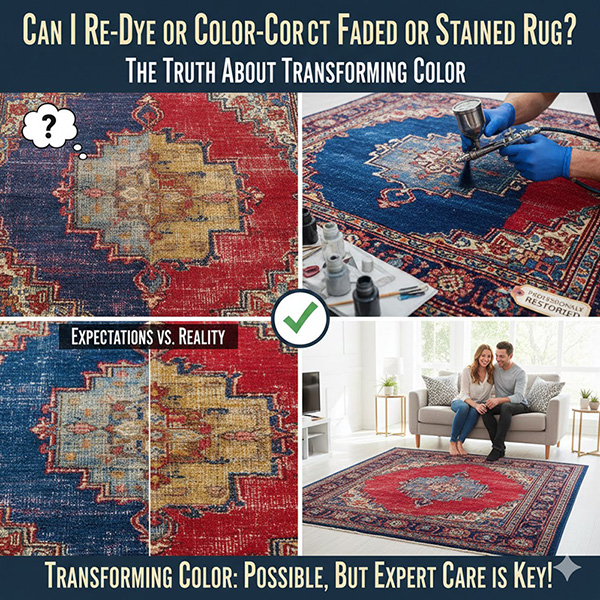
Path A: Professional Color Correction (For Stains & Spot Fading)
This is where real magic—grounded in science—can happen.
What Color Correction Is
- Localized
- Targeted
- Microscopic
- Reversible when done correctly
>>> Can I Repair a Frayed Edge or a Small Burn Hole in My Rug? DIY vs. Pro
The Process (In the Lab)
- Analysis
A handheld spectrophotometer reads surviving dye molecules to reconstruct the original formula. - Custom Mixing
Dyes are blended in micro-batches, accounting for fiber age, oxidation, and light exposure. - Application
Using syringe injectors, micro-brushes, or air pens, dye is applied only to affected pile tips—never the foundation. - Setting
Controlled steam sets the dye bond without spreading or bleeding.
Ideal For
- Sun-bleached corners
- Chemical stains
- Border rejuvenation
- Localized fading
Professional Color Correction: The Tools (Text Infographic)
• Handheld spectrometer
• Syringe injectors
• Micro brushes
• Steam-setting chamber
• Custom dye library
Path B: The Myth of the Home Dye Kit & the Reality of Professional Immersion Dyeing
The DIY Illusion
Bathtubs lack:
- Uniform heat
- Proper agitation
- Stable pH
- Rinse control
Result: streaks, rings, bleed-through, stiff pile, ruined backing.
The Professional Reality (Rare, Risky, Final)
Immersion dyeing is an industrial process:
- Massive temperature-controlled vats
- Continuous circulation pumps
- Full chemical monitoring
It is sometimes used to:
- Over-dye severely faded all-wool rugs
- Salvage rugs by turning them a uniform dark color (e.g., black)
This permanently alters the rug’s character.
It is expensive. It is risky. It is irreversible.
Cost vs. Outcome Analysis
- DIY Kit: $20–$40 | High risk | Catastrophic outcomes common
- Professional Cleaning / Spot Correction: $150–$600 | Low risk | High success
- Professional Immersion Dyeing: $2,000+ | Very high risk | Alters value & identity
The Wiser Alternatives: Cleaning, Repair, and Embracing Patina
Deep Professional Cleaning
Up to 80% of perceived fading is dirt. Embedded soil dulls color dramatically. Cleaning is always step one.
Strategic Repair
Reweaving a stained area with correctly dyed yarn often yields better results than dyeing the stain itself.
Embracing Patina
In handmade rugs, natural color variation—abrash—is celebrated. It is proof of age, authenticity, and life. Sometimes the most elegant solution is acceptance, not alteration.
Honoring the Fiber’s History
Color in rugs is chemistry shaped by time and light. While professional color correction can skillfully address specific flaws, the dream of total color renewal is usually a chemical impossibility.
Seek truth, not just color.
