

Your heart sinks when it happens. A glass tips over. A pet has an accident. You notice a loose fringe thread you swear wasn’t there yesterday. In that moment, one thought takes over: “Can I handle this myself… or am I about to make it worse?”
At Bloom Nestify’s Rug Care & Cleaning, we see both outcomes every week. Some issues truly are small scrapes—a bandage is enough. Others are internal injuries, and a well-meaning DIY attempt can turn a manageable problem into permanent damage.
This guide exists for that exact moment of uncertainty. It is designed to set clear, science-based boundaries between what is safe DIY and what requires professional conservation. Think of this as your calm, trusted voice before you act.
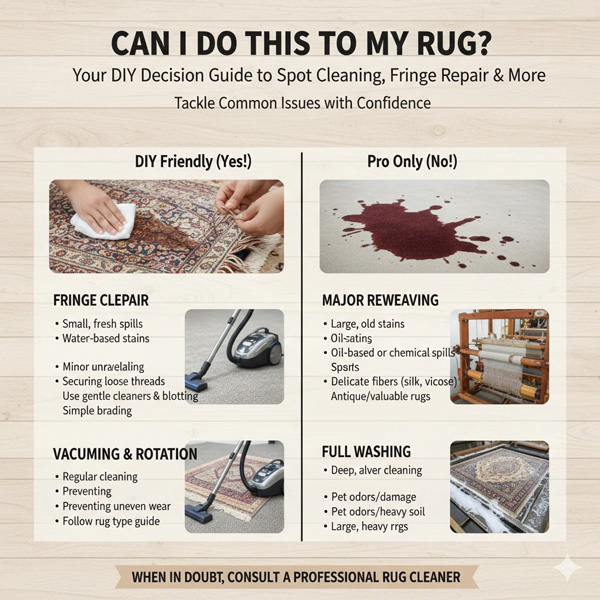
The Ultimate Decision Matrix: Your Go / No-Go Guide
Before you grab a towel or search for a “magic” cleaning hack, pause here.
Quick-Decision Flowchart (Text Guide)
Q1: What’s the problem?
A. A Spill or Stain
- Is it fresh (less than 1 hour old)?
- Yes → DIY may be safe. Continue to Green Light Projects.
- No → Stop. Consult a professional.
- Is it red wine, coffee, ink, makeup, dye, or pet urine?
- Yes → Consult a professional immediately.
B. Physical Damage
- Is it a loose thread, small snag, or uneven fringe end?
- Yes → DIY may be safe.
- Is it a tear, hole, burn, or unraveling edge?
- Yes → Stop. This is structural. Consult a professional.
The A–Z Rug Glossary: Your Ultimate Guide to Materials, Construction & Styles
Rug Dictionary: Demystifying Rug Types, Terms & Materials
C. General Cleaning
- Is it a low-pile, synthetic, machine-made rug?
- Yes → Careful DIY cleaning may be safe.
- Is it a handmade wool, silk, viscose, antique, or heirloom rug?
- Yes → Vacuum only. Professional cleaning required for anything deeper.
If you hesitate at any point, that hesitation is your answer.
>> Laughing Buddha with Wealth Symbols – 2 ft Agarwood Burl Statue
Green Light Projects: Safe DIY with Expert Technique
These are the situations where careful, restrained DIY can genuinely help—if done exactly right.
Project 1: Fresh, Water-Based Spills (Clear liquids, juice, soda)
The Bloom Nestify Protocol
- Blot immediately. Never rub.
- Use plain white paper towels or cotton cloths.
- Press down firmly; let absorption do the work.
- Prepare a gentle solution.
- Mix ½ teaspoon of clear, pH-neutral dish soap in 2 cups of cool water.
- No vinegar. No baking soda. No hydrogen peroxide.
- Lightly dab, don’t soak.
- Dampen a cloth, blot from the outside inward.
- Your goal is to lift residue, not flood the fibers.
- Rinse carefully.
- Use a second cloth with plain water to remove soap.
- Dry thoroughly.
- Place a dry towel under and over the area.
- Weigh it down slightly; allow air circulation.
Bloom Nestify Forensics Note:
We regularly see stains that were once removable become permanent because soap was left behind. Residue attracts dirt, creating a dark “halo” weeks later.
Project 2: Surface Vacuuming & Debris Removal
Proper vacuuming is maintenance—not cleaning—and it matters.
Safe Technique
- Use suction only. Disable beater bars.
- Vacuum with the pile direction, not against it.
- Flip the rug and lightly vacuum the back once a year.
Avoid: Robot vacuums on fringe. They are fringe destroyers.
The Decorative Rug Handbook: From Hanging Hide Rugs to Styling Vintage Treasures
Bloom Nestify’s Rug Care Academy: The Complete Guide to Cleaning, Stain Removal & Maintenance
Project 3: Securing a Snag or Loose Thread
A single pulled thread does not mean disaster—unless you pull it further.
The Safe Method
- Never pull upward. This enlarges the damage.
- Use small scissors to trim the thread flush with the surface.
- For stability, apply a pinhead-sized dot of fabric glue on the back only.
If the snag exposes foundation threads → stop.
Project 4: Neatening Simple Cotton Fringe
Only suitable for machine-made or simple cotton fringe—never silk.
Method
- Lightly mist with water.
- Use a wide-tooth comb, working slowly.
- Tuck stray ends back with a needle; do not cut length to “even it out.”
Bloom Nestify Forensics Note:
Cutting fringe short may look neat today, but it permanently reduces resale and accelerates edge wear.
Red Light Alerts: When DIY Becomes Disaster
This is the line where helpful becomes harmful.
Disaster 1: The “Magic Potion” Stain Cure
Bleach, ammonia, vinegar, peroxide, and internet recipes.
Why It Fails
- Acids and alkalis strip dye bonds.
- Wool fibers are scorched at a microscopic level.
Result: A clean-looking spot that weakens, fades, and eventually becomes a hole.
Disaster 2: Home Shampooers & Power Washing
Why It Fails
- Overwetting causes dye migration.
- Cotton warps rot internally.
- Mold develops long before you smell it.
We call this the “soggy disaster.”
Disaster 3: Cutting Burns or Attempting Re-Weaving
Professional reweaving is done knot by knot, under magnification.
DIY cutting permanently alters structure and pattern.
Disaster 4: Ignoring Pet Urine
Why It Fails
- Urine crystallizes.
- Odor and stains wick back endlessly without pH neutralization.
Surface cleaning only guarantees repeat problems.
Case Study: A DIY Gone Wrong
- Initial Issue: Small red wine spill
- Professional spot treatment cost: ~$95
- DIY Attempt: Vinegar + baking soda
- Result: Dye bleed halo
- Correction: Full immersion wash + color repair
- Final cost: $620
The rug was saved—but at six times the original cost.
Your Rug First-Aid Kit (Safe to Keep at Home)
- White cotton towels
- Distilled water
- pH-neutral clear dish soap
- Soft-bristle brush
- Small scissors
- Fan for drying
Nothing else belongs in emergency care.
The Professional Advantage: Beyond Cleaning to Conservation
Professional rug care is not about “getting it clean.” It is about preserving structure, color, and value.
What Professionals Do Differently
- Fiber identification & colorfast testing
- UV contamination detection
- Controlled wash floors & neutral chemistry
- Air-drying environments
- Master-level reweaving
This is preventative conservation, not an expense.
Empowered Ownership, Intelligent Care
Knowing when to act—and when to stop—is the mark of a responsible custodian.
When in doubt:
- Send us a photo for a Virtual Triage Assessment.
- Schedule certified professional cleaning or repair.
- Download our free Rug Care Emergency Protocol PDF.
At Bloom Nestify, we protect your story—one fiber at a time.
