

Not sure what all those rug terms really mean? Rug Dictionary from Bloom Nestify helps you decode everything—from rug types and materials to essential industry terminology. As part of our Rug Buying Guides, this guide gives you the knowledge to choose, style, and care for your rug with confidence.
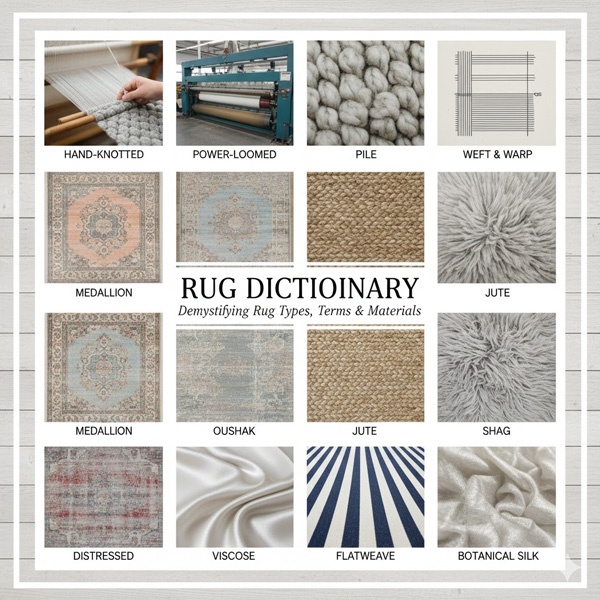
Category 1: Construction & Weaving — How It’s Made
Abrash
Characteristic. Natural variation in color within the same dye lot.
Why It Matters: Adds depth and authenticity—especially prized in hand-dyed, natural fiber rugs.
Bloom Nestify Insight: Abrash is not a flaw. It’s a hallmark of vegetal dyes and hand craftsmanship, often increasing collector appeal.
Dhurrie
Construction. A flatwoven rug from India, typically cotton or wool.
Why It Matters: Lightweight, reversible, and perfect for layering or casual spaces.
The A–Z Rug Glossary: Your Ultimate Guide to Materials, Construction & Styles
Can I Do This to My Rug? Your DIY Decision Guide to Spot Cleaning, Fringe Repair & More
Flatweave / Kilim
Construction. A loom-woven rug without pile; design is created by tightly packed weft threads.
Why It Matters: Durable, thin, reversible—ideal for hanging, layering, or high-traffic areas.
Hand-Knotted
Construction. Each knot is individually tied around warp threads.
Why It Matters: The most durable and valuable construction; can last generations.
Hand-Tufted
Construction. Yarn is punched through a backing with a tufting gun, then glued.
Why It Matters: Faster and less expensive, but not as durable as hand-knotted.
>> Laughing Buddha with Lotus Canopy – 2 ft Agarwood Burl Statue
KPSI (Knots Per Square Inch)
Measurement. Density of knots in hand-knotted rugs.
Why It Matters: Higher KPSI usually means finer detail and higher value (though not always better durability).
Loom-Woven
Construction. Machine- or hand-assisted weaving on a loom.
Why It Matters: Consistent quality and more affordable than hand-knotting.
Pile
Structure. The raised surface of a rug formed by cut or looped yarn.
Why It Matters: Determines softness, texture, and how the rug wears over time.
Warp
Structure. Vertical threads running the length of the rug.
Why It Matters: The backbone of the rug; warp material affects strength and fringe.
Weft
Structure. Horizontal threads woven over and under the warp.
Why It Matters: Creates the rug’s design and structural stability.
The Decorative Rug Handbook: From Hanging Hide Rugs to Styling Vintage Treasures
Bloom Nestify’s Rug Care Academy: The Complete Guide to Cleaning, Stain Removal & Maintenance
Category 2: Materials & Fibers — What It’s Made Of
Wool
Natural Fiber. Shorn from sheep.
Why It Matters: Durable, resilient, naturally stain-resistant, and ideal for most rooms.
Silk
Natural Fiber. Protein fiber from silkworms.
Why It Matters: Creates luminous sheen and fine detail but requires gentle care.
Cotton
Natural Fiber. Often used for warp, weft, or flatweaves.
Why It Matters: Affordable and flexible, but less resilient than wool.
Jute
Natural Fiber. Plant-based fiber with a coarse texture.
Why It Matters: Great for casual, organic looks; sensitive to moisture.
Sisal
Natural Fiber. Stronger, stiffer plant fiber than jute.
Why It Matters: Extremely durable; best for dry, low-humidity areas.
Viscose / Art Silk
Manufactured Fiber. Cellulose-based fiber made to mimic silk.
Why It Matters: High sheen at lower cost—but very sensitive to water and wear.
Polypropylene
Synthetic Fiber. Plastic-based material used in indoor/outdoor rugs.
Why It Matters: Stain-resistant and budget-friendly, but lacks natural patina.
Animal Hide (Cowhide, Sheepskin)
Material. Tanned animal skin with hair intact.
Why It Matters: Naturally durable, organic in shape, and ideal as accent layers.
Category 3: Design, Pattern & Color — The Language of Appearance
Boteh
Motif. Teardrop-shaped symbol, precursor to paisley.
Why It Matters: Common in Persian and Indian rugs; rich with cultural symbolism.
Border
Design Element. The framing band around the rug’s field.
Why It Matters: Defines the rug’s edge and affects how it fits in a room.
Field
Design Element. The central area of the rug.
Why It Matters: Dominates visual impact and pattern density.
Gul
Motif. Repeating geometric medallion common in Turkoman rugs.
Why It Matters: Identifies tribal origin and design lineage.
Medallion
Motif. Large central design, often circular or oval.
Why It Matters: Creates a strong focal point; works best in centered furniture layouts.
Mihrab
Motif. Arch-shaped niche found in prayer rugs.
Why It Matters: Indicates cultural and religious purpose.
Overdyed
Treatment. An older rug re-dyed in a new color.
Why It Matters: Creates a vintage-modern aesthetic with “ghosted” patterns.
Category 4: Condition, Age & Value — Reading the Story
Patina
Characteristic. Softened, mellowed appearance from age and use.
Why It Matters: Highly desirable in vintage and antique rugs; signals authenticity.
Repairs
Condition. Areas that have been professionally restored.
Why It Matters: Quality repairs preserve value; poor repairs reduce it.
Vegetal / Natural Dyes
Dye Type. Colors derived from plants, insects, or minerals.
Why It Matters: Age gracefully and produce abrash; historically authentic.
Synthetic Dyes
Dye Type. Chemically produced colors.
Why It Matters: Bright and consistent, but can fade harshly over time.
Fringe
Feature. Exposed warp ends at the rug’s edges.
Why It Matters: Integral to hand-knotted rugs; condition affects longevity.
Category 5: Care & Maintenance — The Preservation Lexicon
pH-Neutral Cleaner
Product. Cleaner with balanced acidity (around pH 7).
Why It Matters: Protects fibers and dyes during spot cleaning.
Professional Cleaning
Service. Deep cleaning by trained specialists.
Why It Matters: Essential for valuable, delicate, or heavily soiled rugs.
Rotating
Action. Turning the rug periodically.
Why It Matters: Ensures even wear from sunlight and foot traffic.
Pile Direction
Characteristic. Direction fibers naturally lay.
Why It Matters: Affects color appearance and vacuuming technique.
Vacuuming
Maintenance. Routine surface cleaning.
Why It Matters: Prevents dirt from settling into the foundation.
Hand-Knotted vs. Hand-Tufted: A Quick Comparison
| Feature | Hand-Knotted | Hand-Tufted |
|---|---|---|
| Durability | Exceptional (50+ years) | Moderate (10–20 years) |
| Backing | No glue | Latex adhesive |
| Cost | Higher | Lower |
| Repairability | Excellent | Limited |
