

In today’s most compelling interiors, perfection is no longer the goal—presence is. The rooms that feel the most inviting, the most expensive, and the most emotionally grounded are rarely built from pristine, matching pieces. Instead, they carry the quiet confidence of things that look chosen, not purchased all at once.
This is where Oushak and Overdyed rugs emerge as the insider’s secret weapon.
They deliver acquired beauty instantly. They soften hard architecture. They interrupt sterile perfection. They create the illusion that a space has evolved slowly, curated over years, even decades. This is the luxury of patina—of color mellowed by time, of pattern that whispers rather than shouts.
An Oushak doesn’t demand attention; it earns it slowly.
Overdyed rugs are not mistakes made new—they are palimpsests, where history and modern intent beautifully collide.
Together, they form the foundation of lived-in luxury.
This guide is a masterclass in curated patina: how to understand these rugs, how designers use them to solve real-world design problems, and how to care for them as the investment pieces they truly are.
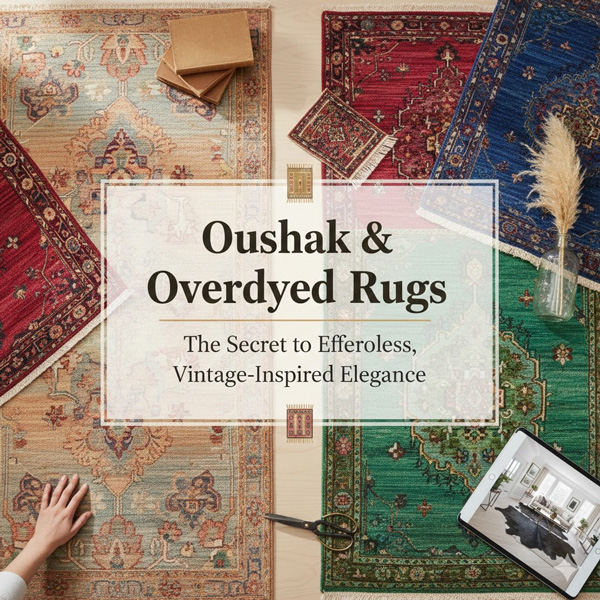
Quick Reference: Oushak vs. Overdyed
| Aspect | Oushak Rugs | Overdyed Rugs |
|---|---|---|
| Overall Vibe | Serene, airy, understated | Dramatic, fashion-forward, artistic |
| Color Story | Muted, earthy, naturally varied (abrash) | Bold, uniform color wash with tonal depth |
| Pattern Presence | Large-scale motifs, softly defined | Pattern “ghosts” through color |
| Best For | Quiet backdrops, anchoring rooms | Statement moments, curated contrast |
| Ideal Rooms | Sun-filled living rooms, open plans | Moody dining rooms, studies, bedrooms |
| Design Role | Neutral with a story | Color as architecture |
Part I: The Oushak Original — Understated Grandeur
Heritage & Hallmarks
Oushak rugs originate in West Turkey, woven for centuries in and around the town of Uşak. Historically prized by European aristocracy and frequently depicted in Renaissance paintings, these rugs were never meant to be loud. Their power lies in scale, softness, and restraint.
Classic Oushaks are known for:
- Large-scale floral and medallion motifs that feel expansive rather than busy
- A muted, earthy palette—creams, taupes, honeyed golds, soft blues, pale sages
- Natural abrash, the gentle color variation that occurs when hand-dyed wool ages and oxidizes at different rates
- Antique wool with a lustrous, almost silky handle
- Generous proportions—often room-sized, designed to unify large spaces
Bloom Nestify Curation Insight:
The most desirable Oushaks rarely have a stark white background. A subtle honey or parchment tone signals age, oxidation, and authenticity—what collectors call “mellowing.”
From Persia to Morocco: A Quick Guide to Rug Styles (Persian, Turkish, Moroccan Berber)
Navajo, Kilim & Dhurrie Rugs: How to Identify, Style as Art, and Preserve Heritage
The Design Magic: Why Oushaks Work Everywhere
Oushaks function as architectural neutrals. Their patterns are large enough to read as structure, yet soft enough to fade into the background. This makes them invaluable in modern design.
They:
- Calm rooms with too many hard lines
- Unify mismatched furniture without forcing coordination
- Add warmth without visual clutter
Think of an Oushak as a canvas already enriched by time.
Design Challenge: A large, open-plan living room feels cold and unfinished.
Solution: A room-sized Oushak in cream, taupe, and soft blue. The scale grounds the space; the muted palette absorbs light and warmth; the pattern adds interest without noise. This is the antidote to sterile perfection.
>> Monumental Laughing Buddha Statue – 8.2 ft Huong Stone Wood with Golden Kirin Base
Identifying Quality: Antique vs. Reproduction
Not all Oushaks are created equal.
Signs of a High-Quality Oushak:
- Soft, flexible wool that feels almost suede-like
- Gentle abrash rather than flat, uniform color
- Patterns that feel slightly off-center or asymmetrical (a sign of hand drawing)
- Colors that appear sun-washed, not chalky or artificially faded
Modern reproductions can be beautiful, but true vintage or antique Oushaks carry depth that cannot be manufactured quickly.
Style & Origin: A World Tour of Rug Traditions, from Persian to Navajo
Style Spotlight: What Are Oushak and Overdyed Rugs? (And Why They’re So Popular)
Part II: The Overdyed Phenomenon — History, Reimagined
Artisanal Alchemy: What Is an Overdyed Rug?
An overdyed rug begins its life as an antique or vintage base rug, often Persian or Turkish. These rugs are carefully sheared, cleaned, and then submerged in a bold, uniform dye bath—navy, charcoal, emerald, blush, inky black.
The result is transformative:
- The original pattern remains, but only as a whisper beneath color
- Wear, age, and abrash become part of the visual texture
- The rug reads as modern, yet unmistakably historic
Overdyed rugs are not about hiding history—they are about reframing it.
The Design Magic: Bold Without Being Busy
Many clients crave color but fear pattern overload. Overdyed rugs solve this elegantly.
Because the color is unified, the eye reads the rug as tonal first, patterned second. This makes them powerful yet controlled.
They excel at:
- Grounding light, minimal interiors
- Adding mood without adding clutter
- Acting as a single, deliberate color gesture
Design Challenge: A minimalist dining room feels flat and impersonal.
Solution: A deep charcoal or navy overdyed rug. The color adds gravity; the ghosted pattern adds soul. Suddenly, the room feels intentional.
A Note on Ethics & Quality
Not all overdyed rugs are created with integrity.
Bloom Nestify Curation Insight:
Quality overdyed rugs use structurally sound base rugs and artisanal dyes. Overdyeing should never be used to mask damage, rot, or severe dye instability.
Ask where the base rug came from. Ask how the dye process was controlled. Transparency is everything.
Part III: The Stylist’s Playbook — Effortless Elegance in Action
The Oushak Strategy: Quiet Power
Use Oushaks when you want a room to feel expensive without trying.
Pair them with:
- Tailored sofas and clean-lined case goods
- Natural textures: linen, oak, stone, leather
- Layered neutrals rather than contrast
They shine in sunlit spaces where their abrash can slowly reveal itself throughout the day.
The Overdyed Strategy: Controlled Drama
Overdyed rugs are punctuation marks.
Use them to:
- Anchor seating in large rooms
- Introduce color without committing to paint
- Balance masculine architecture with softness
A blush overdyed rug in a study. A forest green one in a bedroom. These are confident, editorial choices.
The Ultimate Power Move: Layering
For the truly design-savvy:
Layer a small, bold overdyed rug over a large, neutral Oushak.
The Oushak provides calm and scale.
The overdyed rug adds focus and fashion.
This is tonal layering at its most sophisticated.
Part IV: Curating & Caring for Your “Instant Heirloom”
Sourcing with Discernment
These rugs are investments. Buy fewer, better pieces.
Ask:
- Is this rug antique, vintage, or newly made?
- What dyes were used—natural, synthetic, or a blend?
- Has the rug been structurally restored?
A trained eye matters here more than ever.
The Bloom Nestify Care Protocol
For Oushak Rugs
- Protect from prolonged direct sunlight to preserve abrash
- Blot spills immediately—never scrub
- Rotate annually to ensure even wear
For Overdyed Rugs — Special Handling Required
⚠️ Important: Overdyed rugs may experience dye migration if mishandled.
- Use pH-neutral cleaners only
- Never steam clean or soak
- Avoid placing on damp floors
- Expect minimal initial shedding—it stabilizes naturally
When to Call Us
Professional intervention is essential for:
- Dye bleed or color transfer
- Structural concerns (foundation, edges, corners)
- Deep cleaning of overdyed or delicate antique wool
Preservation is always preferable to restoration.
The Enduring Allure of Character
In a world saturated with mass production, Oushak and Overdyed rugs offer something increasingly rare: irreproducible character. They carry time, intention, and artistic vision into modern life—without nostalgia, without heaviness.
They are the secret behind rooms that feel finished yet relaxed, elevated yet human. Bloom Nestify thanks you for reading our blog!
