

Across continents and centuries, flatweave rugs have served as far more than utilitarian textiles. They are repositories of memory, belief systems translated into pattern, and living records of cultural identity. These are not mere decor; they are woven documents of culture. A Navajo (Diné) rug encodes the cosmology of the American Southwest. A Kilim speaks in the symbolic language of nomadic life across Anatolia and the Balkans. A Dhurrie reflects the pragmatic elegance of Indian craft traditions shaped by climate, courtly patronage, and daily life.
This guide is a bridge between cultural appreciation and modern design. It equips you with three essential competencies of respectful ownership: knowledge (how to correctly identify and distinguish Navajo, Kilim, and Dhurrie rugs), display (how to style them as art with intention), and stewardship (how to preserve their material and cultural integrity). To own one of these flatweaves is to accept a role: not as a consumer, but as a temporary custodian of heritage.
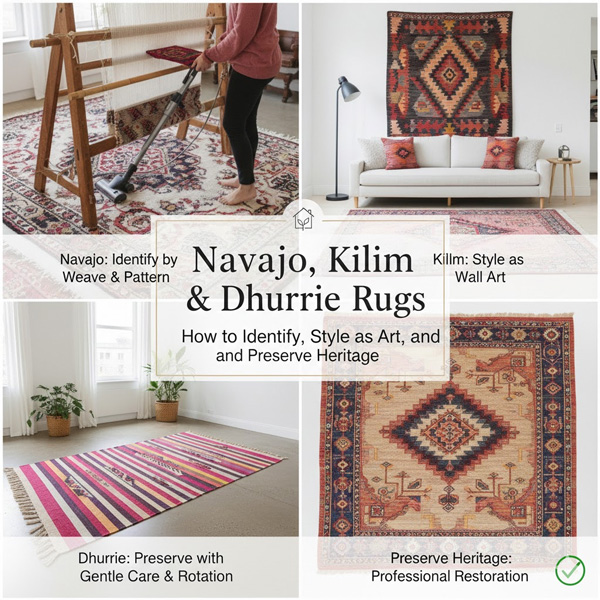
At-a-Glance Comparison Chart
| Feature | Navajo (Diné) Rug | Kilim Rug | Dhurrie Rug |
|---|---|---|---|
| Primary Origin | American Southwest (U.S.) | Turkey, Persia (Iran), Balkans | India |
| Weaving Technique | Vertical loom; wool weft on wool warp | Slit-weave flatweave; no pile | Loom-woven flatweave; often interlocked |
| Materials | Handspun wool; vegetal or early synthetic dyes | Wool, cotton, or goat hair | Cotton or wool; Punja style uses thick cotton |
| Visual Language | Geometric motifs (Diamond, Storm Pattern, Ye’i) | Bold geometric & symbolic patterns | Stripes, checks, medallions; understated geometry |
| Structure | Dense, tapestry-like; selvedge cords | Distinct slits (“teeth”) at color changes | Reversible; practical and durable |
| Traditional Use | Blankets evolved into rugs | Floor coverings, tents, ceremonial uses | Floor coverings, palace carpets, daily use |
| Modern Use | Textile art, wall hangings, statement pieces | Wall art, layering, focal accents | High-traffic areas, layering base, casual interiors |
The Navajo (Diné) Rug: A Story Woven in Wool
Identification & Heritage
The Navajo rug—more accurately, the Diné rug—stands as one of the most important forms of textile art produced in North America. Woven on a vertical loom using wool weft on wool warp, these rugs evolved from earlier blanket traditions in the 19th century. Early weavers utilized Germantown yarns (commercially spun wool introduced via trade), later returning to handspun wool dyed with vegetal dyes as cultural revival and market awareness grew.
Designs are deeply symbolic. The Storm Pattern represents harmony between earth, sky, and the four sacred directions. Ye’i figures reference spiritual beings, traditionally woven with intentional abstraction to avoid literal depiction. Diamonds, stepped motifs, and serrated lines speak to balance, protection, and the natural world of the American Southwest.
Key Authenticity Markers (Navajo Rug Identification):
- Irregular selvedge cords on the sides, often slightly uneven.
- Visible warp ends or tassels at the top and bottom.
- Subtle asymmetry and tension variations—signs of handcraft, not flaws.
- Dense weave with a tapestry-like feel; designs are identical front to back (no pile).
From Persia to Morocco: A Quick Guide to Rug Styles (Persian, Turkish, Moroccan Berber)
Oushak & Overdyed Rugs: The Secret to Effortless, Vintage-Inspired Elegance
Styling as Art
To live with a Navajo rug is to honor its gravity. Style it with the same consideration you would a painting.
Bloom Nestify Styling Principle: Allow the rug to speak without competition.
- Wall as Gallery: Mount a Navajo rug as flatweave rug as wall art in a study or living room. Use a proper textile mounting system—never nails or clamps—to distribute weight evenly.
- Anchored Centerpiece: On the floor, center it in a room with restrained furnishings. Earthy tones—clay, walnut, linen—echo its origins without mimicry.
- Modern Contrast: Drape a smaller piece over the back of a minimalist sofa to juxtapose ancient geometry with contemporary lines.
The Preservation Protocol
Navajo rugs demand reverence in care. Wool and natural dyes are resilient yet vulnerable to neglect.
Do’s
- DO rotate periodically to ensure even light exposure.
- DO vacuum gently with suction only; avoid beater bars.
- DO consult specialists for tribal rug preservation and cleaning.
Don’ts
- DON’T expose to prolonged direct sunlight; vegetal dyes fade gracefully but irreversibly.
- DON’T store in plastic; wool requires breathability.
- DON’T attempt spot cleaning with household chemicals.
Style & Origin: A World Tour of Rug Traditions, from Persian to Navajo
Style Spotlight: What Are Oushak and Overdyed Rugs? (And Why They’re So Popular)
The Kilim: The Nomadic Tapestry
Identification & Heritage
The Kilim is the graphic voice of nomadic and village cultures spanning Turkey, Persia, and the Balkans. Woven using the slit-weave technique, Kilims are flatweaves with no pile, characterized by small vertical openings (“teeth”) where color blocks meet. These slits are not defects; they are signatures of technique.
Patterns function as a visual language. Motifs such as elibelinde (hands-on-hips) symbolize fertility and motherhood; ram’s horns signify strength; protective amulets ward off harm. To own a Kilim is to be a temporary custodian of a centuries-old tradition—one that encodes prayers and stories into wool.
Key Authenticity Markers (Kilim Identification):
- Visible slits at color junctions, especially in older pieces.
- Crisp geometric forms with slight irregularities.
- Materials ranging from wool to cotton or goat hair.
- No pile; identical appearance on both sides.
>> Monumental Laughing Buddha Statue – 8.2 ft Huong Stone Wood with Golden Kirin Base
Styling as Art
Kilims possess extraordinary graphic power. They thrive when given visual authority.
Bloom Nestify Styling Principle: Let the Kilim be the unchallenged focal point.
- Tapestry Display: Frame or mount as a wall hanging. Negative space around it enhances its visual rhythm.
- Layered Statement: Place over a larger neutral rug to ground a seating area.
- Unexpected Use: As a table covering or bedspread, honoring its nomadic versatility while protecting it with mindful use.
The Preservation Protocol
Kilims are structurally delicate at their slits and edges.
Do’s
- DO vacuum both sides gently.
- DO support the entire rug when lifting; never pull from one corner.
- DO test for dye stability before any moisture exposure.
Don’ts
- DON’T allow fringe to bear weight.
- DON’T fold sharply along slit lines.
- DON’T ignore early signs of edge wear—intervene promptly.
The Dhurrie: The Versatile Classic of India
Identification & Heritage
Dhurries originate in India, where they have adorned palace floors and village homes alike. Woven on horizontal looms, Dhurries are prized for practicality and restraint. Many are reversible, a testament to their interlocked weave. Materials range from wool to cotton, with Punja style Dhurries featuring thick cotton yarns woven with a heavy comb.
Patterns are often striped, checked, or medallion-based—less symbolic than Kilims, yet deeply tied to regional aesthetics and climate-driven needs.
Key Authenticity Markers (Dhurrie Identification):
- Reversible structure with minimal design difference front to back.
- Flat, firm hand; cotton Dhurries feel cooler and lighter.
- Clean geometric layouts, often symmetrical.
- Evidence of loom weaving rather than knotting.
Styling as Art
Dhurries are the quiet diplomats of interior design.
Bloom Nestify Styling Principle: Use Dhurries to create calm foundations.
- High-Traffic Elegance: Ideal for dining rooms and hallways.
- Layering Base: Place beneath more delicate rugs for protection and scale.
- Seasonal Textile: Lightweight enough for summer use as a casual bedspread.
The Preservation Protocol
Dhurries are forgiving, but not indestructible.
Do’s
- DO vacuum both sides regularly.
- DO address spills quickly with blotting, not rubbing.
- DO ensure complete drying if any moisture is used.
Don’ts
- DON’T use harsh detergents on cotton dyes.
- DON’T store damp; cotton is susceptible to mildew.
- DON’T assume machine washing is safe without expert guidance.
Ethical Stewardship: Acquisition & Ongoing Care
Buying with Respect
Ethical sourcing begins with informed questions. Ask sellers about provenance, age, materials, and artisan compensation. Slight imperfections are evidence of handcraft—not reasons for negotiation leverage. Avoid replicas marketed without transparency; authenticity sustains living traditions.
The Bloom Nestify Philosophy of Care
Flatweaves demand more nuanced care than machine-made pile rugs. Their structure, dyes, and cultural value necessitate restraint and expertise. Preservation is not about restoration to “new,” but about stabilizing and honoring age.
When to Seek Expert Help
Consult a specialist if you observe dye bleeding, structural weakness, insect damage, or severe fading. Early intervention preserves both value and story.
Becoming a Knowledgeable Custodian
True luxury lies not in possession, but in understanding. Navajo, Kilim, and Dhurrie rugs invite us into a lineage of makers whose hands and histories remain present in every thread. To style them as art, to identify them correctly, and to preserve them thoughtfully is to participate in cultural continuity.
Embrace the role of custodian. Whether you need to Identify, Style, or Preserve your woven masterpiece, Bloom Nestify’s Heritage Textile Division stands ready to support you.
- Unsure of your rug’s origin or care needs? Schedule a Bloom Nestify Heritage Textile Assessment for expert identification and preservation planning.
- Seeking to acquire with integrity? Explore our Curated Global Flatweave Collection, sourced through ethical partnerships.
- Ready to display your textile art? Book a Virtual Gallery Hanging Consultation to showcase your Navajo, Kilim, or Dhurrie with museum-level consideration.
These are not mere decor; they are woven documents of culture. Honor them accordingly. Bloom Nestify thanks you for reading our blog!
