

Modern homes love to blur boundaries. Living rooms spill onto patios. Sunrooms feel almost indoor. Mudrooms double as design statements. It’s completely natural to look at a beautiful rug and think, “Why not just move this outside?”—or to grab an outdoor rug and bring it indoors for flexibility.
Here’s the hard reality:
These spaces may look similar, but from a materials science perspective, they are different planets.
Placing a rug in the wrong environment isn’t a style choice. It’s an environmental stress test—and many rugs fail fast. Let’s replace confusion with engineering clarity.
Rug Placement Verdict Matrix
| Rug Type ↓ / Environment → | Full Sun Patio | Covered Patio | Living Room | Bedroom |
|---|---|---|---|---|
| Handmade Wool Rug | ❌ | ❌ | ✅ | ✅ |
| Natural Fiber (Jute/Sisal) | ❌ | ⚠️ | ⚠️ | ⚠️ |
| Synthetic Indoor Pile | ❌ | ⚠️ | ✅ | ✅ |
| Polypropylene Outdoor Rug | ✅ | ✅ | ⚠️ | ❌ |
Legend:
✅ Appropriate ⚠️ Possible with caveats ❌ Guaranteed damage
The Short Answer: Why Specialization Matters
Let’s be unequivocal.
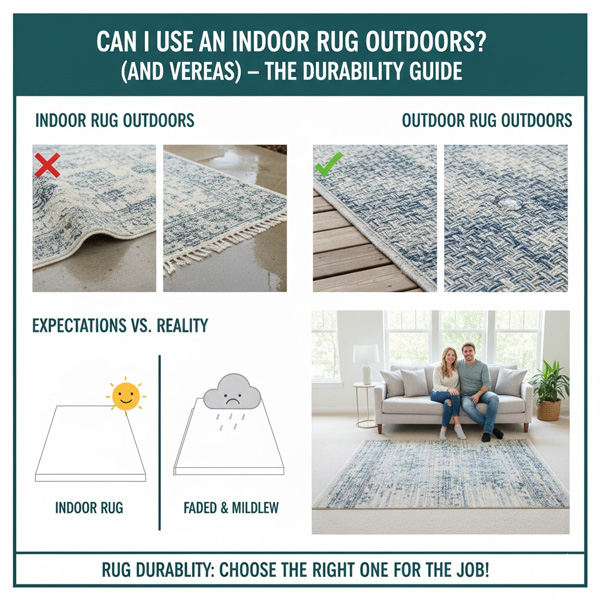
Indoor Rugs Outdoors
This is not “creative.”
It is a controlled experiment in degradation.
Indoor rugs are not engineered for:
- UV radiation
- Moisture exposure
- Temperature swings
- Abrasive grit
Put one outside and you are fast-tracking:
- Fading
- Mold and mildew
- Fiber rot
- Backing delamination
- Insect damage
Warranties? Voided.
Resale value? Gone.
>>> The Luxe Guide to Cowhide & Sheepskin Rugs: Real vs. Faux, Styling & Care
Outdoor Rugs Indoors
This can work—but with important tradeoffs.
Outdoor rugs:
- Are tougher
- Are easier to clean
- Are often thinner and firmer
- Use high-contrast, UV-stable dyes
They usually lack:
- Plush pile
- Thermal insulation
- Luxurious hand feel
They won’t self-destruct indoors—but they may not feel right where comfort matters most.
The Four Horsemen of Rug Destruction: Environmental Stressors
Every rug lives—or dies—based on how it handles these four forces.
UV Radiation (Sunlight)
UV light breaks chemical bonds.
Damage mechanisms:
- Dye molecule breakdown → fading
- Polymer chain scission → brittleness
- Fiber chalking and cracking
Who survives?
- UV-stabilized polypropylene
- Solution-dyed fibers (color embedded at the molecular level)
Who fails?
- Wool
- Silk
- Viscose
- Jute
- Most traditionally dyed indoor synthetics
Moisture (Rain, Humidity, Dew)
Water drives hydrolysis—chemical breakdown due to moisture.
Results:
- Mold and mildew growth
- Fiber swelling and shrinkage
- Backing rot or delamination
- Odor retention
Natural fibers absorb moisture.
Outdoor fibers shed it.
Temperature Extremes
Outdoor spaces swing hot to cold—sometimes daily.
Engineering consequences:
- Thermal expansion and contraction
- Backing warping
- Freeze-thaw cracking
- Accelerated aging of adhesives
Indoor rugs assume climate control. Outdoors violates that assumption.
Abrasion & Debris
Outdoor dirt isn’t “dust.” It’s sandpaper.
- Grit grinds pile tips
- Flat weaves erode
- Fibers fray under foot traffic
Outdoor rugs are engineered dense and tough for this reason.
Decoding the Label: How to Read a Rug for Its True Purpose
Ignore lifestyle photos. Read the materials.
Fiber Decoder Ring
Polypropylene (Olefin) → Outdoor warrior
UV-stable, moisture-proof, mold-resistant
Solution-Dyed Polyester/Acrylic → Hybrid-ready
Good fade resistance, softer hand
Wool → Indoor-only aristocrat
Comfortable, resilient—but hates moisture and sun
Jute/Sisal/Seagrass → Dry-zone specialists
Will rot, stain, and distort if wet
Viscose/Silk → Climate-controlled luxury only
Extremely vulnerable
Backing Tells the Truth
- Plastic mesh / rubberized backing → Outdoor
- Latex or fabric backing → Indoor
If the backing can absorb water, it doesn’t belong outside.
Dye Method Matters
- Solution-dyed = color locked into the fiber → fade-resistant
- Vat-dyed / piece-dyed = surface color → fades outdoors
If the label doesn’t say solution-dyed, assume UV risk.
The Bloom Nestify Failure Analysis
Case Study #4178
Wool rug placed on a screened porch.
Outcome after 6 months:
- ~40% color fade from indirect UV
- Musty odor from ambient humidity
- Moth infestation due to outdoor exposure
Verdict: Total loss. Non-restorable.
The Hybrid Zone: Covered Patios, Sunrooms & Mudrooms
These spaces sit in the gray area—and need smarter choices.
The 80/20 Rule
If a space is:
- 80% protected from rain
- 80% protected from harsh sun
You may use:
- Plush outdoor rugs
- High-performance indoor–outdoor hybrids
But never delicate indoor rugs.
Best Hybrid Options
- Solution-dyed polyester or acrylic
- Tightly woven low-pile constructions
- Indoor–outdoor labeled rugs with softer textures
These bridge comfort and durability.
The Mudroom MVP
Flat-weave indoor–outdoor rugs excel here:
- Catch grit
- Hose-cleanable
- Fast-drying
- No pile to trap moisture
Outdoor Rugs Indoors: Realistic Expectations
Yes, you can bring an outdoor rug inside—but understand the tradeoffs:
Pros
- Easy cleaning
- Spill resistance
- Pet-friendly
- Budget-friendly durability
Cons
- Firmer underfoot
- Less insulation
- More utilitarian look
- Occasional off-gassing when new
Great for:
- Basements
- Playrooms
- Kitchens
- Entryways
Less ideal for:
- Bedrooms
- Formal living spaces
“Can I Salvage This?” – Common Scenarios
“I put an indoor rug on my covered porch for a party.”
→ Bring it inside immediately. Dry thoroughly. Short exposure is usually survivable.
“My indoor rug sat outside for weeks.”
→ Expect fading, odor, and possible structural damage. Send photos for assessment.
“Can I use an outdoor rug on carpet?”
→ Yes, with a proper rug pad to prevent slipping and abrasion.
Making the Smart Choice: The Placement Matrix
Full Sun / Uncovered Patio:
Only 100% synthetic, solution-dyed outdoor rugs.
Covered Porch / Screened Porch:
Outdoor rugs or high-grade indoor–outdoor hybrids.
Living Room / Bedroom:
Choose for comfort and beauty—wool, high-quality synthetics, natural fibers.
Kitchen / Entryway / Mudroom:
Prioritize cleanability and moisture resistance.
Right Rug, Right Place, Long Life
Rugs are engineered objects, not interchangeable décor.
When you respect:
- Fiber chemistry
- Backing design
- Dye technology
- Environmental stressors
You get years of performance instead of months of regret.
The right rug in the right place doesn’t just look better—it lasts longer and costs less over time.
