

Wall-to-wall carpet is comfortable, quiet, and practical—but it can also feel visually one-note. In rentals, you may not be allowed to change it. In larger homes, carpet can blur zones, making a living room, dining space, and entry feel like one soft expanse with no definition.
This is where designers reach for a powerful, magazine-worthy trick: placing an area rug on top of carpet. Done well, it adds texture, color, pattern, and—most importantly—purpose. A layered rug can carve out a conversation zone, ground furniture, or inject personality into a neutral room.
And yet, the hesitation is real:
- Won’t it slide around?
- Will it look bulky or awkward?
- Is it even safe?
Those fears aren’t wrong. But they’re not a reason to abandon the idea. They’re a reason to execute it correctly. Layering isn’t just tossing one rug on another. It’s a calculated design strategy. This guide shows you how to achieve that high-end look with stability, elegance, and zero guesswork.
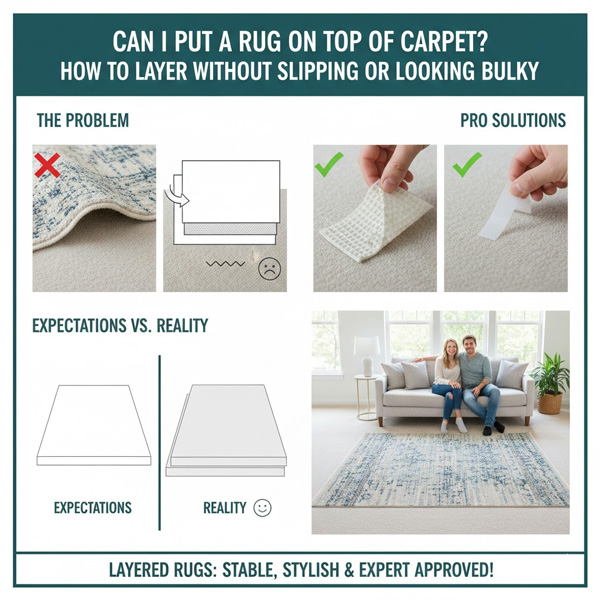
Layering Readiness Checklist
Before you begin, make sure you can confidently check these boxes:
✅ Your wall-to-wall carpet is low to medium pile (not a long shag).
✅ You are committed to buying the correct rug pad (this is non-negotiable for safety).
✅ You understand the top rug must contrast clearly with the carpet in texture, pattern, or color.
✅ Your top rug will be large enough to anchor key furniture, not float like a decorative afterthought.
If you’re nodding yes, you’re ready to layer like a pro.
>> Layering Magic: How to Mix a Cowhide Rug Over a Larger Jute or Sisal Rug
The Direct Answer: Yes, If You Master Contrast & Grip
So—can you put a rug on top of carpet?
Yes. Absolutely. Designers do it all the time.
But success rests on two pillars:
- Physical Security – preventing slippage and trip hazards.
- Visual Logic – avoiding bulk and making the layer look intentional.
Ignore either one, and the look fails. Master both, and you transform carpet from a limitation into a foundation.
The enemy here isn’t the idea—it’s friction, or the lack thereof. And that brings us to the most important rule.
Rule #1: Defeat the Slip – The Essential Rug Pad for Carpet
Let’s be clear: placing an area rug directly on carpet without a proper pad is unsafe. Carpet compresses under weight, allowing the rug to shift unpredictably. That movement creates a genuine trip hazard.
The Wrong Pads (Why Most Fail)
- Standard rubber pads: Designed for hard floors. They grip the rug, but the carpet underneath still shifts.
- Memory foam pads: Too soft. They increase instability and exaggerate the “walking on a marshmallow” feeling.
- Thin felt-only pads: Provide cushioning, but no grip against carpet fibers.
These options address comfort—but not physics.
The Right Pad: Dual-Surface / Felt–Rubber Hybrid
For carpet-on-carpet layering, there is only one correct choice:
A Dual-Surface Rug Pad (Felt/Rubber Hybrid).
Here’s why it works:
- Felt top layer grips the backing of the area rug, keeping it from creeping.
- Rubberized bottom (dots or grid) grips the carpet pile, increasing the friction coefficient and resisting lateral movement.
This two-directional grip stabilizes both surfaces. We’re defying gravity with design—not hoping for the best.
Installation Tip: Choose a pad about 1–2 inches smaller than your top rug on all sides so it remains invisible.
Bloom Nestify Design Clinic
Problem: A client layered a thick shag rug over plush carpet. It felt unstable and looked bulky.
Solution: We replaced the top layer with a flatweave Moroccan-style rug and added a 1/4″ felt–rubber hybrid pad.
Result: Secure footing, crisp edges, and a refined, intentional look.
Rule #2: Defeat the Bulk – The Principles of Visual Harmony
Safety solved, we turn to aesthetics. Bulk happens when textures compete instead of complementing each other.
Contrast Is the Golden Rule
Never pair like with like.
- Plush carpet + plush rug = visual and physical overload.
- Smooth carpet + smooth rug = flat and forgettable.
Instead, seek opposition:
- Flatweave on plush
- Smooth on textured
- Geometric pattern on solid carpet
Contrast creates clarity.
Scale & Proportion Matter
A top rug should always feel intentional.
- Anchor at least the front legs of sofas and chairs.
- Avoid small “island” rugs floating in the middle of carpet—they read as mistakes, not design.
Color Anchoring
Use your top rug to:
- Reinforce your existing palette, or
- Introduce a bold contrast that feels deliberate, not accidental.
The rug becomes the visual punctuation mark in the room.
The Perfect Pair: A Guide to Combining Textures & Patterns
Texture Pairing Matrix (Designer Guidance)
If your carpet is Smooth, Low-Pile, or Berber:
- Patterned wool rugs
- Natural fiber rugs (jute, sisal)
- Vintage kilims or dhurries
If your carpet is Medium or Plush:
- Flatweaves only
- Tight, low-profile jute
- Short-pile traditional or Oriental-style rugs
Avoid: Thick shag, high-loft, or deeply cushioned rugs on any carpet.
Pattern Mixing Rules
- Solid carpet? You can go bold with pattern.
- Patterned carpet (rare)? Keep the top rug solid.
- Mixing patterns? Vary the scale—one large, one small.
Pattern mixing is an art, but restraint keeps it elegant.
Pro Layouts: Zoning & Placement Strategies
1. The Full Furniture Anchor
All furniture legs rest on the top rug. This creates a unified, formal seating zone—ideal for large living rooms.
(Diagram in words: A large rectangle rug fully under sofa, chairs, and coffee table.)
2. The Front-Legs Anchor (Most Popular)
Front legs of seating rest on the rug; back legs stay on carpet. Balanced, flexible, and visually grounding.
(Diagram in words: Rug centered under coffee table, extending just under sofa and chairs.)
3. The Pathway-Free Zone
The rug defines a seating or reading area, with clear walkways around it. Prevents a “quicksand” feeling in high-traffic rooms.
(Diagram in words: Rug placed inside furniture grouping, leaving carpet exposed as walking paths.)
Anchor points—like furniture weight—add stability and reinforce the layout.
From Tripping Hazard to Design Triumph
Layering rugs on carpet isn’t risky when done correctly. It’s refined, practical, and incredibly effective.
Remember:
- The pad is not optional—it’s the foundation.
- Contrast prevents bulk.
- Scale and anchoring create intention.
When physics and aesthetics work together, your carpeted room gains depth, definition, and confidence.
Ready to Layer With Confidence?
Don’t layer without the foundation.
Shop our Premium Dual-Surface Rug Pads—the only pads engineered specifically for securing rugs to carpet.
Unsure about texture or size?
Text us a photo of your room and carpet for a free layering recommendation from our design team.
Find the perfect top layer.
Browse our curated collection of Flatweaves & Low-Profile Rugs, ideal for layering over carpet.
Transform your carpeted space—safely, stylishly, and with intention.
