

To understand a rug is to listen to the land that inspired it.
Long before paintings were framed on walls, before manuscripts were bound in leather, human stories were recorded on looms. Rugs were floors, walls, beds, prayer spaces, and symbols of belonging. They absorbed dust from deserts, snowmelt from mountains, smoke from hearth fires, and the rhythms of daily life. Each knot—tied patiently by hand—became a syllable in a language spoken across generations.
We are not just sorting rugs; we are tracing the Silk Road, nomadic migrations, sacred cosmologies, and the quiet genius of everyday makers.
This guide is a geo-cultural atlas. It maps the world through its great rug-weaving traditions—Persian, Turkish, Caucasian and Central Asian, Moroccan, and Native American—revealing how geography, belief, and material shaped distinct visual languages. With it, you’ll move from “this is beautiful” to “this is a Heriz from northwest Iran” or “this carries the Storm Pattern of the Diné.”
Welcome to the woven world.
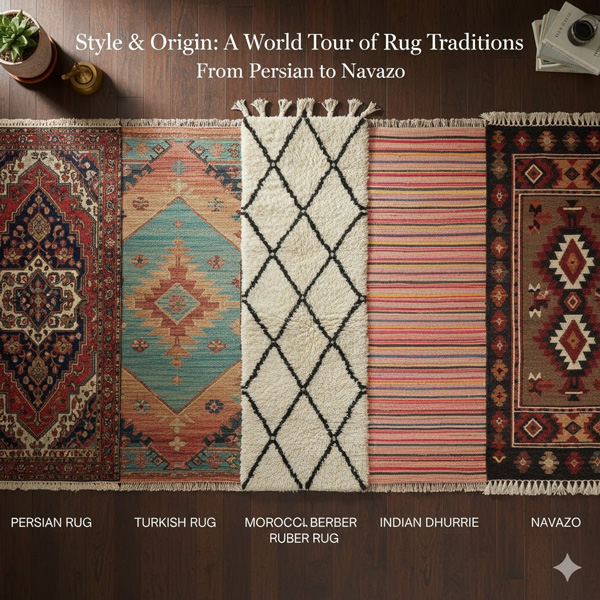
The World Map of Rug Weaving
Imagine a map with luminous nodes:
- Iran (Persia): Tabriz, Isfahan, Kashan, Heriz—courtly cities and mountain towns where poetry entered pile.
- Anatolia (Turkey): Oushak, Hereke—where mosque geometry met Ottoman grandeur.
- The Caucasus & Central Asia: Kazak, Turkmen, Bokhara—tribal routes etched in bold geometry.
- North Africa (Morocco): Atlas Mountains to Sahara—Berber symbols knotted as protection and identity.
- Southwestern United States: Navajo (Diné) lands—vertical looms translating landscape into pattern.
Each region speaks a different dialect of fiber.
The Persian Epoch: Poetry in Pile
The Cultural Canvas
Persian rugs are the product of a civilization that prized gardens, poetry, and order. From royal workshops supported by Safavid shahs to family looms in villages, Persian weaving developed under centuries of patronage and scholarship. The rug became a portable paradise—a vision of Eden laid at one’s feet.
Monumental Laughing Buddha Statue – 8.2 ft Huong Stone Wood with Golden Kirin Base
The Design Language: Motifs & Palette
Persian rug styles are renowned for curvilinear florals, elaborate medallion-and-lattice compositions, and pictorial scenes. Patterns flow like calligraphy. Motifs are rarely random; they encode cosmology and ethics.
- Medallions: The universe centered.
- Garden motifs: Divided fields symbolizing paradise.
- Boteh (Paisley): A cypress or flame—life eternal.
Color Palette: Deep crimson and navy, softened by ivory, enriched with emerald, gold, and indigo.
From Persia to Morocco: A Quick Guide to Rug Styles (Persian, Turkish, Moroccan Berber)
Navajo, Kilim & Dhurrie Rugs: How to Identify, Style as Art, and Preserve Heritage
Symbol Decoder
The Boteh (Paisley): A Persian motif symbolizing a cypress tree (resilience, immortality) or a flame (divine presence). Its migration west would later birth the paisley of European textiles.
Construction Hallmarks
- Hand-knotted pile with high KPSI (knots per square inch)
- Wool on cotton foundations (sometimes silk highlights)
- Precise outlines and balanced symmetry
Notable Sub-Styles or Cities
- Tabriz: Balanced florals, ivory fields, fine drawing—often early 20th century masterpieces.
- Isfahan: Exquisite finesse, silk accents, lyrical curves.
- Kashan: Rich reds, central medallions, velvety wool.
- Heriz: Bold, geometric medallions; durable mountain wool.
Bloom Nestify Authentication Clue
Look for curvilinear precision and layered borders. Persian city rugs favor harmony and refinement over raw geometry.
The Turkish Legacy: From Mosque to Oushak
The Cultural Canvas
Anatolia is a bridge—between Asia and Europe, nomadism and empire. Turkish rugs reflect Seljuk geometry, Ottoman court aesthetics, and Islamic architecture. Here, the rug often functioned as a prayer space and a public statement of faith and hospitality.
The Design Language: Motifs & Palette
Turkish designs favor bold scale and clarity.
- Oushak rugs: Large-scale stylized florals, airy compositions.
- Prayer rugs (Mihrab): A niche pointing toward Mecca.
- Kilims: Flatweave tapestries with symbolic geometry.
Color Palette: Softer and sun-washed—coral, apricot, sage, Aegean blue.
Comparative Note
A medallion in Persian design is often intricate and centered; in Turkish Oushaks, it’s simplified and expansive, leaving room to breathe.
Oushak & Overdyed Rugs: The Secret to Effortless, Vintage-Inspired Elegance
Style Spotlight: What Are Oushak and Overdyed Rugs? (And Why They’re So Popular)
Construction Hallmarks
- Ghiordes (Turkish) double knot—strong and symmetrical
- Lustrous wool; silk in Hereke pieces
- Thicker handle than many Persian city rugs
Notable Sub-Styles
- Oushak: Room-sized serenity; favored by European palaces.
- Hereke: Court-level luxury in silk and wool.
- Anatolian Kilim: Flatweave narratives in geometric code.
Bloom Nestify Authentication Clue
Check for double-knot structure and a relaxed, open design—especially in Oushaks, where space is as important as pattern.
The Nomadic Spirit: Caucasus & Central Asia
The Cultural Canvas
In the Caucasus and Central Asia, rugs were not commodities—they were portable homes. Woven by tribal peoples—Azeris, Kazakhs, Turkmens—these rugs carried protection, lineage, and belief across vast terrains.
The Design Language: Motifs & Palette
Here, geometry reigns.
- Tribal guls: Repeating emblems of clan identity.
- Dragon motifs: Power and guardianship.
- Ram’s horns: Strength and fertility.
Color Palette: High-contrast reds and blues, punctuated by ivory and black.
Construction Hallmarks
- Wool on wool foundations
- Thick, sturdy pile
- Long fringes—evidence of loom structure
Notable Sub-Styles
- Kazak: Monumental medallions; bold, joyful geometry.
- Bokhara: Repeating “elephant foot” guls.
- Turkmen: Deep reds with disciplined repetition.
Bloom Nestify Authentication Clue
Look for animal totems and assertive geometry. The absence of delicate florals signals nomadic origin.
The Sands of Morocco: Symbols of the Sahara & Atlas
The Cultural Canvas
Moroccan rugs are woven primarily by Berber women, often for personal use—wedding gifts, birth rites, tribal identity. These are intimate textiles, coded with protection, memory, and autonomy.
The Design Language: Motifs & Palette
Moroccan rug types range widely, united by abstraction.
- Diamonds & lozenges: Protection, femininity.
- Chevrons & zigzags: Paths, rivers, life journeys.
- Freeform fields: Intuition over symmetry.
Color Palette: Either neutral and undyed or wildly expressive with salvaged textiles.
Construction Hallmarks
- Hand-knotted, often high plush pile
- Asymmetry embraced
- Flatweave rag techniques for recycled pieces
Notable Sub-Styles
- Beni Ourain: Ivory fields with black lines; mountain minimalism.
- Boucherouite: Rag rugs—vibrant, sustainable, expressive.
- Azilal: Symbol-rich with playful color.
Bloom Nestify Authentication Clue
Expect intentional irregularity. Moroccan rugs are personal diaries, not court commissions.
The American Spirit: Navajo & Southwest Weaving
The Cultural Canvas
Navajo (Diné) weaving is a story of adaptation and sovereignty. Introduced to sheep and looms by Spanish settlers, Diné weavers transformed these tools into a profound artistic language tied to cosmology and land.
The Design Language: Motifs & Palette
- Storm Pattern: Crosses and rectangles symbolizing rain, lightning, and balance.
- Ye’i figures: Holy People—sacred, ceremonial imagery.
- Diamonds and serrated lines: Mountains, protection.
Color Palette: Earth tones from vegetal dyes or brilliant hues from Germantown yarns (late 19th–early 20th century).
Construction Hallmarks
- Vertical loom
- Continuous warp
- Tapestry weave with clean edges
Notable Aspects
- Two Grey Hills: Natural black, white, and grey wool.
- Germantown period: Vivid reds, greens, and blues.
- Side cord selvages: A signature structural detail.
Bloom Nestify Authentication Clue
Look for weft-faced tapestry structure and symbolic geometry aligned with Diné cosmology.
Comparative Motif Moment: One Shape, Many Meanings
- Medallion:
- Persian: Cosmic center
- Turkish: Decorative anchor
- Caucasian: Totemic emblem
- Diamond:
- Moroccan: Protection and fertility
- Navajo: Balance and the four directions
Context transforms shape into story.
Collecting the World, One Knot at a Time
When you know where a rug comes from, you know how to listen to it. The colors become climate. The patterns become belief. The weave becomes a record of hands at work across centuries.
A rug is not just decor—it is geography made tactile. Bloom Nestify thanks you for reading our blog!
