

If you’ve ever scrolled through rug listings and felt a little lost, this is your flashlight 🔦.
Three names show up everywhere—Persian, Turkish, and Moroccan Berber. They’re the heavyweight champions of the rug world. Deeply influential. Instantly recognizable (once you know how). And wildly different in personality, even though they’re often grouped together.
Once you see these differences, you can’t unsee them. Let’s play a quick game of “Spot the Style.”
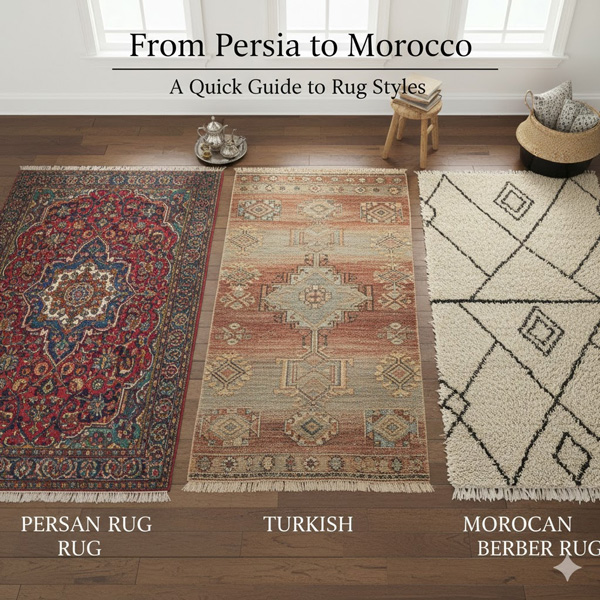
Style Snapshot: Persian vs. Turkish vs. Berber
| Style | Overall Vibe | Pattern Scale | Typical Colors | Best For |
|---|---|---|---|---|
| Persian | Formal, storied | Small to medium, very detailed | Crimson, navy, ivory | Classic or high-contrast modern spaces |
| Turkish (Oushak) | Calm, grand | Large-scale, airy | Cream, honey, sage, pale blue | Modern, open-plan rooms |
| Moroccan Berber | Cozy, organic | Simple, symbolic | Ivory/cream with dark contrast | Minimalist, Scandinavian, boho interiors |
Style 1: The Persian – The Ornate Storyteller
The Vibe in One Word
Regal.
Persian rugs feel like history underfoot. They’re visual novels—dense, expressive, and unapologetically decorative.
Spot It By
- Intricate, all-over pattern — there’s almost no empty space
- A central medallion or repeating floral framework
- Flowing floral and vine motifs (curves, not straight lines)
👉 The Tell-Tale Sign: If every inch feels intentional and detailed, you’re likely looking at a Persian.
The Color Story
Classic jewel tones:
- Deep crimson reds
- Navy and midnight blues
- Soft ivory and warm gold accents
Even faded Persians retain richness—they age like good wine.
The Modern Match
Persian rugs are incredible anchors.
- In traditional spaces, they reinforce elegance and heritage
- In modern interiors, they act like a statement artwork—especially under clean-lined furniture
Think: a bold Persian rug beneath a minimalist sofa. High contrast, high impact.
Navajo, Kilim & Dhurrie Rugs: How to Identify, Style as Art, and Preserve Heritage
Oushak & Overdyed Rugs: The Secret to Effortless, Vintage-Inspired Elegance
A Style to Avoid
If you love ultra-minimal, airy, or “quiet” rooms, a Persian can feel visually busy. This style wants attention—and deserves it.
> Large Hand-Carved Laughing Buddha Statue – 8.2 ft Solid Padauk Wood
Bloom Nestify Styling Hack
Use a Persian rug as the only complex element in the room. Keep furniture and accessories simple so the rug can tell its story without competition.
Don’t Confuse It With…
Turkish Oushak rugs.
Oushaks have bigger motifs, more open space, and much softer colors. Persians are tighter, richer, and more intricate.
Style 2: The Turkish Oushak – The Serene Scaler
The Vibe in One Word
Serene.
If Persians are poetry, Oushaks are pauses. They’re spacious, calm, and quietly confident.
Spot It By
- Large-scale, stylized florals or medallions
- A noticeable open field (you can “breathe” between motifs)
- A soft, almost washed-out appearance
👉 The Tell-Tale Sign: Big patterns + gentle colors + lots of background space.
The Color Story
Think “sun-faded elegance”:
- Cream and ivory
- Honey, taupe, soft gray
- Pale blue, sage, muted terracotta
Often described as chalky or milk-washed.
The Modern Match
Designers love Oushaks—and here’s why:
- The large scale works beautifully in open-plan living spaces
- Muted colors make them function like a neutral with interest
- They soften modern furniture without overpowering it
Perfect under sectionals, dining tables, and in rooms with lots of light.
Style & Origin: A World Tour of Rug Traditions, from Persian to Navajo
Style Spotlight: What Are Oushak and Overdyed Rugs? (And Why They’re So Popular)
A Style to Avoid
If you’re craving high contrast, bold geometry, or sharp modern graphics, an Oushak may feel too gentle.
Bloom Nestify Styling Hack
Let an Oushak replace a “plain” neutral rug. You get warmth and pattern without visual noise—ideal for contemporary homes.
Don’t Confuse It With…
Persian Heriz rugs.
Heriz designs are bolder, more geometric, and higher contrast. Oushaks are softer, larger-scale, and more relaxed.
Style 3: The Moroccan Berber – The Textural Symbolist
The Vibe in One Word
Organic.
Berber rugs feel raw, tactile, and deeply human. They’re less about decoration and more about texture and meaning.
Spot It By
- Simple geometric lines and symbols (diamonds, zigzags, ladders)
- A plush, high pile (especially in classic Beni Ourain rugs)
- A neutral base with dark contrast lines
👉 The Tell-Tale Sign: Looks simple at first glance—but feels amazing underfoot.
The Color Story
Traditionally:
- Ivory or cream wool
- Black or dark brown line work
Modern Berbers may include color, but the classic look is high-contrast and natural.
The Modern Match
Berber rugs are a dream in modern homes:
- Scandinavian
- Mid-century modern
- Bohemian
- Minimalist lofts
They act as a textural neutral, warming up spaces filled with wood, concrete, steel, and glass.
A Style to Avoid
If you want intricate florals, pictorial scenes, or formal elegance, Berbers will feel too raw and minimal.
Bloom Nestify Styling Hack
Use a large Beni Ourain rug to instantly soften a room full of hard surfaces. It’s comfort and design in one move.
Don’t Confuse It With…
Flatweave kilims.
Berbers (especially Beni Ourain) are thick and plush. Kilims are thin and flat with sharper geometry.
Your Design Passport, Stamped
You don’t need to memorize weaving history to shop confidently—you just need a few clear signals.
- Persian = detailed, rich, story-filled
- Turkish Oushak = calm, spacious, designer-approved
- Moroccan Berber = plush, symbolic, effortlessly modern
Now you’re no longer browsing blindly—you’re spotting styles with intent. Bloom Nestify thanks you for reading our blog!
